A lease for a rowhouse in Baltimore City has to satisfy two rulebooks at once. Maryland’s Real Property Article sets the statewide floor, and Article 13 of the Baltimore City Code stacks city-only requirements on top of it. A template downloaded from a national site usually covers the first and skips the second, which is how a landlord ends up in Rent Court holding a lease that’s missing the clauses the judge expects to see. This checklist walks the lease from first page to attachments. Our earlier post on what a Maryland lease must include covers the state list in more depth.

The state floor from the Real Property Article
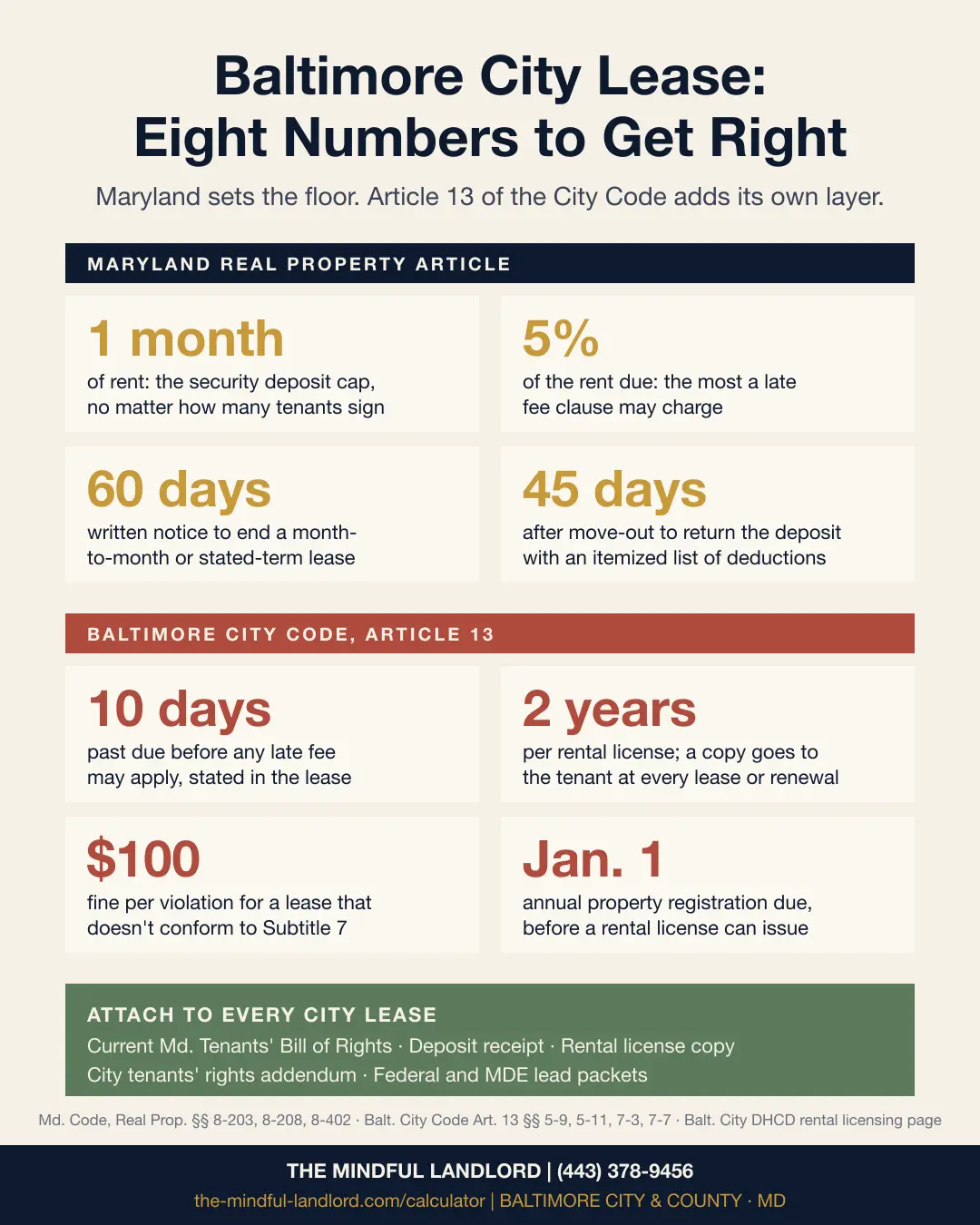
A landlord who offers 5 or more dwelling units in Maryland may not rent a unit without a written lease, and if that landlord skips the writing, the tenancy is presumed to run 1 year from the tenant’s first occupancy. Any landlord who uses a written lease has to give a prospective applicant a complete copy of the proposed form of lease on written request, without first collecting a deposit or a signature.
Four things must appear in the lease itself: a statement that the premises will be delivered in a condition fit for habitation with reasonable safety (or whatever the actual agreement about condition is), the landlord’s and the tenant’s specific obligations as to heat, gas, electricity, water and repairs, a receipt for the security deposit, and a copy of the most current Maryland Tenants’ Bill of Rights. The state housing department is blunt about the last one: landlords must attach the current Bill of Rights to every lease, may not edit it, and must use the most recently published version, which comes out by October 1 each year.
Clauses Maryland forbids, which judges in Rent Court notice
The same statute lists provisions a landlord may not put in a lease: a confession of judgment, a waiver of any right or remedy the tenant has under law, a late fee above 5% of the rent due for the period, a jury trial waiver, a notice-to-quit period shorter than the law allows, and self-help repossession of the unit or the tenant’s belongings. It also bars forcing electronic delivery of rent increase or eviction notices, penalizing a tenant for calling the police, demanding more than the deposit plus the first month’s rent to move in, and shifting the District Court filing surcharge onto the tenant except where the Courts Article allows it.
An automatic renewal clause gets special treatment. Unless the renewal period is 1 month or less, it must be set apart from the rest of the lease with a space for the tenant’s written acknowledgment, and without the tenant’s initials, signature or witnessed mark it’s unenforceable. Any prohibited provision is unenforceable, and a landlord who tenders a lease containing one can owe the tenant actual damages plus attorney’s fees.
The security deposit clause and the receipt it must contain
Maryland caps the security deposit at the equivalent of 1 month’s rent per unit, regardless of how many tenants sign. A landlord may go up to double that only when the tenant has qualified for utility assistance through the Department of Human Services, the lease has the tenant paying utilities to the landlord, and both sides agree in writing to the amount. Charge more than the cap and the tenant can recover up to 3 times the excess plus attorney’s fees, with 2 years after the tenancy ends to bring the claim.
The receipt has to be built into the written lease, and it has to say specific things: the right to a move-in inspection on request by certified mail within 15 days of occupancy, the right to attend the move-out inspection on 15 days’ certified-mail notice, the landlord’s duty to inspect within 5 days before or after the stated move date, the itemized list of deductions and the refund by first-class mail within 45 days, and the penalty of up to 3 times the withheld amount plus attorney’s fees. Keep a copy of that receipt for 2 years after the tenancy ends. A landlord who never gives one owes the tenant $25.
The city’s own lease requirements in Article 13
This is where downloaded templates fail. Since 1981, any landlord renting Baltimore City dwelling units by written lease has had to meet Subtitle 7 of Article 13, and the tenant gets a copy of the lease, signed by both sides, at the time of signing. The lease must state the name, address and telephone number of the owner, or of an agent authorized to receive court process for the owner, and an owner who isn’t customarily present in a metropolitan Baltimore office must name such an agent in the lease.
Late fees get a city rule on top of the state cap. A Baltimore City residential lease must include a provision that the landlord may not apply late fees until the rent is more than 10 days past due, and a lease that permits a late penalty must also say it can’t be applied until payment is more than 10 days late or, for a tenant who gave written notice that a government benefit arrives after the due date, until that benefit has been received. The ordinance applies to leases signed after its April 30, 2021 effective date.
If the tenant pays for water, say so expressly. An owner who requires a tenant to pay water or wastewater costs must put that requirement in an express lease provision, must make the tenant a designee under the Public Information Act for the water account records, and, where costs are allocated, must describe the allocation method and state the average monthly allocated cost for the unit over the prior 12 months.
Along with the signed lease, the tenant must receive a tenants’ rights brochure approved by the Housing Commissioner covering free or reduced-price legal representation, mediation programs, and the right to know the rent in arrears. The city’s licensing page offers that addendum and a sample lease for download, with the note that the addendum is to be provided at lease signing. A lease that doesn’t conform, or a landlord who skips the copy or the brochure, is a misdemeanor carrying a fine of up to $100 per violation.
Rental license and registration language on Charles Street and everywhere else
No person may rent or collect rent for a Baltimore City rental dwelling without a currently effective license from the Housing Commissioner. The license runs 2 years from issuance. It must be given to any prospective tenant who requests an application and to every tenant when a lease or renewal is offered, executed or renewed, advertising must carry the license number, and a newly built or renovated unit without a number yet must include the code’s prescribed sentence in the lease and the ads.
Getting that license means registering the property each year by January 1, passing an inspection by a state-licensed inspector registered with the city (or a Section 8 inspection), submitting current lead certification for each unit, paying registration fees, clearing open violations, and filing inspection reports within 90 days. We covered the inspection side in the Baltimore rental inspection and lead checklist. Attach the license to the lease and write its number on page one.
Lead paint attachments for pre-1978 rowhouses
Most city housing predates 1978. Two lead packets ride with the lease. Federal rules require every lease of target housing to include the Lead Warning Statement in the regulation’s exact words, the lessor’s disclosure of known lead-based paint or hazards, a list of available reports, the tenant’s acknowledgment of receiving them and the EPA pamphlet, and dated signatures. The lessor keeps the completed attachment or lease for no less than 3 years from the start of the lease.
Maryland adds the state program. At each change in occupancy, before the next tenant moves in, an affected property must pass the lead dust test with chipping, peeling or flaking paint removed or repainted, and the owner must have the property inspected to verify it. On signing, the owner gives the tenant the Maryland Department of the Environment’s notice of tenant’s rights with a copy of the current inspection certificate, by certified mail or another MDE-approved verifiable method, and repeats the notice at least every 2 years.
Keep the certificate number handy: a complaint for unpaid rent on an affected property has to state that the property is registered with MDE and give the inspection certificate number for the current tenancy.
Notice clauses and what the Fayette Street courthouse will ask
Two notice periods belong in the lease. To end a month-to-month tenancy or a stated-term lease longer than a week, the landlord gives 60 days’ written notice before the tenancy expires, and the shortcut that lets a landlord elsewhere in Maryland rely on a tenant’s spoken notice doesn’t apply in Baltimore City. For unpaid rent, the landlord must give a written 10-day notice of intent to file on the Judiciary’s form, by first-class mail with certificate of mailing, by posting on the door, or electronically if the tenant elected that, and the complaint must affirm the date the notice was given. Our 10-day notice guide shows the form and the timeline.
Before you file anything, run the lease against this list. Then check the numbers in our free rental calculator at https://the-mindful-landlord.com/calculator, or call (443) 378-9456.
Questions people ask
Can I use a free online lease template for a Baltimore City rental? Only as a starting point. National templates rarely include the owner-or-agent contact clause, the 10-day late fee language or the city’s tenants’ rights addendum, and many still carry the confession-of-judgment and jury-waiver clauses Maryland forbids.
Does the Tenants’ Bill of Rights have to be the current year’s version? Yes. The lease must include the most current version, and the state says landlords may not edit it and must use the edition published by October 1 each year.
How much can I collect at signing? No more than the security deposit plus the first month’s rent, and the deposit itself is capped at the equivalent of 1 month’s rent except in the narrow utility-assistance case.
What happens if my lease is missing a city-required clause? The tenant can ask a court to restrain the violation, and a nonconforming lease is a misdemeanor with a fine of up to $100 per violation. Fix the form before the next renewal, not after a filing.
If you’d rather hand this off, call (443) 378-9456 or tell us about your property at https://the-mindful-landlord.com/contact. The free calculator at https://the-mindful-landlord.com/calculator shows what management would look like for your unit.