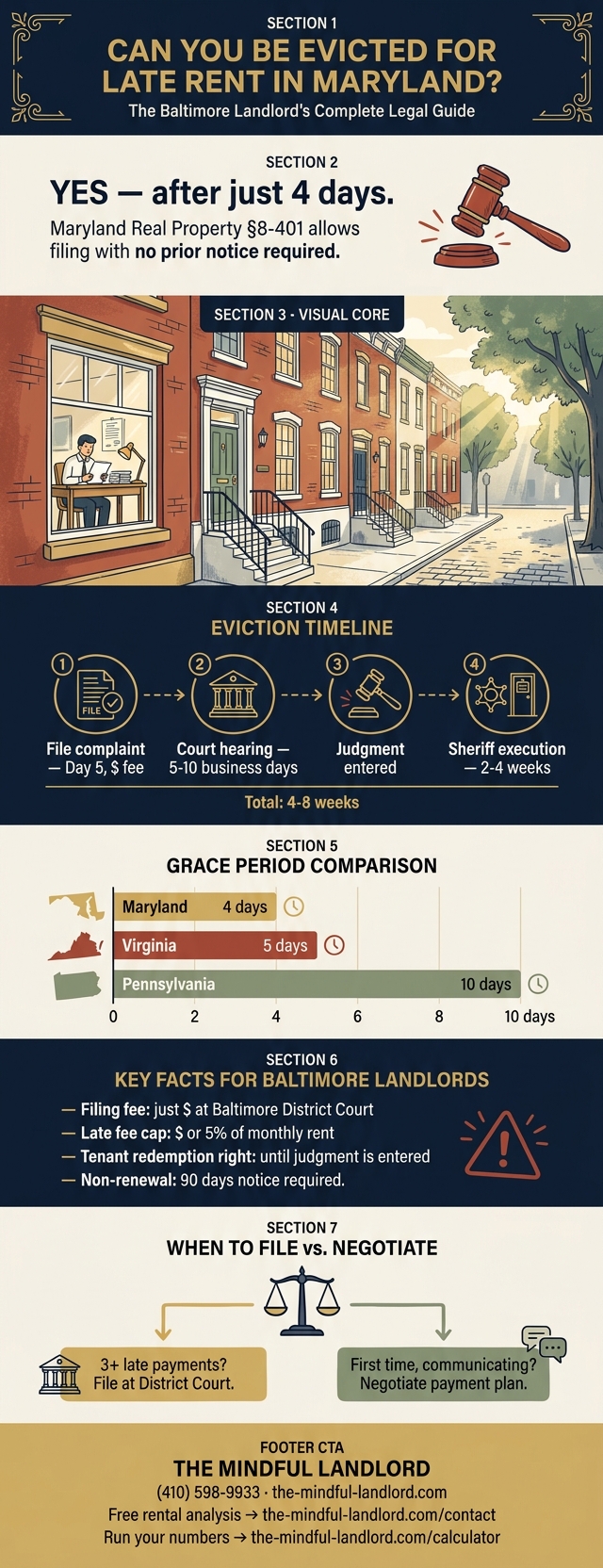
Yes — in Maryland, a landlord can begin the eviction process for late rent after just a 4-day grace period. Under Real Property §8-401, if rent is due on the 1st and your tenant has not paid by the 4th, you can file a Failure to Pay Rent complaint at Baltimore District Court the next morning. No notice required. No waiting period.

Maryland’s Late Rent Law: The 4-Day Grace Period Explained
What Maryland Real Property §8-401 actually says
Maryland Real Property §8-401 gives a residential landlord the right to file an action for “failure to pay rent” as soon as rent is in arrears. The statute imposes no minimum waiting period beyond the lease’s due date. A 4-day grace period has become customary — and courts will honor a shorter grace period written into your lease. If your lease says rent is due on the 1st with a 3-day grace, you can file on the 4th. The statute requires no certified letter, no door posting, no advance warning.
How Baltimore District Court applies the grace period in practice
Baltimore District Court at 5800 Wabash Avenue (21215) handles all Failure to Pay Rent cases in Baltimore City. With a lease, the rent amount, and the tenant’s address, the filing takes about 15 minutes. The $25 filing fee is paid at the clerk’s window. The court schedules a hearing 5–10 business days out and serves the tenant. Judges here see dozens of these filings weekly — the process is routine and efficient for prepared landlords.
The Failure to Pay Rent Process in Baltimore District Court
No notice required: Maryland lets landlords file immediately after the grace period
This surprises landlords from other states. Virginia requires a 5-day pay-or-quit notice. Pennsylvania requires 10 days. Maryland requires nothing because the lease itself is the notice — the tenant signed a document specifying the due date. This makes Maryland one of the fastest states in which to begin the eviction process for unpaid rent.
Step-by-step filing, hearing, judgment, and execution timeline
| Step | Action | Typical Timeline |
|---|---|---|
| 1 | File Failure to Pay Rent complaint ($25 fee) | Day 5 (day after grace period) |
| 2 | Court schedules hearing and serves tenant | 5–10 business days after filing |
| 3 | Hearing: judge reviews, issues judgment if unpaid | Hearing date |
| 4 | Tenant’s 4-day appeal window closes | Judgment + 4 calendar days |
| 5 | Warrant of Restitution issued (sheriff removes tenant) | 2–4 weeks after judgment |
| 6 | Keys returned, unit vacant | Total: 4–8 weeks from filing |
What tenants can do to stop eviction before a judgment is entered
Maryland gives tenants a right called “redemption.” Up until the moment a judge enters judgment, the tenant can pay the full amount owed — rent plus court costs — and the eviction proceeding stops. Once judgment is entered, you are not legally required to accept payment to stop execution. In practice, many tenants in Baltimore City cases pay before the hearing date once they receive the court summons.
Lease Clauses That Change the Late Rent Timeline
What your Maryland lease can shorten — and what it cannot
You can write a lease specifying a grace period shorter than 4 days, and Baltimore District Court will honor it. You can also specify that three late payments in 12 months constitute cause for non-renewal. What you cannot do: waive the tenant’s right to redeem before judgment, or charge a late fee that exceeds Maryland’s statutory cap.
Maryland’s late fee cap: $30 or 5% of monthly rent, whichever is greater
Under Real Property §8-211, late fees are capped at $30 or 5% of the monthly rent, whichever is greater. On a Fells Point unit at $2,200/month, the maximum is $110. The late fee must be written into the lease — a verbal agreement is unenforceable. Include the dollar amount or percentage in every lease you sign.
The Real Cost of Getting This Wrong
What chronic late rent actually costs Baltimore landlords
The $25 filing fee is the smallest cost. A Fells Point landlord with a $2,200/month unit: if a tenant pays on the 8th every month, the landlord carries 8 days of receivable per month — 96 days of exposure annually. Model a full non-payment scenario: 4–8 weeks to recover the unit, potential damage, plus vacancy time. That gap is financed entirely out of pocket.
Before You Commit, Run the Numbers
Before deciding whether to pursue eviction or negotiate a payment plan, you need to know your monthly buffer. Run your Fells Point property through the TML rental calculator to model what a 30-day late payment does to your actual cash flow. Many landlords discover that two months of lost rent wipes out an entire year’s profit margin — which changes how quickly you move to file at District Court. Use the calculator at the-mindful-landlord.com/calculator before your next lease negotiation.
The Landlord’s Decision Tree: Pursue Eviction or Negotiate?
When chronic late payment warrants filing at Baltimore District Court
Not every late payment warrants a trip to 5800 Wabash. Use this framework: Has the tenant communicated proactively, or gone silent? Is this the first late payment in a two-year tenancy, or month three of a pattern? If a tenant is more than 10 days late with no communication, or has been late three or more times in 12 months, file. The $25 filing fee is cheap insurance. The filing itself often prompts payment before the hearing date.
Non-renewal strategy: the lease exit that avoids eviction court
For tenants who pay — just always late — non-renewal is often the cleaner path. Maryland requires 90 days’ notice for non-renewal of a year-to-year tenancy in Baltimore City. A consistently late tenant who keeps the unit in good condition may not be worth the court record. Serve the non-renewal notice on day 91 before lease expiration, and you avoid the eviction process entirely.
How Professional Property Management Changes the Late Rent Equation
Automated collection systems that compress late payment rates
The Mindful Landlord manages 50+ Baltimore properties with a 98% occupancy rate. Automated collection portals with scheduled late-fee triggers and pre-hearing notices change tenant payment behavior. When the reminder hits on the 28th and the late notice generates automatically on day 5, tenants pay on time at measurably higher rates. The system also removes the awkward personal negotiation from the landlord-tenant relationship.
Why tenant screening is the first line of defense against late rent
The best late-rent management is avoiding late-paying tenants in the first place. TML’s screening process verifies income at 3x monthly rent, checks prior-lease payment history, and flags eviction filings. Our 21-day tenant placement guarantee is built on qualified tenant supply — not luck. With $0 vacancy fees and a 4-hour emergency response policy, professional management often pays for itself in the first late-rent scenario you avoid. Call (443) 378-9456 to discuss your property’s specific risk profile with our team.
Frequently Asked Questions
How late can rent be before eviction in Maryland?
Maryland law provides a 4-day grace period under Real Property §8-401. Rent due on the 1st can be accepted through the 4th without triggering eviction rights. Your lease may specify a shorter grace period, which Baltimore District Court will honor. Many Baltimore leases specify 3-day grace periods — courts enforce what is written in the signed lease agreement.
Does Maryland require a landlord to give notice before filing for eviction for late rent?
No. Maryland does not require a formal notice to quit before filing a Failure to Pay Rent complaint. A Baltimore landlord can file at District Court the day after the grace period expires — one of the most landlord-friendly procedural rules in Maryland law. This differs significantly from Virginia (5-day notice) and Pennsylvania (10-day notice). Maryland’s position is that the signed lease is sufficient notice of the payment obligation.
How long does a Maryland eviction take for unpaid rent?
From filing to hearing: typically 5–10 business days in Baltimore District Court. After judgment: 4-day appeal window. Actual eviction execution via sheriff: 2–4 weeks after judgment. Total timeline from filing to keys returned: 4–8 weeks in most Baltimore cases. Courts may be slower during high-volume months, which is why filing promptly after the grace period matters — delays compound.
What late fee can a Baltimore landlord charge?
Maryland caps late fees at $30 or 5% of monthly rent, whichever is greater, under Real Property §8-211. On a $2,000/month unit, that is $100 maximum. The fee must be specified in the lease to be enforceable. A verbal agreement on late fees is not recognized in Maryland court. Write the late fee amount explicitly into every lease, including the date it triggers.
Can a Maryland tenant stop eviction by paying rent after a complaint is filed?
Yes. Maryland tenants have the right to redeem — paying all rent owed plus court costs — up until a judgment is entered. After judgment, the landlord is not obligated to accept payment to stop execution, though some choose to negotiate. This right to redemption is built into the statute and cannot be waived by the lease. Many Baltimore City tenants pay before the hearing date once they receive the court summons.