Maryland doesn’t tell you how much you can raise the rent. It tells you when you can’t. There’s no statewide law that limits a rent increase when a lease is renewed, though some local jurisdictions do set limits. For our owners in Baltimore City and Baltimore County, the size of the increase is usually a market call. Timing, paperwork and motive are where landlords from Hampden to Dundalk get into trouble.
Below are the situations that block an increase outright, as we apply them across the 50+ properties we manage. For pricing an increase that is allowed, see how to raise rent on a Baltimore rental.
In the middle of a lease term
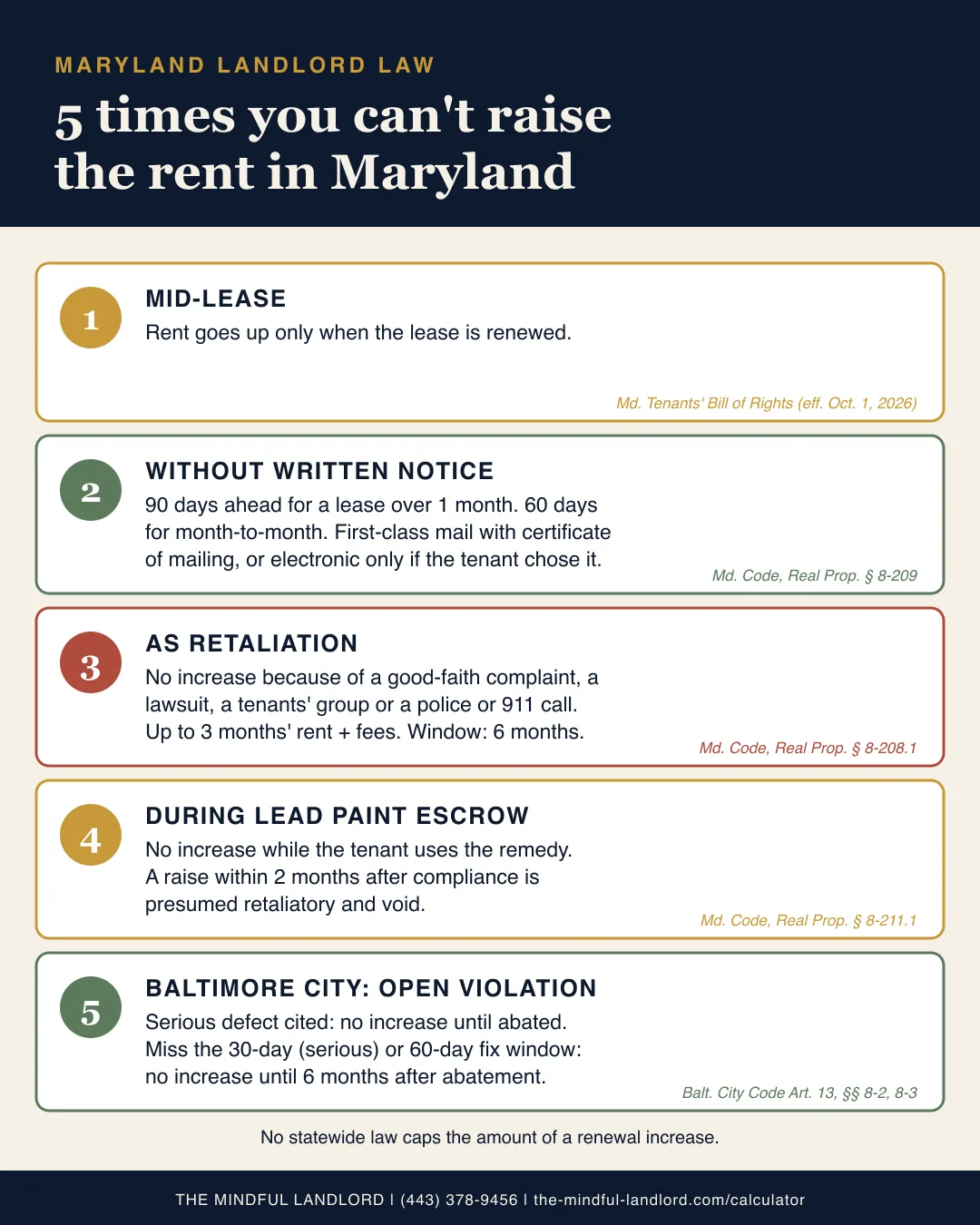
The State’s Tenants’ Bill of Rights, attached to every Maryland residential lease, says a landlord may only increase the rent when the lease is renewed. If your tenant on Belair Road signed a 12-month lease in March, the rent in that lease is the rent until the term ends.
That catches owners who bought a building with tenants in place, or whose insurance jumped mid-year. Budget for it, and put renewal dates on a calendar the day a lease is signed.
Without the right written notice, delivered the right way
Real Property § 8-209 is the statewide notice rule, and it’s the one to get right first. A landlord has to tell the tenant in writing before raising the rent. How far ahead depends on the tenancy:
- Lease term longer than 1 month (a typical 12-month lease): at least 90 days before the increase.
- Term longer than 1 week but not more than 1 month (month-to-month): at least 60 days before.
- Week-to-week with a written lease: at least 7 days before.
- Week-to-week with no written lease: at least 21 days before.
Delivery matters as much as timing. The notice goes by first-class mail with a certificate of mailing. It can go by email, text or a tenant portal only if the tenant elected electronic delivery, and the method has to give you proof of transmission. You also can’t make electronic notice a condition of accepting someone’s rental application.
A text sent 60 days before a 12-month lease renews, to a tenant who never opted into electronic notices, misses twice: late, and sent the wrong way. Use a dated letter, a certificate of mailing and a copy in the tenant file.
Section 8-209 also says it doesn’t override any local law that requires more notice or gives tenants more protection, so check your county before you rely on the State minimum. One exception runs the other direction. The rent increase notice rule doesn’t apply when you’ve already given written notice to end the tenancy under § 8-402(c)(2). If you aren’t renewing, you’re ending the tenancy, not raising the rent, and different deadlines apply.
After a tenant complains, sues or calls for help
Maryland’s retaliation statute, Real Property § 8-208.1, bars a landlord from arbitrarily increasing the rent or cutting services because the tenant did something the law protects. The protected acts are:
- A good-faith complaint, written or actual, about a lease violation, a violation of law or a condition that’s a substantial threat to health or safety, made to the landlord or to a public agency.
- Filing a lawsuit against the landlord, or testifying or taking part in one involving the landlord.
- Participating in a tenants’ organization.
- Calling law enforcement or emergency services to the property.
If a court finds an increase was retaliatory, it can award the tenant damages up to 3 months’ rent, plus reasonable attorney fees and court costs. The same cap runs the other way when a tenant’s retaliation claim was in bad faith or without substantial justification.
Two limits apply. The tenant’s protection depends on being current on the rent when the increase happens, unless they’re withholding rent under the lease, through rent escrow under § 8-211 or a comparable local ordinance. And an action taken more than 6 months after the tenant’s protected act isn’t treated as retaliatory under the statute.
Don’t plan around a 6-month clock. Decide renewal rents before anything happens. If a tenant in Pigtown reports a leak to 311 and your renewal letter goes out three weeks later with a bump, you want a rent sheet, dated before the complaint, showing the number came from market comparisons and was applied the same way to other units.
Not sure what your rental should earn at renewal? Run the numbers in our free rental calculator at https://the-mindful-landlord.com/calculator, or call us at (443) 378-9456.
While a tenant is using the lead paint escrow remedy
Real Property § 8-211.1 gives tenants a separate escrow right when a landlord doesn’t meet the lead risk reduction standard. The tenant can pay rent into an escrow account with the clerk of the District Court instead of to you.
Once a tenant elects that remedy, the rent may not be raised. And any attempt to raise the rent, end the tenancy or evict, except for nonpayment, within two months after you comply with the standard is presumed retaliatory and void.
Older rowhouses are where this comes up. Get the lead certificate current before the renewal season, not after a tenant files. Our rental inspection and lead paint checklist walks through the inspection side.
In Baltimore City, while a violation notice is open
This rule lives in Article 13, Subtitle 8 of the Baltimore City Code. It doesn’t apply in Baltimore County.
When an inspection that wasn’t triggered by a tenant complaint produces a violation notice citing a serious defect, the landlord can’t increase the rent for that unit until the defects are corrected and the notice is abated (§ 8-2). The code’s list of serious defects is broader than owners expect. It covers no heat, light, electricity, or hot or cold running water (unless the tenant pays that utility and didn’t), inadequate sewage disposal, a rodent infestation outside a 1-family dwelling, lead paint on surfaces inside the unit, a structural defect that seriously threatens occupants, and any health or fire hazard.
The clock after the notice expires matters:
- Serious defects fixed and abated within 30 days after the notice expires: the increase can take effect from the date of abatement or the lease renewal, whichever is later.
- Less-than-serious defects have to be repaired within 60 days after the notice expires. Miss that, and the rent goes back to what it was when the notice issued.
- Miss either deadline and you can’t raise the rent until 6 months after the date of abatement.
- Exterior work in cold months. If you get notice of exterior violations between October 1 and April 1 for repairs that need an air temperature of 50°F or above, the 60-day period for those defects runs to June 1.
When the violation notice came from a tenant complaint, § 8-3 adds a timing test. The bar applies if the written violation notice was issued more than 60 days before the increase takes effect, or if the tenant filed a written complaint with the Commissioner, copying the landlord, before getting the rent increase notice.
A tenant can go to court to stop an increase that breaks § 8-2 or § 8-3. Under § 8-5 you keep your right to an administrative review of a violation notice, so if a notice on your Reservoir Hill unit is wrong, challenge it rather than raising the rent and hoping.
For a reason tied to who the tenant is
Housing discrimination is illegal under Maryland and federal law, and the Tenants’ Bill of Rights lists the protected classes: race, color, religion, sex, disability, marital status, familial status, sexual orientation, gender identity, national origin, source of income and military status. Some local jurisdictions add more.
Raising the rent only for the household that just had a baby, or the one paying with a voucher, invites a complaint you can’t explain. Set increases by unit type and market data, write the method down and apply it evenly.
A pre-renewal checklist we use
Run this about four months before any lease ends, which leaves room for the 90-day notice:
- Pull the lease. Confirm the end date and the type of tenancy, so you know whether you owe 90 days or 60.
- Check for open city notices. For Baltimore City units, confirm no violation notice is open and none is pending repair. If one is, fix and abate it first.
- Check the lead status. Is the certificate current? Is any escrow case open, or did you come into compliance in the last two months?
- Review the last 6 months of the file. Look for complaints to you or to an agency, lawsuits, police or emergency calls, and tenants’ organization activity. If anything’s there, make sure your number was set before it and on the same basis as other units.
- Set the number from comps and write down how you got there.
- Send the notice correctly and keep the proof.
- Make the effective date the renewal, never mid-term.
If a step turns up a problem, delay the increase. A month of old rent costs less than a retaliation claim.
Questions people ask
Is there a rent cap in Baltimore? Maryland has no statewide limit on rent increases at renewal, though some local jurisdictions limit how much rent can go up. The Baltimore City rules we see most often govern when you can raise rent, such as the bar while a serious-defect violation notice is open, rather than how much.
Can I raise the rent on a month-to-month tenant with 30 days’ notice? No. A month-to-month tenancy needs written notice at least 60 days before the increase, delivered by first-class mail with a certificate of mailing or electronically only if the tenant elected that.
My tenant reported a problem to the city. Can I still raise the rent at renewal? Possibly. An increase made because of a good-faith complaint is retaliation, and in Baltimore City an open serious-defect violation notice blocks the increase until it’s abated. Fix the problem, document how you set the rent, and send proper notice.
If you’d rather hand this off, call (443) 378-9456 or tell us about your property at https://the-mindful-landlord.com/contact. The free calculator at https://the-mindful-landlord.com/calculator shows what management would look like for your unit.