Maryland leaves the size of a rent increase to you and the market. The notice is a different story. Real Property § 8-209 says a landlord has to tell the tenant in writing before increasing the rent, sets how many days ahead that notice must go out, and limits how it can be delivered. Get the date or the delivery wrong and the new rent isn’t on solid ground, even if the number itself was fair.

We send renewal notices for 50+ properties across Baltimore City and Baltimore County, so this guide stays on the notice itself: when it goes out, how it travels, what goes in it and what to keep afterward. If you’re still deciding whether an increase is allowed at all, start with when a landlord can’t raise rent in Maryland. For setting the number, see how to raise rent on a Baltimore rental.
Count backward from the day the new rent starts
The lead time depends on the length of the tenancy, and the statute measures it from the date the higher rent takes effect.
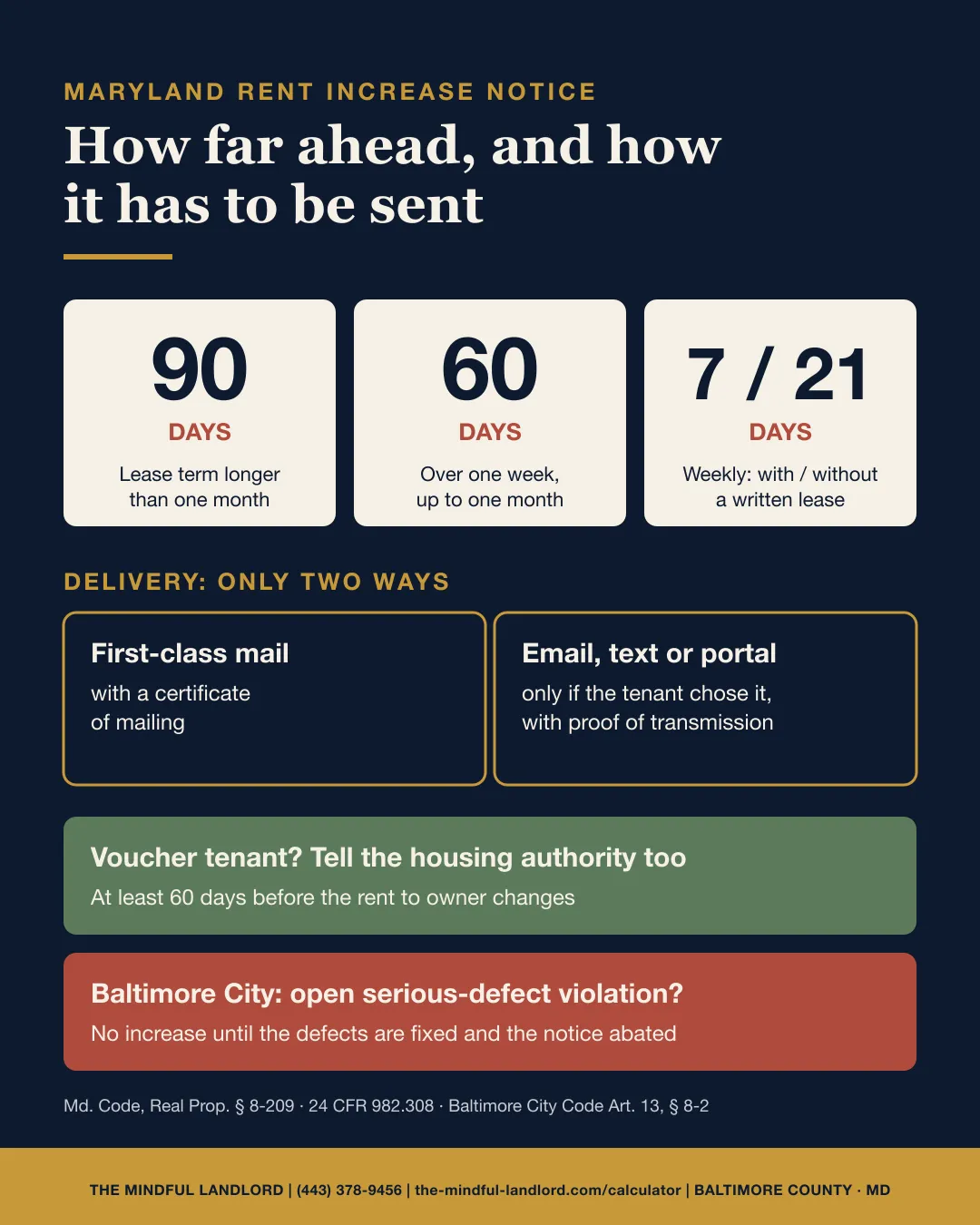
- Lease term longer than one month (the usual 12-month lease): at least 90 days before the increase.
- More than one week, up to one month (month-to-month): at least 60 days before the increase.
- One week or less: at least 7 days if there’s a written lease, or at least 21 days if there isn’t.
Here’s a hypothetical to show the arithmetic. A 12-month lease on a Hamilton rowhouse runs through June 30, 2027, and the owner wants the new rent to start July 1, 2027. Ninety days before July 1 is April 2, 2027, so the notice has to go out no later than that. A month-to-month tenant whose new rent starts March 1, 2027 needs notice by December 31, 2026, which lands in the middle of holiday mail.
We don’t mail on the deadline. Our renewal calendar flags each lease about four months before it ends, the letter goes out two to three weeks before the legal cutoff, and the cushion absorbs a sick day, a post office line or a tenant who asks a question that changes the offer.
A rent change rides on the renewal
The Maryland Tenants’ Bill of Rights, the State document that must be attached to every residential lease, puts it plainly: a landlord may only increase the rent when the lease is renewed. The current version took effect October 1, 2026, so leases signed now should carry that edition. A mid-term increase on a fixed-term lease isn’t something a well-timed notice can fix.
Two lease provisions matter here. A lease can’t include a clause that shortens any notice period required by law, so “tenant waives the 90-day notice” does nothing for you. And if your lease renews automatically, the Bill of Rights says the automatic renewal term has to sit apart from the rest of the lease and be signed or acknowledged separately by the tenant. Our Maryland lease guide covers the rest of the packet.
Watch the tenant who simply stays. Under § 8-402(d), when a landlord consents to a holdover, the tenant becomes month-to-month unless the written lease says otherwise and the tenant initialed it. From then on, the 60-day rule applies to the next increase, not the 90-day one.
Delivery the statute accepts
Section 8-209 allows two routes, and only two.
- First-class mail with a certificate of mailing. Ask for the certificate at the counter when you mail the letter, and keep it with a copy of what you sent.
- Electronic delivery, if the tenant elected it, by email, text message or an electronic tenant portal. The method has to give you proof of transmission.
The tenant has to choose the electronic option. You can’t make a lease application depend on the tenant agreeing to electronic notices, so the election belongs on its own page in the lease packet, signed and dated, with a box the tenant can leave unchecked. A text sent to a tenant who never opted in is a text, not a notice.
Taping a letter to the door and handing it over at the stoop aren’t on the list for this notice. If you deliver by hand as a courtesy, mail it too.
What goes in the letter
A rent increase notice should be one page that a tenant can read in a minute. Ours carries:
- The property address and unit, and every adult tenant on the lease by name.
- The current monthly rent and the new monthly rent, written as dollar amounts.
- The date the new rent starts.
- The renewal terms you’re offering with it, such as a new 12-month term or month-to-month.
- How and by when the tenant should respond.
- The date of the letter and a phone number that reaches a person.
Keep the letter date and the mailing date the same. If they differ by a week, you’ll spend time in court explaining why.
Raising rent while ending the tenancy
Section 8-209 doesn’t apply to a landlord who has given written notice of intent to terminate the tenancy under § 8-402(c)(2). That notice has its own clock: 60 days before the tenancy expires for a written lease longer than one week or a month-to-month tenancy, and 90 days for a year-to-year tenancy. The Bill of Rights says the same thing in tenant language: 90 days in most cases, unless the notice comes with a notice of intent to terminate.
That’s a real option, but a blunt one. A termination notice tells the tenant the tenancy is ending, and a tenant who reads it that way may simply leave. We use it when an owner wants the unit back or a full reset, not as a way around the 90-day window.
Motive counts too. Under § 8-208.1, a landlord may not arbitrarily increase the rent because a tenant made a good-faith complaint to the landlord or a public agency, sued or testified, joined a tenants’ organization, or called police or emergency services. An action more than 6 months after the protected act isn’t treated as retaliatory. If a tenant filed a complaint this spring, time the letter and keep a record of how you set the new figure.
Voucher tenants need a second notice
For a Housing Choice Voucher tenancy, the federal rule adds a step. Under 24 CFR 982.308, the owner must notify the housing authority of any change in the rent to owner at least 60 days before it takes effect, and the new rent is subject to the program’s rent reasonableness test.
So a voucher renewal sends two notices: one to the tenant under § 8-209 and one to the housing authority that administers the voucher. Send the authority’s copy early enough for its review to finish before the effective date. Our Section 8 landlord guide walks through the rest of that process.
Check Baltimore City records before you mail
In Baltimore City, look up the property before the letter goes out. Under City Code Art. 13, § 8-2, when an inspection that wasn’t triggered by a tenant complaint produces a violation notice citing a serious defect, the landlord can’t increase the rent until the defects are corrected and the notice is abated. If the repairs are made and the notice abated within 30 days after the notice expires, the increase starts at abatement or at renewal, whichever comes later. Miss that window and the rent can’t go up until 6 months after abatement.
Statewide, there’s no law that limits how much rent can rise at renewal, though some local jurisdictions do set limits. Section 8-209 also says it doesn’t override any local law that requires more notice or gives tenants more protection, so a property outside Baltimore City or Baltimore County should get a check of its own county’s rules. The same goes for a lease form you picked up somewhere else.
The notice file we keep for every renewal
When a tenant disputes an increase, the file decides it. For each renewal, ours holds:
- The calendar entry showing the effective date and the computed deadline.
- A copy of the letter exactly as sent.
- The certificate of mailing, or the electronic proof of transmission plus the tenant’s signed election page.
- The housing authority notice and its response, for voucher units.
- A note of the City violation check and its date, for Baltimore City units.
None of this takes long once it’s a habit. It becomes slow when you rebuild it from memory a year later. If you’d like to see what having us run renewals would cost on your unit, the free calculator at https://the-mindful-landlord.com/calculator gives a number in a minute, or call (443) 378-9456.
Questions people ask
Can I raise the rent in the middle of a lease in Maryland? Not under the Tenants’ Bill of Rights, which says a landlord may only increase the rent when the lease is renewed. Plan the increase for the renewal date and send notice on the § 8-209 schedule.
Can I send a rent increase notice by text or email? Only if the tenant elected electronic delivery, and the method has to give you proof of transmission. Otherwise use first-class mail with a certificate of mailing.
How much notice does a month-to-month tenant get? At least 60 days before the increase takes effect.
Is there a cap on rent increases in Baltimore? No statewide law limits rent increases at renewal, though some local jurisdictions set limits. In Baltimore City, an open violation notice for a serious defect can block an increase entirely.
If you’d rather hand this off, call (443) 378-9456 or tell us about your property at https://the-mindful-landlord.com/contact. The free calculator at https://the-mindful-landlord.com/calculator shows what management would look like for your unit.