Every Maryland lease must hit 12 legal checkpoints — rent, grace period, late fee cap, security deposit, lead disclosure, entry notice, pet policy, utilities, occupancy, term and renewal, fair housing, and your Baltimore City rental license number. Miss any one and a routine dispute can turn into a forfeited deposit or a District Court judgment. This guide walks every required element, the Baltimore add-ons state law doesn’t spell out, and the numbers to model before you hand a tenant a pen.
The Mindful Landlord has reviewed Baltimore leases for 20+ years. Failure patterns are predictable: out-of-state templates, one-page leases from the 1990s, missing lead addenda, late-fee clauses that quietly exceed Maryland’s cap. Each is a losing position in court. Call (443) 378-9456 for a trained set of eyes on your lease.
Why Maryland Lease Compliance Starts Where State Law Ends
Lease disputes sit near the top of Baltimore District Court’s civil docket. The reason is almost always a lease that meets the statutory floor but fails to address the friction points that cause real fights — who pays the water bill, what “reasonable notice” means before you inspect, whether the tenant can add a roommate without telling you.
State floor vs. what smart landlords add
Maryland Code Real Property §§ 8-203 through 8-212 set the floor: deposit limits, interest, late-fee caps, grace periods, habitability. Treat that as a starting point. A lease that merely mirrors state law leaves every gray area open to a judge’s interpretation — rarely the interpretation a landlord would write themselves.
Why a one-page lease is a liability in Baltimore
A one-page lease guarantees you’ll argue about everything not on the page. If the lease is silent on a mid-tenancy pet, a renovation rent adjustment, or landlord entry rights, Maryland’s default rules apply — and defaults almost always favor the tenant.
How lease defects trigger deposit forfeitures
Under § 8-203, a landlord who withholds a deposit without a written itemized statement within 45 days of move-out — or who charges a deposit exceeding two months’ rent — can be liable for up to three times the wrongfully withheld amount plus attorney’s fees. A defective lease hands that claim to the tenant.
The 12 Clauses Every Maryland Lease Must Have
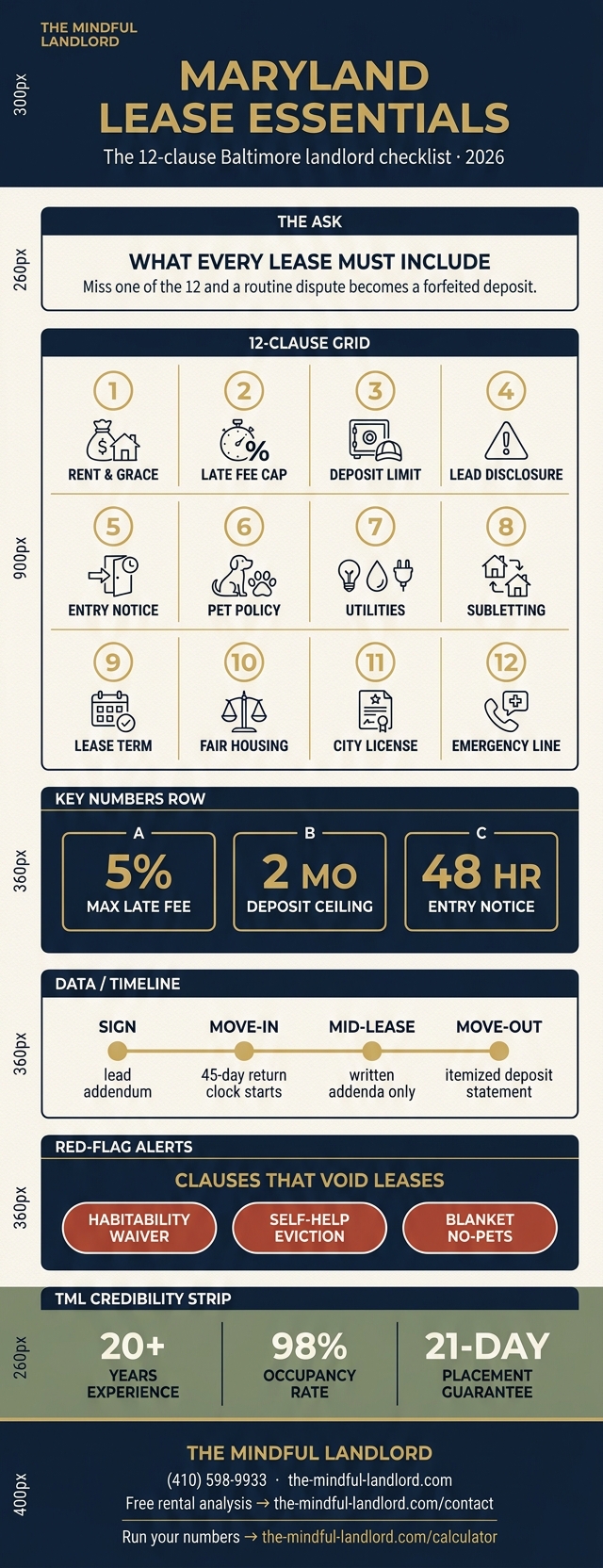
Treat this as your pre-signing checklist. Any lease missing one of these twelve elements is not ready to sign in Baltimore.
- Rent, due date, grace period. Maryland caps the grace period at 5 days before a late fee can attach (§ 8-208).
- Late fee cap. 5% of monthly rent (§ 8-208(d)(3)). A flat $50 late fee on a $750 unit is unenforceable on its face.
- Security deposit ceiling and interest. Maximum two months’ rent (§ 8-203). Interest accrues from receipt at a state-set annual rate published by the Maryland Department of Assessments and Taxation.
- Lead paint disclosure and EPA pamphlet. Federally mandated for pre-1978 units, separately enforced by Maryland’s Lead Rental Certification program.
- Right-to-repair and entry notice. Spell out a 48-hour written notice rule for non-emergency entry. Maryland requires “reasonable notice”; 48 hours is the safest interpretation.
- Pet policy and limits. Cap the pet deposit inside the two-months’-rent overall ceiling. Service and emotional-support animals are not pets under Fair Housing — carve that out explicitly.
- Utilities. Spell out electric, gas, water, trash, internet. “Tenant pays all utilities” is a fight waiting to happen in a rowhouse with shared meters.
- Subletting and occupancy. Require written approval for any sublet or roommate swap. Cap occupancy at two per bedroom plus one (HUD default).
- Term, renewal, and notice-to-vacate. Maryland default is 60 days’ written notice on a year-long tenancy, 30 days on month-to-month. Put both in writing.
- Retaliation and fair-housing statement. A short paragraph affirming compliance with the federal Fair Housing Act and Maryland anti-retaliation law.
- Baltimore City rental license number. Required in the lease under DHCD rules. Missing it can void your right to pursue non-payment in rent court.
- Emergency contact and 24-hour maintenance line. A tenant who can’t reach you at 2 AM during a water leak files a habitability complaint the next morning. TML holds a 4-hour emergency response standard — build that expectation into the lease.
Baltimore-Specific Add-Ons State Law Doesn’t Mandate
These clauses aren’t in the Maryland code, but every experienced Baltimore landlord adds them. Federal Hill is a good test case: dense with pre-1950 rowhouses, formstone façades, and tight shared alleys. A lease that ignores those realities will be renegotiated by a judge.
Lead-paint certificate for pre-1978 properties
Maryland requires annual lead-risk-reduction certification for rental units built before 1978. Reference the certificate number in the lease and attach a copy as an addendum. For Federal Hill, this is non-negotiable — the stock is overwhelmingly pre-war.
Rodent and pest clause — Baltimore City code § 122
City code requires rental units to be free of infestation at move-in. Spell out mid-tenancy responsibility: landlord for building-level issues, tenant for unit-level hygiene.
HVAC and hot water heater age disclosure
Disclose the age of major systems. A 20-year-old boiler that dies in February is a vacancy risk, and a clause that sets expectations around replacement timing protects you when it happens.
Renter’s insurance — enforce or waive?
Many Baltimore landlords now require proof of renter’s insurance at signing and at each renewal. Set a minimum liability limit ($100,000 is standard) and require the landlord to be named as an interested party.
What Your Lease Numbers Actually Look Like — Model Before You Sign
Before you finalize your rent amount and security deposit, run the math. A $100-per-month pricing mistake compounds to $1,200 in lost revenue per year — and an oversized deposit can violate Maryland law before the tenant has even unpacked. Use the TML Rental ROI Calculator to model your specific unit before you sign.
Step 1: Set rent at the right price for your neighborhood
Federal Hill two-bedroom rowhouses trade in a tight band. Underprice by 5% and you leave real money on the table over a two-year tenancy; overprice by 5% and you extend your vacancy window past the 21-day tenant placement guarantee TML holds itself to. The right rent is the one your market comps support — not the one your mortgage requires.
Step 2: Calculate the maximum lawful security deposit
Maryland’s two-month cap is simple math. For a $1,850/month unit, the maximum lawful deposit is $3,700. Anything above that is statutorily void — and potentially triples your exposure under § 8-203(e).
Step 3: Model your late fee revenue and vacancy buffer
A 5% late-fee cap on $1,850 rent is $92.50 per month. That’s a ceiling, not a target — a late fee is a deterrent, not a revenue stream. What actually moves your annual return is vacancy buffer: one 30-day vacancy burns $1,850 before you collect a dollar from the next tenant.
Use the TML Rental ROI Calculator to stress-test your lease economics
Maryland Lease Clauses That Get Baltimore Landlords in Trouble
Four patterns we see most often in portfolios we inherit — and the four that cost landlords the most in court.
Waiving habitability — void as a matter of law
Any clause that purports to waive Maryland’s implied warranty of habitability is unenforceable. “As-is” language does not save you from a rent-escrow action when the boiler dies in January.
Self-help eviction language — illegal
Changing locks, cutting utilities, or removing belongings is flatly illegal in Maryland regardless of the lease. The only lawful path is summary ejectment or tenant-holding-over action in District Court.
Blanket no-pets — Fair Housing trap
A “no pets” policy without a service-animal and emotional-support-animal carve-out invites a Fair Housing complaint. Maryland enforces FHA protections aggressively — build the exception into the pet clause from day one.
Automatic rent increase without proper notice
Maryland requires 60 days’ written notice before raising rent on a year-to-year tenancy and 30 days on a month-to-month. An “automatic CPI adjustment” that skips the notice requirement will not hold up.
Mid-Lease Changes: Addendum or New Lease?
Most lease changes don’t need a new document — a short addendum signed by both parties does the work. Use an addendum for: pet additions, mid-term rent changes by mutual consent, parking reassignments, added occupants. Use a new lease for: term extensions beyond the original expiration, a change of legal tenants, or ownership transfers.
Maryland does not permit unilateral mid-lease rent increases on a fixed-term lease. You can offer an addendum at a higher rate in exchange for value — a term extension, an appliance upgrade, a parking spot. When adding tenants, screen them the same as the originals and make them jointly and severally liable. When removing tenants, require a written release from all parties and re-qualify the remaining tenant on income.
Disciplined lease docs plus fast response times are how TML maintains a 98% occupancy rate across our portfolio.
Frequently Asked Questions
Does Maryland require a written lease?
Maryland does not require a written lease for tenancies under one year, but a written lease is strongly recommended. Without one, the tenancy defaults to month-to-month under state law, which limits your ability to enforce specific terms around pets, guests, or rent increases.
Can a Baltimore landlord charge more than 1 month’s security deposit?
No. Maryland law caps the security deposit at two months’ rent (MD Code Real Property § 8-203). Charging more is illegal, and landlords who violate this cap may owe tenants damages plus attorney’s fees.
What happens if I use an out-of-state lease template in Maryland?
Out-of-state templates typically omit Maryland-specific requirements such as the 5-day grace period, the 5% late fee cap, the 48-hour entry notice, and Baltimore City’s rental license disclosure. A non-compliant lease can be partially or fully unenforceable — and can expose you to tenant counterclaims.
How much notice must I give before entering a tenant’s unit in Maryland?
Maryland law requires landlords to give reasonable notice before entering — courts generally interpret this as 24 to 48 hours. Your lease should spell out 48 hours in writing to avoid disputes.
Is a verbal lease enforceable in Maryland?
A verbal lease is legally binding in Maryland for month-to-month tenancies but is difficult to enforce in practice because there is no written record of agreed terms. Baltimore landlords should always use a written lease to document rent, deposit, and key obligations.