You own the rowhouse, but once a tenant moves in, you can’t just let yourself in because the gutter guy is free on Tuesday. Maryland has a statute that tells you when you can enter, how much warning you owe, what the warning has to say and what hours you can knock. It’s Real Property § 8-221, and it applies across the State, from a two-bedroom in Highlandtown to a single-family house out in Parkville. Getting it wrong hands a tenant a clean claim against you and turns a routine repair into a fight.

Reasons the statute lets you come in
Section 8-221 starts with a list of purposes. A landlord may enter to make repairs, maintenance, modifications, renovations or improvements; to inspect the unit; to show it to prospective or actual buyers, mortgage lenders, tenants or contractors; to protect the safety of the property and the people living there; to complete work a government agency ordered; or to respond to a written request from the tenant.
That covers a furnace tune-up, a pre-listing walk-through, a lender’s appraiser and the contractor measuring for new windows. What the list doesn’t cover is dropping by to see how the place looks because a neighbor on the block said something.
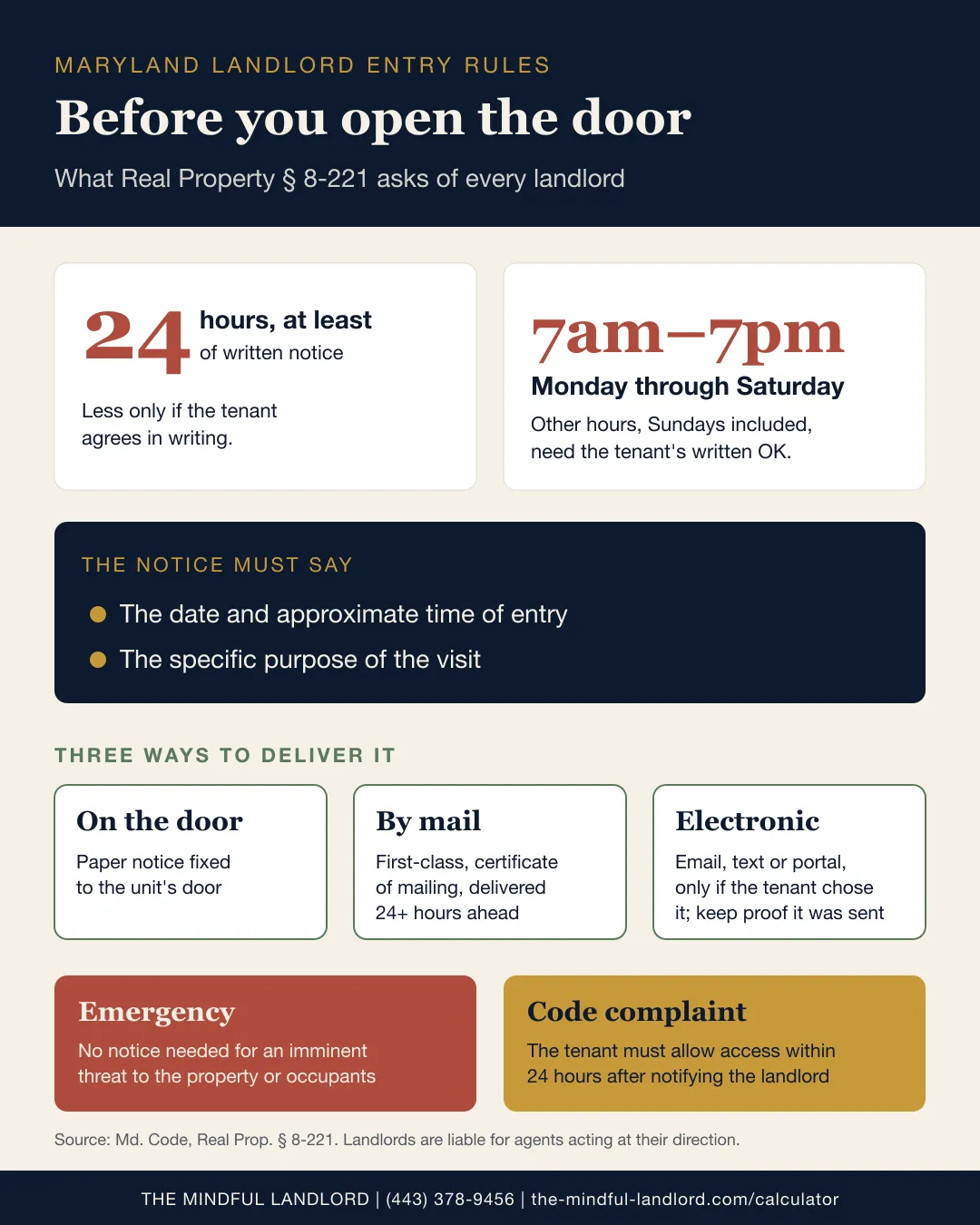
The statute also runs the other way once. If a tenant alleges a housing code violation, the tenant has to give the landlord access to the unit within 24 hours after notifying the landlord of the problem. A tenant who reports a dead heater has to let your HVAC tech in.
What the written notice has to say and how it gets there
Before a non-emergency entry, you owe the tenant written notice at least 24 hours before the time you plan to enter. A phone call doesn’t count.
The notice has two required pieces: the date and approximate time you intend to enter, and the specific purpose. “Maintenance” is thin. “Replace the kitchen faucet cartridge and check under the sink for leaks” is specific, and it gives the tenant a reason to move things out from under the sink before you arrive.
Delivery is where landlords trip up. The statute allows three methods:
- First-class mail with a certificate of mailing, but only if it’s delivered at least 24 hours before the entry time. Mail it Monday for a Tuesday visit and you’ve likely missed.
- A paper notice fixed to the door of the unit.
- Electronic delivery by email, text message or a tenant portal, but only if the tenant elected electronic delivery. The portal has to be one the tenant can reach both when the notice goes out and at the entry time.
Electronic delivery has to give you proof the notice was sent. Keep the screenshot or the portal log.
A tenant can agree in writing to let you in on less than 24 hours’ notice. A text back that says “Tomorrow morning works, come at 9” is a written agreement you can save. A verbal “sure, whenever” at the door is not.
If you want a refresher on handling repair requests from the first call to the finished job, our post on handling tenant maintenance requests in Baltimore walks through the order of operations.
Hours you can knock
Even with proper notice, you may enter only between 7:00 a.m. and 7:00 p.m., Monday through Saturday, unless the tenant agrees in writing to another time. Sunday is off the table without that written agreement.
That window catches people who manage rentals around a day job. Showing a Canton rowhouse at 7:30 on a weeknight because that’s when the prospective tenant can come is outside the hours. Get the current tenant’s written OK first, and save it.
Emergencies that skip the notice
You can enter without notice in an emergency. The statute describes it as entry to protect or preserve the property from an imminent threat, to protect the safety of occupants from an imminent threat, or for the health, safety and welfare of other tenants and staff.
Water pouring through the ceiling below, a gas smell or smoke fit. A slow drip under a sink that’s been there for a week doesn’t, and neither does a contractor who happens to be free right now.
When you do go in on an emergency, write it down the same day. Note the time, what you saw, who came in with you and what was done, then send the tenant a short written summary. Nothing in § 8-221 requires that summary, but it’s the record you’ll want if the tenant later says the “emergency” was a pretext.
Contractors, property managers and who answers for them
Under § 8-221(e), a landlord is liable for any violation committed by the landlord or by an agent acting at the landlord’s direction. Your handyman, your HVAC company and your property manager all count when you sent them.
So the notice rules travel with the work order. If you hand a key to a contractor and say “go whenever,” and they let themselves in at 8 p.m. on a Sunday, the violation is yours. Put the date, the window and the purpose on the work order itself, and tell your contractor that the window isn’t flexible without the tenant’s written OK.
A lease can’t rewrite this. Under § 8-208(d), a landlord may not use a lease containing a provision that has the tenant waive any right or remedy provided by applicable law. A clause that says “landlord may enter at any time without notice” isn’t going to hold. Your lease can do useful things, like setting out how you’ll handle routine inspections or asking the tenant to choose electronic delivery at signing. It can’t take away the 24 hours.
Not sure what your rental should earn or what this will cost you? Run the numbers in our free rental calculator at https://the-mindful-landlord.com/calculator, or call us at (443) 378-9456.
When a tenant pushes back
A tenant who wants to enforce § 8-221 has to show one of two things: that you entered in violation of the section, or that you made repeated demands for entry that didn’t follow it. The second one matters. A string of texts saying “I’m coming by tomorrow, be home” without the required content or method can be enough, even if you never went in.
If the tenant proves either, the court may issue an injunction against you, award damages for breach of the tenant’s right to quiet enjoyment of the home, or both.
Timing makes it worse. Maryland’s retaliation statute, § 8-208.1, bars a landlord from bringing or threatening an action for possession, arbitrarily raising rent or cutting services, or ending a periodic tenancy because the tenant made a good faith complaint about a lease violation, a violation of law, or a condition that seriously threatens health or safety. If a court finds retaliation, it may award damages up to the equivalent of 3 months’ rent, plus reasonable attorney fees and court costs. A landlord who answers a tenant’s complaint with a burst of entry demands and then a notice to vacate is building the tenant’s case for them. We cover the full set of those rules in our post on landlord harassment rules in Maryland.
If a tenant refuses a properly noticed entry, don’t force it. Send a second written notice for a new date, keep copies of both, and if the refusals keep coming, talk to a Maryland landlord-tenant attorney before you do anything else.
Inspections Baltimore City orders
Section 8-221 lists work ordered by a government agency as a valid reason to enter, and Baltimore City adds its own inspections. Under the City’s Strengthening Renters’ Safety Act, multi-family properties picked for “priority inspection” are inspected at least twice a year, at least four months apart, and the owner or manager must post notice of those inspections.
Posting the City’s notice in the hallway doesn’t replace the State rule. Each tenant whose unit will be entered still gets their own written notice. Keep a copy of both with the inspection file.
A notice you can reuse
Here’s a format that covers what the statute asks for. Adjust the details and keep a copy of each one you send.
Notice of Entry Date sent: [date] To: [tenant name], [address and unit] We intend to enter your home on [day, date] at approximately [time] to [specific purpose, such as “replace the bathroom exhaust fan and test the smoke detectors”]. Who will enter: [landlord, manager or contractor name]. Delivered by: [door posting / first-class mail with certificate of mailing / email, text or portal you chose for notices]. If this time doesn’t work, reply in writing with a time that does.
Ask every new tenant at lease signing whether they want notices by email, text or portal, and get that choice in writing. Where nobody asked, a paper notice on the door doesn’t depend on the tenant’s election.
Questions people ask
How much notice does a Maryland landlord have to give before entering? Written notice at least 24 hours before the planned entry, stating the date, approximate time and specific purpose. The tenant can agree in writing to less.
Can a landlord enter on a Sunday in Maryland? Only if the tenant agrees in writing to that time. Without it, entry is limited to 7 a.m. to 7 p.m., Monday through Saturday.
Does a text message count as notice? Yes, if the tenant elected electronic delivery and you can show the text was sent. If the tenant never chose electronic notices, use a paper notice on the door or first-class mail with a certificate of mailing delivered at least 24 hours ahead.
Can my lease give me the right to enter without notice? No. Maryland bars lease provisions that have a tenant waive a right or remedy provided by law, so a clause that skips the 24-hour notice won’t override the statute.
If you’d rather hand this off, call (443) 378-9456 or tell us about your property at https://the-mindful-landlord.com/contact. The free calculator at https://the-mindful-landlord.com/calculator shows what management would look like for your unit.