Plenty of Baltimore rentals still run on a handshake. A cousin moves into the second floor of a rowhouse in Pigtown, an old lease ran out two years ago and nobody signed a new one, or a buyer inherits a tenant along with the deed. Rent gets paid. Nobody thinks about paperwork until something breaks, and then landlords assume no lease means no rules. Maryland law says close to the opposite: the tenant keeps most of the protections a written lease would have spelled out, and the landlord loses some of the tools a lease would have given them.
What kind of tenancy you have when nothing is signed
A tenant paying monthly rent with no written lease is usually treated as a month-to-month tenant. The same thing happens when a lease runs out and you keep taking rent. Under Real Property § 8-402(d), when a landlord consents to a holdover tenant staying, that tenant becomes a periodic month-to-month tenant, unless the written lease said otherwise and the tenant initialed it. A tenant who paid weekly before the holdover becomes week-to-week instead.
That label decides how much notice each side owes. With no document, a District Court judge in Baltimore City is going to rebuild the deal from rent receipts, texts and testimony. What you can’t show, you can’t claim.
The rule for owners with five or more units
Small owners sometimes don’t realize this rule exists. Under § 8-208(a), a landlord who offers 5 or more dwelling units for rent in Maryland may not rent a residential unit without using a written lease. The count is units you offer for rent in the State, so a Hampden owner with three rowhouses and a duplex in Highlandtown is already there.
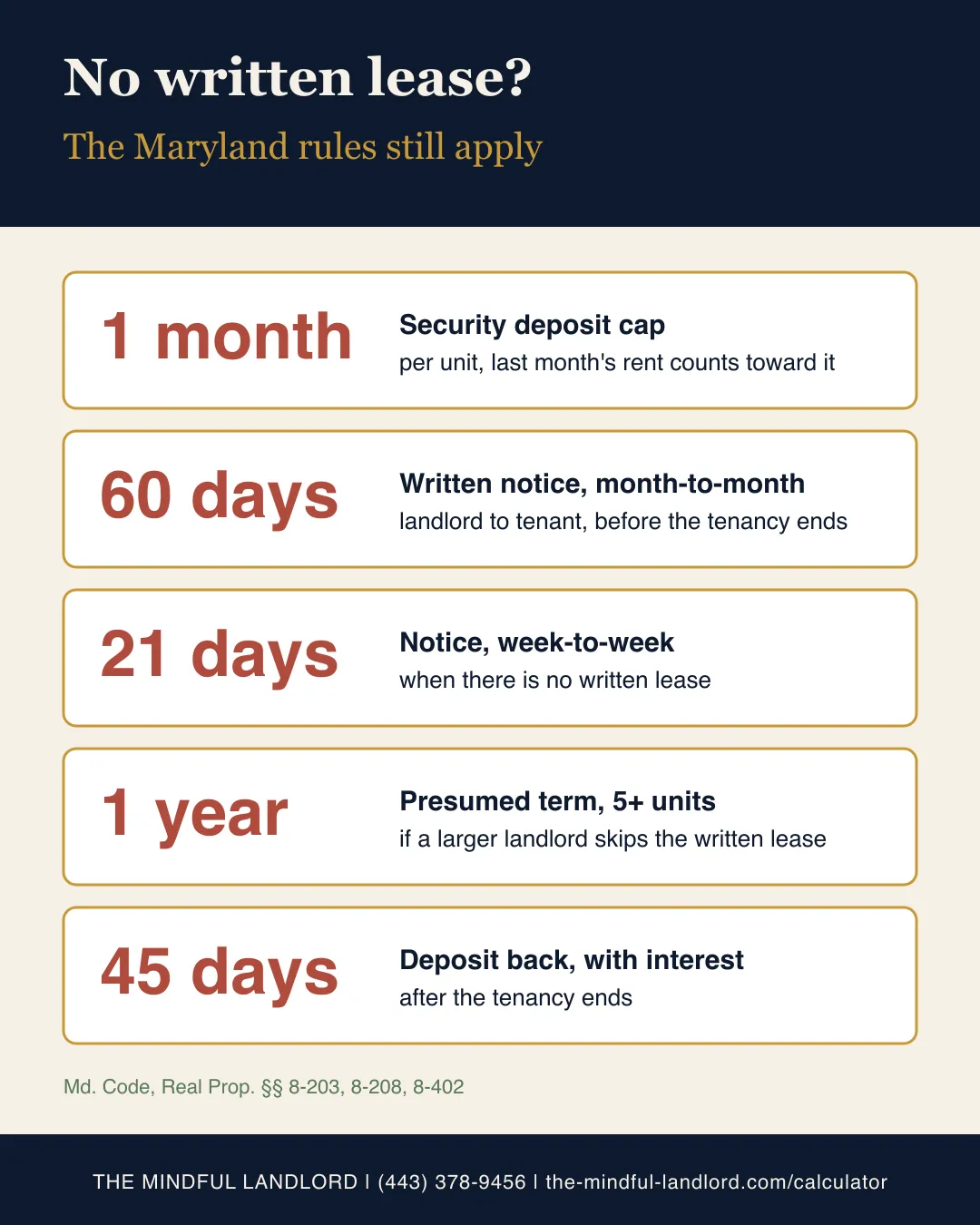
The penalty is built into the tenancy itself. If that landlord skips the written lease, the tenancy is presumed to last 1 year from the tenant’s first day of occupancy, and the tenant can end it earlier with 1 month’s written notice. In plain terms, you’re locked in for a year and the tenant isn’t. That’s the reverse of the flexibility most owners think they’re buying.
Rights a tenant keeps without a lease
Most of what protects a tenant in Maryland lives in the statute, so it doesn’t need a signature to apply.
The deposit cap. A landlord may not take a security deposit of more than 1 month’s rent per dwelling unit, no matter how many tenants live there. Maryland counts last month’s rent paid in advance as part of the security deposit, so collecting “first, last and deposit” on a handshake deal can put you over the cap. You still owe the deposit back with interest within 45 days after the tenancy ends.
Repairs and rent escrow. The rent escrow statute, § 8-211, applies to all residential dwelling units leased for human habitation in the State, whether publicly or privately owned, single or multiple units. It covers serious defects like lack of heat, light, electricity, or hot or cold running water. A tenant with nothing in writing can use it the same as one with a 30-page lease. If you’d like the full picture of what counts, our post on uninhabitable conditions in Baltimore rentals goes through it.
Protection from retaliation. A landlord of any residential property may not bring an action for possession, raise the rent arbitrarily or end a periodic tenancy because a tenant made a good faith complaint, to the landlord or to a public agency, about a lease violation, a violation of law or a condition that seriously threatens health or safety. A tenant who calls Baltimore City code enforcement about a dangerous condition is covered. If a court finds the landlord retaliated, it can award damages up to the equivalent of 3 months’ rent plus reasonable attorney fees and court costs.
What the landlord gives up without a written lease
A lease is where you put the things the law lets you add. Without one, you have no late fee clause to point to. Maryland caps a lease late fee at 5% of the rent due for that period, but you need a lease provision that says it to collect anything at all. The same goes for rules on pets, smoking, guests, parking behind the house and who pays the BGE bill.
Maryland also spells out what a lease must contain: a statement about the condition of the premises, each side’s specific obligations for heat, gas, electricity, water and repairs, a security deposit receipt, and a copy of the current Maryland Tenants’ Bill of Rights. The deposit receipt itself is supposed to be included in a written lease. So the handshake deal leaves you out of step with the deposit rules before anyone has moved a box.
There’s also the money from a court case. Even without a lease, you can still file for failure to pay rent, but before filing you must give the tenant written notice of your intent to file and 10 days to cure. Without a written agreement on the rent amount and due date, proving what was owed comes down to your bank records and the tenant’s memory. Keep every receipt.
How to end a tenancy that was never written down
A landlord who wants the unit back from a month-to-month tenant has to give written notice of the intent to end the tenancy 60 days before it expires. For a week-to-week tenant with no written lease, the landlord’s notice is 21 days. A lease can never shorten those periods; Maryland bars any lease term giving a notice to quit shorter than the law provides, though both sides can agree to a longer one.
Baltimore City adds a wrinkle. Elsewhere in Maryland, a landlord can rely on proof that the tenant gave verbal notice of moving out. That rule does not apply in Baltimore City. If a City tenant tells you over the phone they’re leaving at the end of the month and then doesn’t, don’t count on that phone call in court. Get the move-out date in writing, or send your own written notice.
Once the notice period runs and the tenant hasn’t left, you file a holdover case in District Court. We’d never touch the locks or the tenant’s belongings while that case is pending; the court process is the route. Our eviction notice periods guide has the full set of timelines.
The City license comes before any lease
Whatever paperwork you have with the tenant, Baltimore City wants its own. All non-owner-occupied properties in the City that are rentals must be licensed as a rental, in addition to being registered. To get the license you need a passing inspection by a State licensed inspector who is registered with the City, or a passing Section 8 inspection, plus current lead certification for each unit. Registration covers every non-owner-occupied property and is due by January 1 each year.
Owners renting to family often skip this. If your Reservoir Hill rowhouse has someone paying you rent, it needs the registration and the license. The City vs. County rental license breakdown explains how this differs once you cross into the County.
Putting an informal tenancy on paper
This takes an afternoon. Write down what the deal already is: the rent, the due date, who pays which utility, the deposit you’re holding and where it’s banked. Then turn that into a proper lease with the required pieces, including the Tenants’ Bill of Rights and a deposit receipt.
A few things to watch when you hand it over:
- Don’t use the new lease to sneak in a rent increase or a shorter notice period. A long-time tenant will read a sudden overhaul as pressure.
- If you want the lease to renew on its own, put the automatic renewal clause apart from the rest of the lease with a space for the tenant’s initials or signature. A Maryland automatic renewal provision without the tenant’s initials, signature or witnessed mark can’t be enforced by the landlord.
- If the deposit you collected years ago was more than 1 month’s rent, refund the difference now rather than waiting for a move-out dispute.
- Keep the signed copy and a record of how you delivered it.
If the tenant won’t sign, you’re still in a month-to-month tenancy on whatever terms you can prove. Every future disagreement starts from scratch, and the 60-day notice is your exit.
Not sure what your rental should earn or what this will cost you? Run the numbers in our free rental calculator at https://the-mindful-landlord.com/calculator, or call us at (443) 378-9456.
Questions people ask
Is a verbal lease legal in Maryland? Yes, for most small landlords a verbal month-to-month arrangement is a real tenancy. A landlord who offers 5 or more units for rent in the State must use a written lease, and if they don’t, the tenancy is presumed to run 1 year from the tenant’s first occupancy.
How much notice do I give a Baltimore tenant with no lease? For a month-to-month tenant, written notice 60 days before the tenancy ends. For a week-to-week tenant with no written lease, 21 days.
Can I raise the deposit when I finally write a lease? Only up to the cap. The total security deposit can’t exceed 1 month’s rent per unit, and money you took as last month’s rent counts toward it.
Does a tenant without a lease have to pay rent into escrow to get repairs? Rent escrow is available to tenants in any residential unit leased for habitation in Maryland, lease or no lease, for serious defects like no heat or no running water.
If you’d rather hand this off, call (443) 378-9456 or tell us about your property at https://the-mindful-landlord.com/contact. The free calculator at https://the-mindful-landlord.com/calculator shows what management would look like for your unit.