The County license runs on a three-year term and has its own per-unit fee schedule.
What the County requires before a tenant gets keys
Baltimore County requires every rental property to have either a rental license or an exemption license, and the County cites Code Section 35-5-201 as the authority. The property has to be registered and licensed before a tenant moves in. If you’ve signed a lease on an unlicensed house, move the start date or get the application filed now. Don’t hand over keys and plan to catch up later.
Keep one folder per property, paper or digital. When a question comes up at renewal or sale, check that folder first.
Buildings of six or fewer units need a license, short-term rentals included, and buildings of seven or more units need one as well.
An exemption license is still a license you have to apply for. It covers units occupied only by the owner’s relatives plus one adult who doesn’t have to be related, units exempted by federal or state law, and dwellings on the National Register of Historic Places or the County Landmarks List.
Hypothetically, say your adult daughter lives in a house you own and a friend of hers wants to move in to share costs.
How the County differs from the City line
The County license is valid for three years and can be renewed for further three-year terms. Exemptions and self-certifications also have to be renewed. For a typical small County rental, the application needs a completed inspection sheet from a licensed home inspector or an exemption affidavit, along with any required lead inspection certificate.
Put every expiration date in one spreadsheet with the jurisdiction in its own column. If you’re buying in the County, ask the seller for the current license at contract, then confirm with the County what you need to file as the new owner before settlement. For rent increases, see our post on raising rent on a Baltimore rental.
When you’re buying, ask the seller these questions in this order:
- Does the property have a current license or exemption license, and when does it expire?
- Is the information on file accurate, including tenants and the legal agent?
- Are there open code violations or pending inspections?
Get the seller’s answers in writing and compare them with what the County tells you.
Fees, legal agents and tenant information on the application
The current County application form lists the fees:
- $60 per unit not occupied by the owner.
- $60 per owner-occupied unit with 3 or more tenants.
Changing information on an existing application costs nothing. Use it every time a tenant, agent or mailing address changes. Keep a copy of every application, every update and every payment confirmation in the property folder. That way you can show what you filed and when.
Every owner has to name a legal agent to receive service of process. If you live outside Maryland, that agent has to be a Maryland resident, and the agent can’t be your tenant. Pick someone who will actually answer.
Before you name anyone, ask three things. Are they willing to accept legal papers for you? How will they reach you the same day? What happens if they move or become unavailable? Get their agreement in writing, and revisit the choice each time you renew.
The application also asks for the names and contact information of adult tenants, and you have to update that information within 30 days of any change. Say, hypothetically, you own a Catonsville duplex and one side turns over in March. The new adults on that lease need to be reported to the County inside 30 days. Put the County update on the same move-in sheet as the deposit receipt and the lead notices, and do it before the first rent payment posts.
Questions about your own property? Call The Mindful Landlord at (443) 378-9456. You can also price your rental with our free calculator: https://the-mindful-landlord.com/calculator.
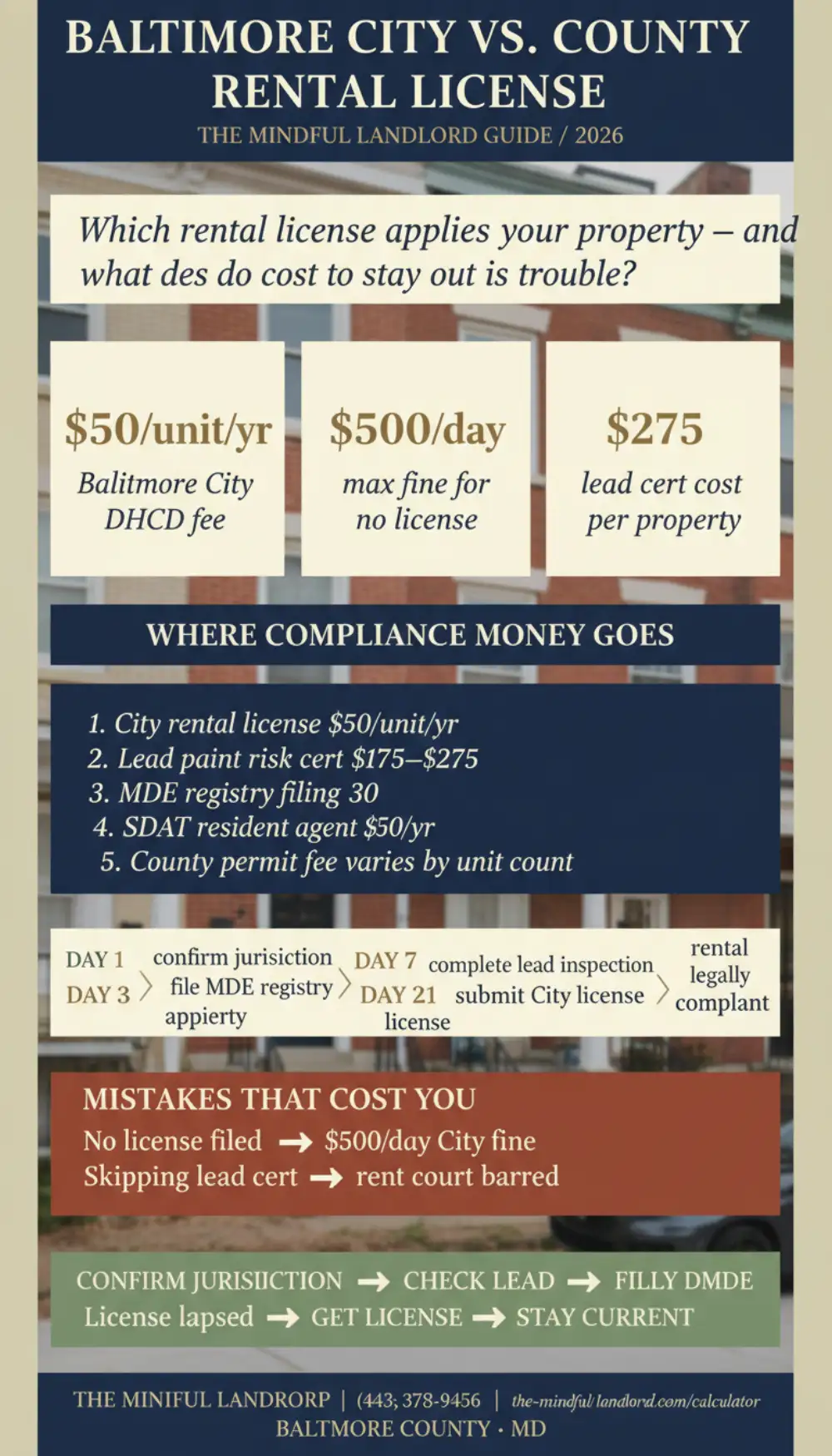
Lead paperwork for older houses
For homes built before January 1, 1978, the County won’t license the property without a valid MDE lead registration tracking number. You also have to send copies of the lead inspection certificates with the application.
Run a pre-1978 County turnover in this order.
- Confirm the MDE registration is current and pull the tracking number.
- Do the paint work and get the lead-dust test and inspection certificate.
- Bring in the home inspector for the County inspection sheet.
- File the County application with everything attached.
Keep the tracking number and every certificate in the property folder. If any step stalls, push back the move-in date rather than filing an incomplete application.
For a longer walk-through, see our Baltimore rental inspection and lead paint checklist.
Apartment buildings and the unrelated-adults rule
Buildings with 7 or more units, apartment complexes included, can self-certify by affidavit if they had fewer than three code violations in the past three years. Buildings that don’t meet that bar must have 10% of their units inspected before registration. Close out violations promptly and keep the closure paperwork somewhere you’ll find it at renewal.
Hypothetically, suppose a tenant complaint at your apartment building turns into a cited violation. Fix it, ask the County how to document the closure, and file that proof with your renewal papers.
More than two unrelated adults can’t live together unless the County approves the unit as a boarding or rooming house, and that approval needs a use permit. Take a hypothetical four-bedroom house near Towson with four unrelated graduate students who want to split it. Without that approval and use permit, the arrangement runs into the County’s limit.
Settle the occupant count before you list the house. Get every adult who will live there on the application, and write a lease clause that names the occupants.
What an unlicensed unit costs you in fines and in court
Violations of §§ 35-6-101 to 35-6-113 can lead to denial, suspension, revocation or non-renewal of the license.
If you find out a unit has lapsed, fix that before anything else. Call the County and ask what you need to file to bring the unit current. Also ask whether anything changes for a tenant already living there. Talk to a Maryland attorney before you take any action against a tenant in an unlicensed unit.
If you own in the County and want someone handling licenses, lead registration and renewals on a calendar, see our Baltimore County property management page.
If you’d rather hand this off, call (443) 378-9456 or tell us about your property at https://the-mindful-landlord.com/contact. The free calculator at https://the-mindful-landlord.com/calculator shows what management would look like for your unit.