Question? In Maryland, a rental becomes uninhabitable when major problems like
Most Baltimore landlords know they need to keep their properties in decent shape. What they often do not know is exactly where the legal line sits — the specific conditions that transform a run-down rental into a legally uninhabitable one, the cure timelines Baltimore District Court enforces, and the compounding financial exposure that follows when violations go unaddressed.
This guide covers both COMAR 05.12.02 (the state habitability standard) and Baltimore City Housing Code — and explains how the two interact in ways that frequently catch local landlords off guard.
What Maryland Law Defines as Uninhabitable
COMAR 05.12.02 habitability standards — the legal text Baltimore courts use
Maryland’s baseline habitability standard lives in Real Property Article Section 8-211 and the implementing regulations under COMAR 05.12.02. The statute defines a defective condition as any condition that constitutes a substantial and serious threat to the life, health, or safety of occupants.
At the state level, that threshold includes: adequate structural integrity; heating capable of maintaining 68 degrees F from October 1 through May 31; functional hot water (minimum 110 degrees F); working plumbing with no sewage backup; safe electrical systems; pest control; and trash disposal facilities. These are not aspirational — they are the statutory minimum, and failing any one of them opens the door to rent escrow proceedings in Baltimore District Court.
Baltimore City Housing Code additions that exceed state requirements
Baltimore City’s Housing Code (Article 13) layers additional requirements on top of the state standard. Baltimore City DHCD enforces several city-specific rules that state law does not require:
- Carbon monoxide detectors in every unit with a gas appliance — not just bedrooms
- Window guards when children under 10 are present on floors above the ground level
- Enhanced lead paint rules: pre-1978 units with children under 6 require DHCD-issued lead-free or lead-safe certification before and during tenancy, not just at turnover
- Exterior maintenance standards covering facades, gutters, and downspouts that state law leaves to local discretion
The practical takeaway: a Roland Park landlord who is fully compliant with state law can still face a Baltimore City housing code violation. The city standard is higher, and city inspectors enforce it independently of state courts.
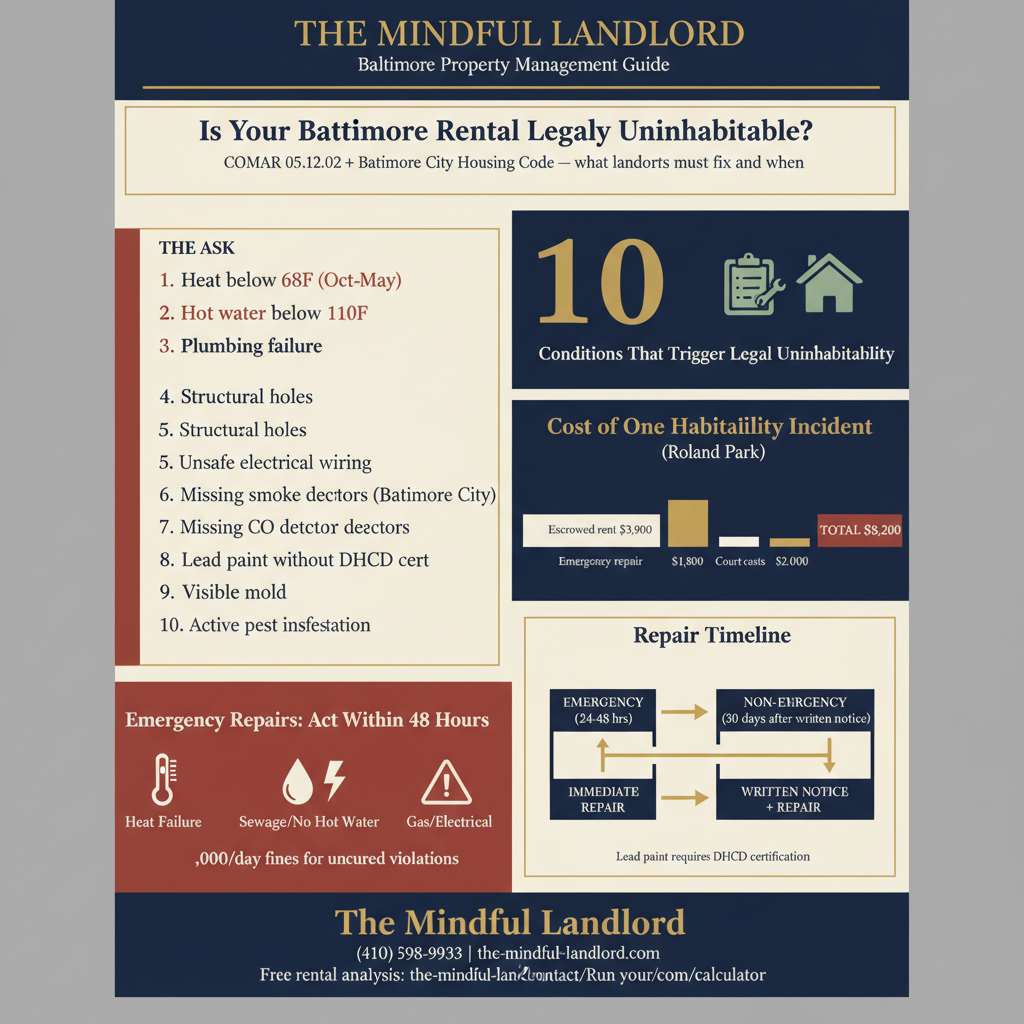
The 10 Conditions That Make a Baltimore Rental Legally Uninhabitable
Critical systems: heat, hot water, and plumbing thresholds
These three generate the most rent escrow filings in Baltimore District Court, because they are quantifiable and documented quickly:
- Heat below 68 degrees F between October 1 and May 31 — any failure to maintain this threshold is a statutory violation
- Hot water below 110 degrees F — the minimum supply temperature required at the tap
- Plumbing failure — sewage backup, non-functional toilet, or no running water triggers immediate action
Structural and safety: conditions that trigger automatic violations
- Exposed or unsafe electrical wiring — frayed, exposed, or improperly grounded circuits
- Structural failures — holes in the roof, walls, or floors that allow water or pest intrusion
- Missing or non-functional smoke detectors — required in every bedroom and hallway
- Missing CO detectors (Baltimore City) — required in any unit with gas-fired appliances
Environmental: lead paint, mold, and pest infestation standards
- Lead paint — peeling or chipping paint in a pre-1978 unit with children under 6 requires a DHCD lead-free or lead-safe certificate; absence of the cert is itself a violation
- Visible mold — any visible mold growth on interior surfaces is a Baltimore Housing Code violation; documentation by a tenant triggers a mandatory landlord response
- Active pest infestation — rodent or cockroach infestation requires licensed pest control remediation, not DIY treatment
What Tenants Can Do When a Baltimore Landlord Fails to Repair
This section is written from your perspective as a landlord — because understanding what tenants can do is the clearest way to understand what you are actually exposed to when repairs go undone.
Rent escrow at Baltimore District Court: how the process works
Maryland’s rent escrow statute (RP Section 8-211) allows tenants to petition Baltimore District Court to place rent into a court-held escrow account instead of paying it to the landlord. The tenant must: (1) Provide written notice of the defective condition. (2) Give the landlord a reasonable time to repair. (3) File a rent escrow petition with the District Court using Form DC/CV 083.
Once a rent escrow petition is granted, your rental income is frozen. Funds accumulate in the court’s account — unavailable to you — until the court rules on the habitability dispute. In practice, contested cases in Baltimore District Court take 30 to 60 days to resolve. During that entire window, you receive nothing while your mortgage, insurance, and operating costs continue.
Repair-and-deduct: Maryland’s $1,500 limit and requirements
Maryland also allows tenants to hire their own contractor for essential repairs and deduct the cost from rent — up to $1,500 or one month’s rent (whichever is less) — after providing reasonable written notice and giving the landlord an opportunity to make the repair. Under RP Section 8-211.1, this remedy applies to conditions affecting health or safety.
Constructive eviction: when a tenant can legally terminate the lease
If conditions are serious enough that a tenant is effectively forced out of the property, Maryland courts will recognize a constructive eviction — meaning the tenant may legally terminate the lease without penalty and potentially seek damages from the landlord. This is the scenario that combines lost rent, potential legal liability, and an immediate vacancy.
The Real Cost of Getting This Wrong
Baltimore Housing Code violation penalties and rental license exposure
Baltimore City can issue fines of up to $1,000 per day for uncured housing code violations. Repeated or serious violations can trigger a referral to DHCD’s rental licensing division, which has authority to suspend or revoke your rental license. A suspended license means the property may not be legally rented — to anyone — until the license is reinstated.
Before You Commit, Run the Numbers — modeling a habitability dispute
Here is what a single habitability incident can actually cost a Roland Park landlord. Scenario: boiler failure in January. Day 3: tenant sends written notice of no heat. Day 14: landlord has not completed repair; tenant files rent escrow petition. Days 14-59: income frozen (45-day window to resolution). Escrowed rent: $2,900 (median Roland Park 2BR, 45 days). Emergency boiler replacement: $4,800. Court costs and attorney: $500. Code violation fines (30 uncured days at $1,000 per day): $30,000. Total exposure: $38,200.
Does your Roland Park rental have the cash-flow cushion to absorb a 45-day income freeze and a five-figure repair bill? Run your property through The Mindful Landlord’s free rental ROI calculator to see your actual annual cash flow — and whether your reserves can handle a habitability dispute. Takes under two minutes. No sign-up required.
Baltimore Landlord Repair Timelines: What the Law Actually Requires
Emergency repairs: the 24-48 hour standard for life-safety issues
Baltimore City Housing Code designates certain failures as emergencies requiring immediate response — generally within 24 to 48 hours. These include: heat failure (October 1 through May 31), sewage backup or non-functional toilet, no hot water, water intrusion through the roof or exterior walls, and gas leak or exposed electrical hazard.
Immediate response means repair or temporary remediation within the window — not scheduling a contractor for the following week. Baltimore inspectors will document a landlord’s failure to act within the emergency timeline as evidence for code violations and rent escrow proceedings.
Non-emergency repairs: the 30-day cure period
For non-life-safety defects, Maryland law gives landlords a reasonable time to cure — typically interpreted as 30 days after written notice from the tenant. Courts do not start the clock on verbal complaints; the clock starts with written notice. Maintain a written record of every maintenance request and your response, including timestamps. This documentation is your primary defense in any rent escrow proceeding.
Lead paint: DHCD certification requirements and timelines
Baltimore City’s lead paint rules are among the strictest in Maryland. Pre-1978 properties with a child under 6 in residence require a current DHCD lead-free or lead-safe certificate. At turnover — when a unit with a child under 6 becomes vacant — the landlord must obtain a new DHCD inspection and certification before re-renting. Failure to hold a current certificate is itself a violation, separate from whether peeling paint is actually present.
How Professional Property Management Prevents Habitability Claims
The proactive inspection system that catches problems before tenants escalate
The 50+ properties under The Mindful Landlord’s management in the Baltimore area benefit from a documented annual inspection cycle — not reactive maintenance after a tenant complaint. Annual inspections catch developing issues before they cross the habitability threshold: a slow boiler, early signs of mold under a bathroom vanity, a deteriorating window seal. Each inspection produces a written record, timestamped and stored, which serves as evidence of proactive compliance if a dispute ever arises.
With 20+ years of experience managing Baltimore-area rentals, our team has navigated habitability disputes, rent escrow proceedings, and DHCD lead paint inspections — we know exactly which conditions require emergency response, which have a 30-day window, and how to document compliance in a way that holds up in District Court.
TML’s 4-hour emergency response: the direct answer to habitability risk
The Mindful Landlord’s 4-hour emergency response commitment covers heat failures, sewage backups, and water intrusion around the clock. When a Roland Park tenant loses heat at 11pm in February, you are not scrambling to find an HVAC contractor at 6am — we have vendor relationships that make same-night response standard, not exceptional. We maintain a 98% occupancy rate across our managed portfolio. Call us at (443) 378-9456 to discuss your Roland Park property, or request a free property analysis online.
Before you decide whether professional management makes financial sense for your property, run your numbers through our free rental ROI calculator. Input your current rent, expenses, and vacancy assumptions, and see your actual annual return — with and without management fees factored in.
Frequently Asked Questions
What is considered uninhabitable in Maryland?
Under COMAR 05.12.02, a Maryland rental is uninhabitable if it lacks adequate heat (68 degrees F October 1 through May 31), hot water, working plumbing, functional electrical systems, structural integrity, or protection from pests. Baltimore City Housing Code adds CO detectors in units with gas appliances and stricter lead paint requirements.
Can a Maryland tenant withhold rent for uninhabitable conditions?
Not directly. Maryland law requires tenants to pay rent into court escrow — not withhold it — while a habitability dispute is pending. The tenant must first provide written notice and give the landlord a reasonable opportunity to repair before filing with Baltimore District Court.
How quickly does a Baltimore landlord have to fix a heating problem?
Heat failure between October 1 and May 31 is an emergency under COMAR. Baltimore City Housing Code expects heat restored within 24-48 hours. Failure to repair exposes landlords to code violations, rent escrow proceedings, and potential rental license suspension.
What are the penalties for housing code violations in Baltimore City?
Baltimore City can issue fines of up to $1,000 per day for uncured violations. Serious or repeated violations can result in rental license revocation, making the property legally unrentable until reinstated.
Does a lead paint violation make a Baltimore rental uninhabitable?
Peeling or chipping paint in a pre-1978 Baltimore unit with children under 6 present triggers DHCD enforcement. The property may be declared uninhabitable and the tenant may have grounds to terminate the lease and seek damages.
Know Your Numbers Before a Habitability Dispute Knows Them For You
A single rent escrow case can freeze 45+ days of income and generate five-figure code fines. Run your Baltimore rental through our free calculator to see your actual cash flow — and whether your reserves can absorb a worst-case habitability incident.
Use the Free ROI CalculatorQuestions? Call (443) 378-9456 or schedule a free property analysis.
FAQ
**Q: My tenant’s heat went out on a cold night. How long do I have to get it fixed before it’s a big problem