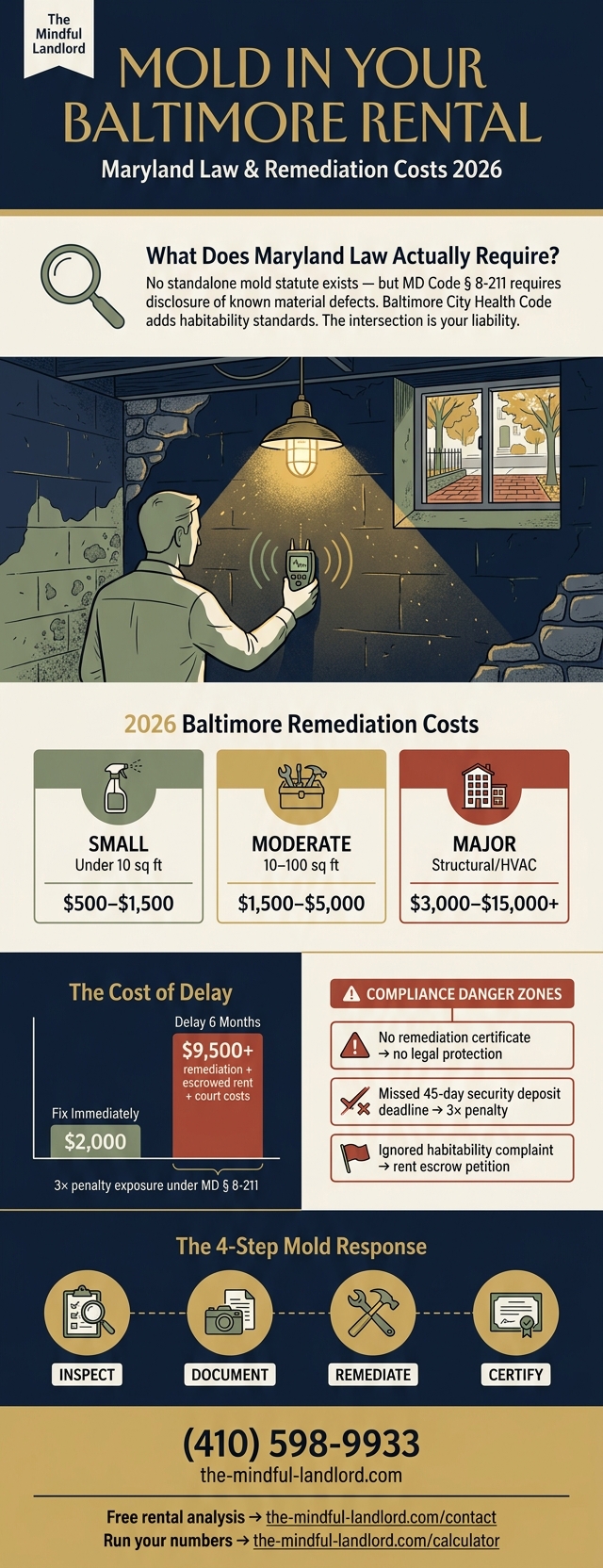
Maryland does not have a standalone mold disclosure statute — but that does not protect you as a landlord. Under MD Code Real Property § 8-211 and the Baltimore City Health Code, you are legally required to disclose known material defects and maintain habitable conditions. Mold that poses a health hazard is a habitability failure. Ignore it, and your tenant can petition to withhold rent, code enforcement can fine you, and a $2,000 repair becomes an $8,000 legal problem. Here is what the law actually requires and what licensed remediation costs in Baltimore in 2026.
What Maryland Law Actually Says About Mold Disclosure
The Maryland habitability code and mold crossover
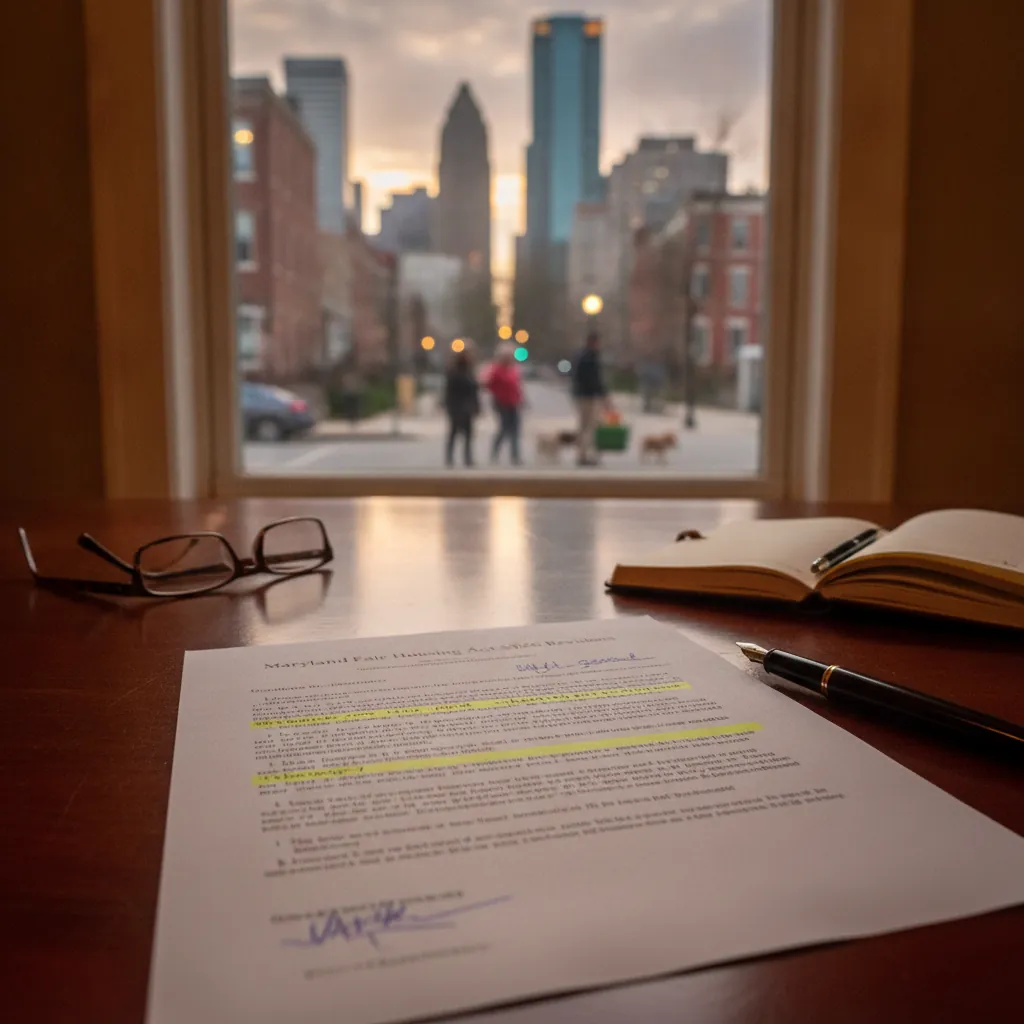
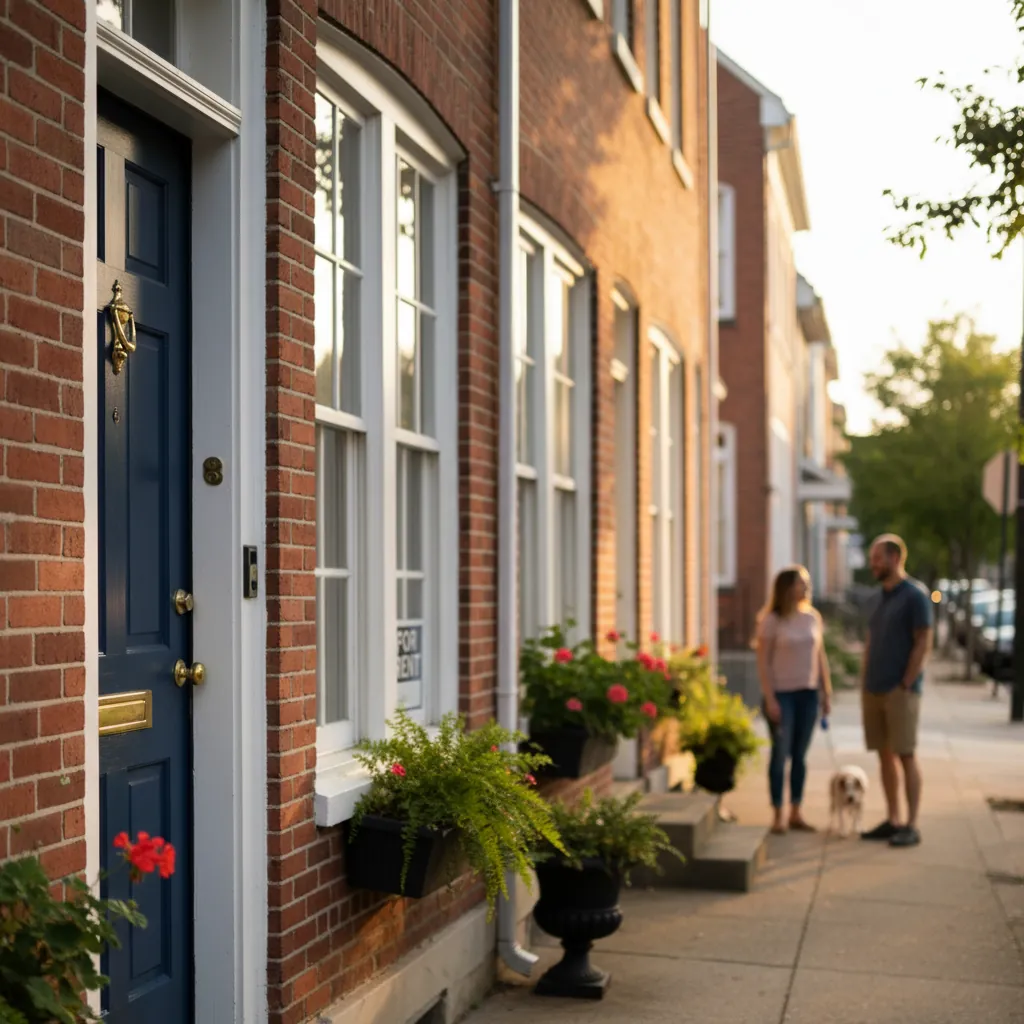
There is no standalone mold disclosure statute in the Maryland Code. What exists is MD Code Real Property § 8-211, which requires landlords to disclose known material defects affecting habitability, and the Baltimore City Health Code, which mandates habitable conditions across fourteen categories — including moisture intrusion and air quality. Mold sits at the intersection of both. A Hampden rowhouse with visible basement mold is not a gray area. The question is whether you knew. If you knew — or should have known through reasonable inspection — and failed to disclose or remediate, you are exposed.
When disclosure is legally required vs. when it is best practice
Disclosure is legally required when you have actual knowledge of a material defect affecting habitability. Best practice is to disclose anything a reasonable tenant would consider material — including past remediation, recurring moisture, or HVAC issues that could cause future mold. The cost of over-disclosing is zero. The cost of under-disclosing is a rent escrow petition, a code violation, and potential lease voidability.
Baltimore City Health Code: habitability standards for mold
Baltimore City Housing Code requires rental units to be free of conditions that constitute a danger to health or safety. Code inspectors can cite mold as a habitability violation with no minimum square footage threshold. A failed inspection triggers a mandatory repair order, and repeat violations can result in rental license suspension — meaning you cannot legally collect rent until the license is reinstated. With 50+ properties managed across Baltimore City and County, TML has seen how fast a moisture issue escalates when it is not caught at the annual inspection.
How to Identify a Reportable Mold Problem Before Your Tenant Does
Visual inspection checklist: where mold hides in Baltimore rowhouses
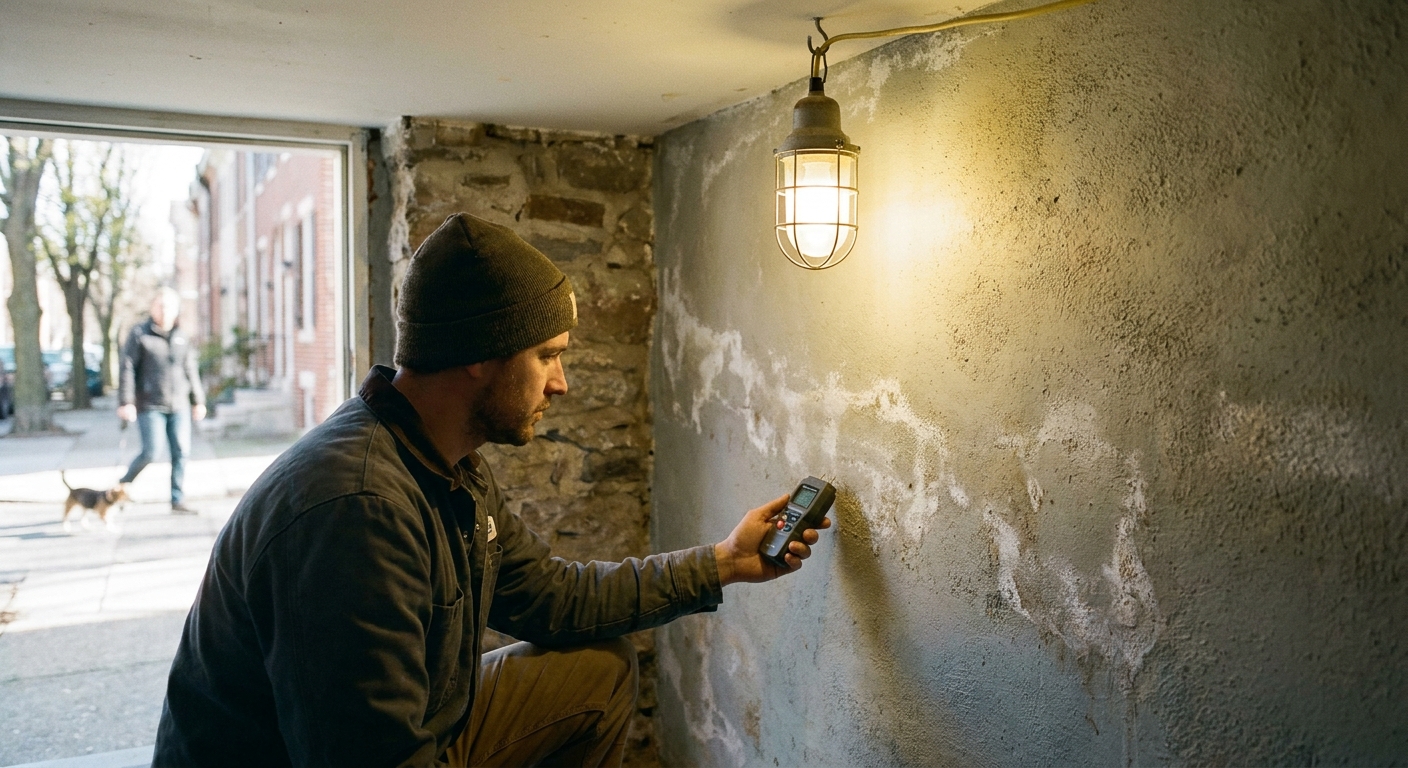
Hampden and surrounding older neighborhoods have specific vulnerabilities: limestone foundations with limited vapor barriers, painted brick that traps moisture, flat roof sections prone to slow leaks, and single-pane windows with chronic condensation. Your annual inspection checklist should cover: basement slab and walls (look for white efflorescence first — moisture precedes mold), under-sink cabinets, attic insulation near roof penetrations, window sills, and HVAC return air plenums.
HVAC, basement, and crawl space: the three highest-risk zones
In Baltimore rental stock, the highest-risk zones are HVAC systems — mold on evaporator coils spreads airborne spores throughout the unit — basements with sump pits or floor drains that back up, and crawl spaces with exposed soil. In rowhouses, party walls between units can channel moisture invisibly for months before it becomes visible. Catch it during your annual inspection, not when your tenant sends a certified letter.
When to call a licensed inspector vs. handle it yourself
Use the EPA’s 10-square-foot rule: anything under 10 sq ft on a non-porous surface you can clean with diluted bleach falls within DIY range. Anything larger, anything on porous surfaces (drywall, wood framing, insulation), or anything in your HVAC system requires a licensed remediation contractor. In Baltimore, remediation should be documented with a certificate of completion — that document is your protection in a tenant dispute or code hearing.
Licensed Mold Remediation in Baltimore: What It Costs in 2026
Small surface mold (under 10 sq ft): DIY vs. professional cost
For surface mold under 10 sq ft on tile or painted concrete, licensed remediation runs $500–$1,500 in Baltimore — covering containment, removal, HEPA vacuuming, and a completion certificate. DIY costs $30–$80 in materials, but carries documentation risk. For anything in a rental unit, the professional option is the right call.
Moderate remediation (10–100 sq ft): average Baltimore contractor range
Moderate mold — a bathroom wall, a basement section, or a closet behind plumbing — runs $1,500–$5,000 in Baltimore, depending on material type and containment requirements. Drywall removal, framing treatment, and replacement drywall add cost. Get three bids and verify licensing through the Maryland Home Improvement Commission (MHIC) before signing. Most qualified contractors in this range provide a written scope and a one-year warranty against recurrence.
Major structural remediation: when it hits $3,000–$15,000 and when insurance helps
Major structural remediation — involving HVAC systems, floor joists, subfloor, or significant wall sections — runs $3,000–$15,000+ in Baltimore. Your landlord insurance policy may cover remediation if mold results from a covered peril: a burst pipe, roof leak, or appliance failure. Tenant-caused moisture conditions are typically excluded. Document the moisture source before filing any claim. TML’s 4-hour emergency response protocol means active water intrusion is stopped before it becomes a major remediation event.
The Real Cost of Getting This Wrong
Tenant rent withholding rights under Maryland law
Under MD Code Real Property § 8-211, Baltimore tenants can petition District Court to pay rent into escrow rather than to you if your unit has a habitability condition you were notified about and failed to repair. Mold certified by a licensed inspector as a health hazard qualifies. Escrow petitions freeze your rent income for months. A $2,000 remediation job delayed six months can cost $6,000 in escrowed rent, $1,500 in court costs, and the repair bill you owed anyway.
Baltimore City code enforcement: fines, court appearances, license suspension
Baltimore City code enforcement fines for habitability violations run $50–$500 per violation per day, plus a $250 reinspection fee per visit. Repeat violations go to Housing Court, which can impose mandatory repair orders. Failure to comply can result in rental license suspension. TML-managed properties run at 98% occupancy in part because our inspection protocol catches these issues before code enforcement does.
Before You Commit, Run the Numbers
Before you decide to delay that baseline inspection or skip the licensed remediation quote, model what a 30-day vacancy plus a code fine does to your annual return. A Hampden rowhouse at $1,800/month loses $60/day vacant — plus up to $500/day in code fines while the violation is open. That math changes the calculus on a $2,000 remediation bill entirely.
Documenting Mold: The Paper Trail That Protects You in Court
Move-in inspection photos and baseline moisture readings
Every TML-managed unit receives a move-in inspection report with timestamped photos from standardized angles and baseline moisture readings at high-risk zones. If a tenant later claims mold was present at move-in, that documentation is your defense. Without it, you are litigating from memory against a plaintiff with photos on their phone.
Tenant notification letters: what to include and what to avoid
When mold is discovered mid-tenancy, send written notice within 24 hours: location, scope, remediation timeline, and any temporary measures taken. Do not write anything that minimizes the condition or disputes health concerns — those statements become exhibit A at a rent escrow hearing. Keep the tone factual and action-oriented.
Keeping remediation records for the security deposit dispute file
After remediation, add the contractor’s certificate of completion, before/after photos, and the invoice to the tenant’s file. If the same area shows new mold at move-out, your documentation establishes the pre-move-out baseline. Without it, you cannot deduct remediation costs from the security deposit and survive Baltimore District Court.
How TML Handles Mold Proactively for Managed Properties
Annual moisture and HVAC inspection protocol
TML’s annual inspection protocol includes a moisture probe checklist at every high-risk zone in every managed unit. HVAC systems are inspected and serviced each spring. Any moisture reading above threshold triggers a follow-up before the tenant is notified. This is part of why TML maintains a 21-day tenant placement guarantee: well-maintained units rent faster and hold tenants longer.
Vendor network: licensed Baltimore remediation contractors
TML maintains preferred vendor relationships with MHIC-licensed remediation contractors across Baltimore City and County. When a mold condition is identified, we get same-week estimates from contractors vetted over 20+ years. Speed matters: in Maryland, the landlord’s reasonable repair timeline starts the day the condition is reported. Delays while waiting on contractor quotes are not a defensible position in Housing Court.
Why fast remediation keeps your unit filled
Tenants who experience a slow or dismissive response to a habitability complaint do not renew. TML’s managed properties run at 98% occupancy because our protocol — including our 4-hour emergency response for active water intrusion — prevents habitability issues from becoming tenant relations failures. Call (443) 378-9456 to talk through how the protocol works for your property, or visit the-mindful-landlord.com/services for a full overview.
Frequently Asked Questions
- Does Maryland law require landlords to disclose mold to tenants?
- Maryland does not have a standalone mold disclosure statute, but landlords must disclose known material defects under MD Code Real Property § 8-211 and maintain habitable conditions under the Baltimore City Health Code. Failure to disclose known mold can void lease provisions and expose landlords to code fines.
- How much does mold remediation cost in Baltimore?
- In 2026, Baltimore licensed mold remediation ranges from $500–$1,500 for small surface mold under 10 sq ft, $1,500–$5,000 for moderate remediation (10–100 sq ft), and $3,000–$15,000+ for major structural remediation involving drywall, framing, or HVAC systems.
- Can a Baltimore tenant withhold rent because of mold?
- Yes. Under Maryland rent escrow statute (MD Code Real Property § 8-211), tenants may petition Baltimore City District Court to pay rent into escrow if the landlord fails to remedy a condition that makes the unit substantially uninhabitable. Mold qualifies when it poses a health hazard.
- What is the EPA guideline for DIY mold cleanup vs. professional remediation?
- The EPA recommends professional remediation for mold covering more than 10 square feet. In Baltimore rentals, landlords should always hire licensed contractors for anything beyond a small spot to protect tenant health and create a defensible paper trail.
- Does Baltimore City rental licensing cover mold inspections?
- Baltimore City rental license inspections check habitability conditions including moisture and mold. A failed inspection can result in fines, mandatory repair orders, and in repeat violation cases, license suspension that prevents legal renting of the unit.