Baltimore City’s registration and licensing rules decide whether a house here can legally be rented in the first place. The city’s registration date is January 1 every year.

The deposit cap and where the money has to sit
Before you reuse it, compare the deposit amount in the lease with the rent in the same lease, and correct the template itself so the old figure doesn’t come back on the next signing.
Whichever option you choose, write down where each deposit is held, the date it went in and the account name, and keep that note in the tenant file. As a hypothetical, if you own three units and each deposit sits at a different bank, one page listing all three saves you from digging through statements at move-out.
Receipts, interest and the move-out letter
Under Real Property § 8-203.1 you owe the tenant a written deposit receipt that notifies the tenant of their rights. Build the receipt language into your lease template so nobody has to remember it.
At move-in, walk the unit yourself and take dated photos of every room, every appliance and the floors. As a hypothetical, if a tenant in a Highlandtown two-bedroom disputes a scratched kitchen floor eight months later, the timestamped photo from move-in day is what settles it. Save the photos in one folder per unit, named with the address and move-in date, and keep a copy somewhere other than your phone. Ask the tenant to walk the unit with you and initial a short list of anything already worn, so you both start from the same record.
If you’re keeping any part of the deposit, you have to mail a written list of damages with an itemized cost statement by first-class mail. Miss the letter and the right to withhold for damages is gone. Wrongfully keep any part of it and the tenant can recover up to three times what you withheld plus attorney’s fees. Draft the damage list from your move-in photos and your written repair quotes, so every charge points to something you can show. Keep a copy of the letter and proof of mailing in the tenant file.
Registration and the license itself
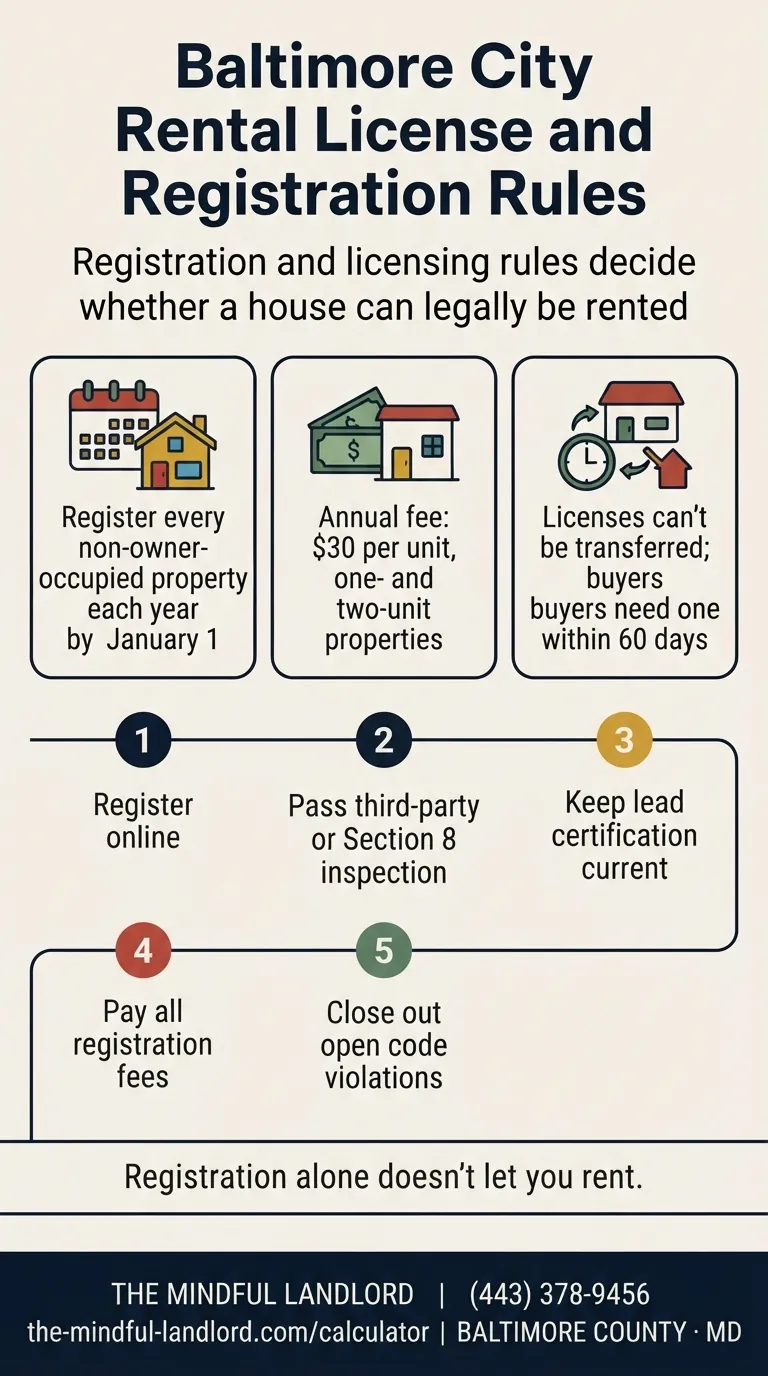
Baltimore City Code Article 13, § 4-8 sets the annual registration fee at $30 per unit for one- and two-unit properties. Every non-owner-occupied property in the city has to be registered each year by January 1, whether it’s rented or sitting empty. A transfer triggers a new registration within 10 days. As a hypothetical, a vacant rowhouse in Remington that you bought to renovate still needs its registration while the drywall is going up.
Registration alone doesn’t let you rent. Non-owner-occupied rentals also need a license, and the city requires online registration, a passing third-party inspection or a Section 8 inspection for each unit, current lead certification for each unit, all registration fees paid and no open code violations.
You pay for the third-party inspection, and it has to be done by a state-licensed home inspector registered with the Housing Commissioner. The inspection can’t be dated more than 90 days before your application. In buildings with nine or fewer units, every unit gets inspected. When you apply, you also have to give each resident a copy of the inspection report. We walk through what inspectors check, room by room, in our Baltimore City rental inspection guide.
Maryland requires rentals built before 1978 to be registered with the Maryland Department of the Environment unless certified lead-free, and that’s separate from the city’s registration fee. Assume your rowhouse is in that group until the deed history or a lead-free certificate says otherwise. For property outside the city, see our Baltimore County rental license guide.
Questions about your own property? Call The Mindful Landlord at (443) 378-9456. You can also price your rental with our free calculator: https://the-mindful-landlord.com/calculator.
Recent rule changes
The Strengthening Renters’ Safety Act took effect January 1, 2026. Licenses can no longer be transferred, which means a buyer needs a new license within 60 days of the transfer.
The ordinance also requires owners of high-violation properties to post the rental license number in common areas, in leases and in ads. Leaving it off is a $250 citation. If you fall in that group, add the number to every template once.
The ordinance creates “priority dwellings,” meaning rentals with 20 or more units that met two or more violation-based criteria in the prior year. DHCD inspects the worst of them at least twice a year and can deny, suspend or revoke their licenses. The 2025 list was amended on April 25, 2026.
At the state level, the Safe and Healthy Homes for All Act took effect July 1, 2026 and requires the state housing department to plan how to identify severe health and safety risk properties, publish that list and report by August 31, 2027. If DHCD has cited one of your properties recently, pull the open violations now and close them out, because an open code violation already keeps a license from issuing under the current rules.
What we’d do with a rowhouse in Hampden
Take a hypothetical. You own a pre-1978 rowhouse in Hampden, the tenant has given notice and a new tenant is lined up for next month.
Start with the old tenant. Pull the lease, the deposit receipt and your move-in photos the day notice arrives. After the walkthrough, get repair pricing in writing within a week.
Then the new tenant. Confirm your license hasn’t lapsed and, if you own a high-violation property, that the license number appears in the listing and the new lease. Because the house was built before 1978, confirm the MDE lead registration is current unless the house is certified lead-free, and that lead certification for the unit is in place before anyone moves in. If you’ve been holding off on a rent change, our post on how to raise rent on a Baltimore rental covers the notice side.
Last, give the new tenant the deposit receipt at signing and do your dated photo walk before the furniture arrives.
Questions people ask
Do I have to register a vacant house in Belair-Edison? Yes. Every non-owner-occupied property in Baltimore City must be registered each year whether or not it’s rented or occupied.
Can I keep the seller’s rental license after I buy? No. Licenses can’t be transferred, and the buyer needs a new license within 60 days of the transfer.
What happens if I miss the 45-day damage letter? You lose the right to withhold any part of the deposit for damages. If you keep it anyway, you’re exposed to up to three times the withheld amount plus attorney’s fees.
If you’d rather hand this off, call (443) 378-9456 or tell us about your property at https://the-mindful-landlord.com/contact. The free calculator at https://the-mindful-landlord.com/calculator shows what management would look like for your unit.