The city license comes before the listing

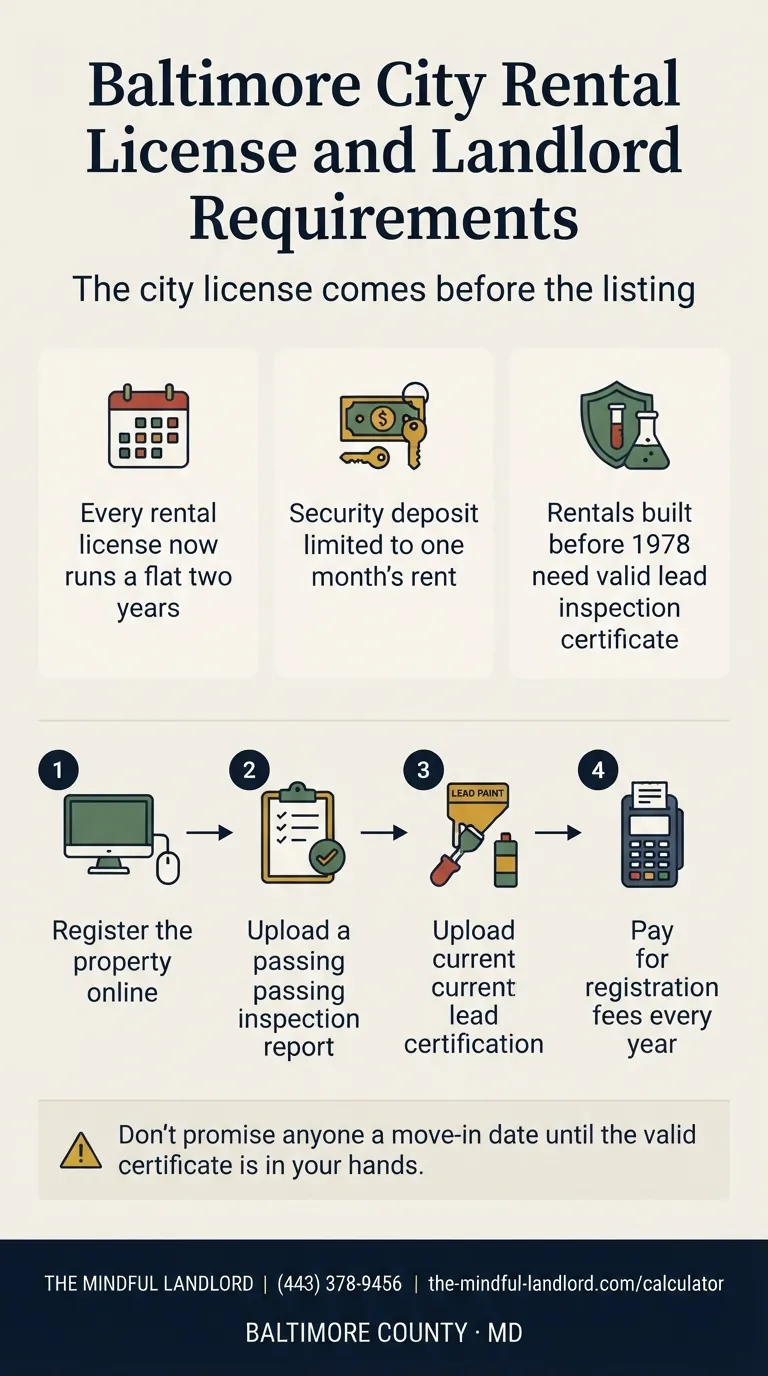
Baltimore City Code Art. 13 § 5-4 generally makes it unlawful to rent out a dwelling, advertise it for rent or take rent on it unless the Housing Commissioner has issued you a license that’s in effect. That license has to be valid both while the unit is being offered and while someone lives there. So the clock starts the day you list, and an unlicensed vacant house with an ad running is already out of compliance.
To get the license, you register the property online. You also upload a passing report from an inspector who holds a Maryland license and is on the City’s registered list (a passing Section 8 inspection also works), along with current lead certification for each unit. Registration fees come due every year.
The city’s licensing overhaul took effect January 1, 2026, and every rental license now runs a flat two years instead of the old tiered terms. A license no longer moves with the deed, so a buyer of a rental has to get one in their own name. Failing to post a license can cost you a $250 citation.
For rentals across the county line, our Baltimore County management page covers how we handle that side.
Lead certificates on older rowhouses
Unless your rental carries lead-free certification, if it was built before 1978 it has to be registered with the Maryland Department of the Environment, and every new tenancy needs a valid lead inspection certificate. Renewal is due by December 31. Rentals built after 1977, and properties with a passing Lead Free certificate, are exempt from registration. The state lead fee is separate from any city or county rental registration fee. Don’t promise anyone a move-in date until the valid certificate is in your hands.
The lease packet and the deposit
Real Property § 8-203 generally limits the security deposit to one month’s rent for the unit, however many people sign the lease. An exception covers certain tenants who get DHS utility assistance.
Within 30 days, the money has to be deposited, and one option is an interest-bearing account that holds nothing but security deposits, at a Maryland branch of a federally insured institution. Don’t park it in your operating account in the meantime. Under § 8-203.1, the tenant gets a written receipt spelling out the move-in and move-out inspection rights, you keep a copy for 2 years, and skipping the receipt means you owe the tenant $25.
Interest on the deposit runs at 1.5% a year or the 1-year Treasury yield curve rate from the year’s first business day, whichever is higher. Interest accrues monthly and isn’t compounded. To keep any of the deposit for damage, you have to mail the tenant a list of damages with an itemized statement of costs by first-class mail; otherwise you lose the right to withhold for damages entirely. Keep money back without a reasonable basis and the tenant can sue for triple what you kept, plus reasonable attorney’s fees.
Every lease also needs an unedited copy of the most recent Maryland Tenants’ Bill of Rights attached, currently the version dated October 1, 2026.
Questions about your own property? Call The Mindful Landlord at (443) 378-9456. You can also price your rental with our free calculator: https://the-mindful-landlord.com/calculator.
Taking a tenant to District Court
The Renters’ Rights and Stabilization Act raised filing fees and generally bars passing them on to tenants.
The court won’t issue a warrant of restitution until 7 days after judgment, up from 4 before the 2024 act.
If you want a fixed-term or month-to-month tenant out, you owe them written notice.
What we’d do in your position
Build one folder per unit.
Next, put dates on a calendar. The license now runs two years.
At move-out, photograph the unit the day the keys come back. We’d write the itemized list with invoices or estimates attached and mail it first-class within two weeks, keeping the certificate of mailing. The refund and interest go in the same envelope.
Check your screening against the laws that took effect October 1, 2026. If you have 5 or more units, criminal history generally waits until after a conditional offer. Income and credit screening of subsidy users is restricted too. Some owners must offer to report on-time rent to a credit bureau, and existing leases need the offer by January 1, 2027.
If you’d rather hand the calendar off, our Baltimore property management fee guide compares what managers charge. Full management with us is a flat 10% of rent collected.
Questions people ask
Is there a cap on rent increases in Baltimore City? Our post on how to raise rent on a Baltimore rental covers the notice periods.
Does Baltimore have a just-cause eviction law? A 2026 state bill would have allowed counties to pass good-cause eviction laws, but it has shown no movement since its Senate hearing on February 12, 2026.
Can I charge the tenant my eviction filing fee? Generally no, since the 2024 act bars passing filing fees on to tenants.
How much notice does a city tenant have to give me? The current Tenants’ Bill of Rights says Baltimore City tenants need give only 30 days’ notice to end any tenancy, unless the lease requires more.
If you’d rather hand this off, call (443) 378-9456 or tell us about your property at https://the-mindful-landlord.com/contact. The free calculator at https://the-mindful-landlord.com/calculator shows what management would look like for your unit.