Most deposit fights in Maryland aren’t lost on the damage. They’re lost on the paperwork. A landlord walks into a rowhouse after move-out, sees a burned countertop and a carpet that needs replacing, and assumes the deposit covers it. Then the list goes out late, or it has no receipts behind it, and the right to keep any of the money is gone. The rules live in § 8-203 of the Real Property Article, and they reward the landlord who builds a record from the first day of the lease. This post walks through that record in the order you’ll need it.

What the deposit can and can’t pay for
Start with the limits, because they decide what’s worth photographing. Under § 8-203(f), a deposit may be withheld for unpaid rent, for damage due to breach of lease, or for damage by the tenant or the tenant’s family, agents, employees, guests or invitees in excess of ordinary wear and tear to the premises, common areas, major appliances and furnishings the landlord owns.
That phrase, in excess of ordinary wear and tear, is where every dispute lands. The statute doesn’t define it, so your documentation has to carry the argument. Faded paint in a sunny front room after several years is the life of the paint. A hole kicked through a bedroom door is not. In the District Court on Fayette Street, the landlord who shows the condition at move-in next to the condition at move-out is the one who gets to keep the money.
The deposit also isn’t a penalty. The statute says it is not liquidated damages and may not be forfeited for a breach except in the amount you were actually damaged. So the claim is always the real cost of the repair, never a round number.
The receipt sets up every claim you’ll make later
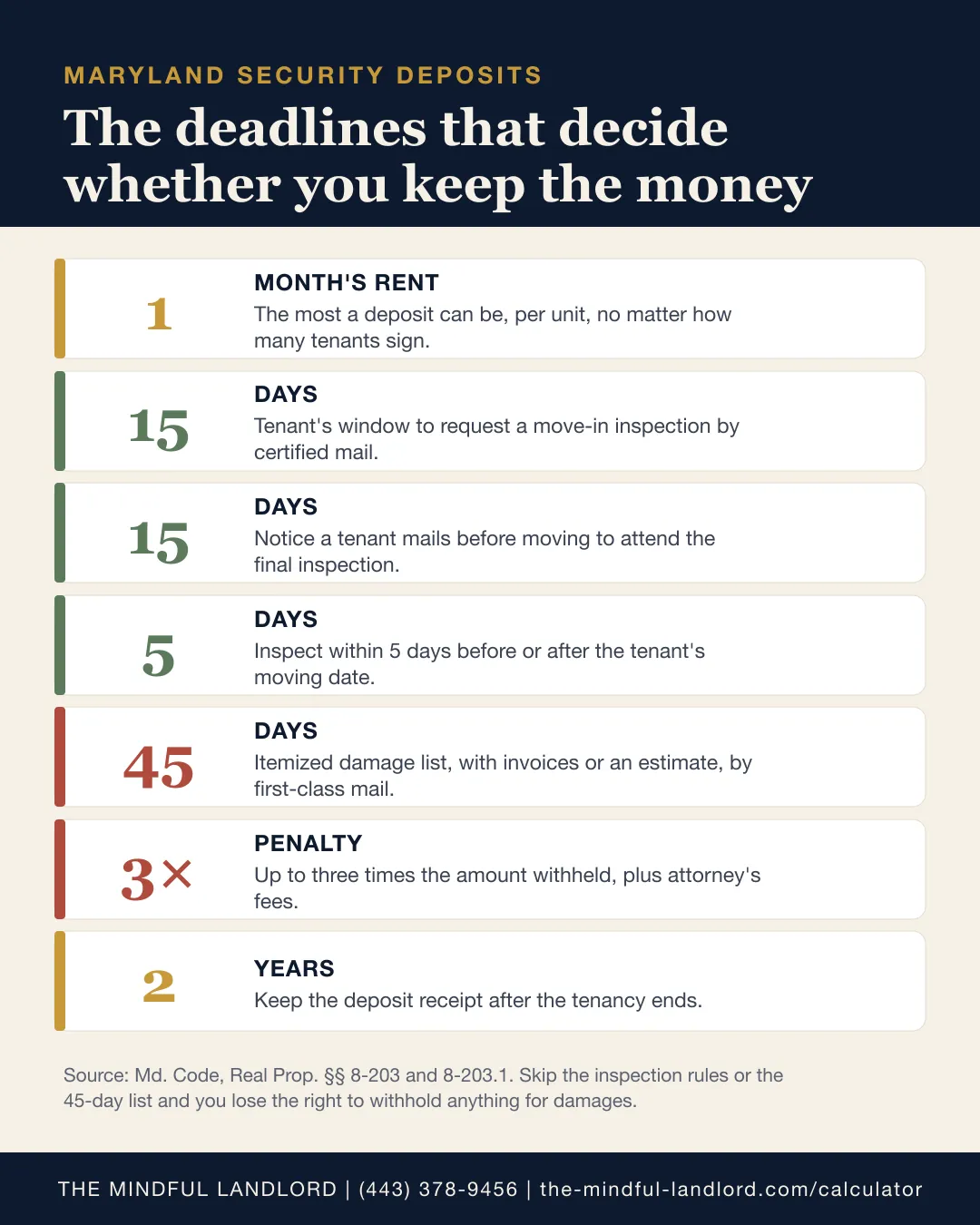
Documentation begins before the tenant has a key. Maryland caps the deposit at the equivalent of 1 month’s rent per dwelling unit, regardless of the number of tenants. You must give the tenant a receipt for it, and the receipt has to be included in the written lease.
Section 8-203.1 spells out what that receipt tells the tenant: the right to a move-in inspection in the tenant’s presence if requested by certified mail within 15 days of occupancy, the right to be present at the move-out inspection, your obligation to inspect within 5 days before or after the stated moving date, the right to receive the list of charges by first-class mail within 45 days after the tenancy ends, and a statement that breaking the deposit law can make you liable for up to 3 times the amount withheld, plus reasonable attorney’s fees. Keep a copy of the receipt for 2 years after the tenancy ends. If you never give one, you owe the tenant $25.
Our walkthrough of required Baltimore City lease clauses shows where the receipt sits in the lease. For this post, the point is simpler. The receipt is the first page of your damage file.
Building the move-in record in a Remington rowhouse or anywhere else
The law gives the tenant the right to ask for a move-in inspection. It doesn’t stop you from doing one every time, and you should. A move-in record is the only way to prove that the scratch on the hardwood in a Remington back bedroom wasn’t already there.
Here’s the routine that holds up:
- Walk every room in the same order each time: front door, living room, kitchen, each bedroom, each bathroom, basement, exterior.
- Take wide photos of each wall, then close-ups of anything worn, chipped or stained. Put a tape measure in the close-ups so size is obvious.
- Film a slow walk-through on your phone with the date visible in the file details. Say the room names out loud as you go.
- Write a short condition sheet: room, item, condition, notes. Have the tenant sign and date it, and give them a copy.
- Photograph the appliances inside and out, with model labels showing.
Store all of it in one folder named for the address and the lease start date. When the tenancy ends in three years, you’ll want to find it in a minute, not an afternoon.
The move-out inspection under § 8-203(f)
A tenant who wants to attend the final inspection has to ask for it the right way. Under § 8-203(f), the tenant notifies you by certified mail of the intention to move, the date of moving and the new address, mailed at least 15 days before the move. Once you receive that notice, you notify the tenant by certified mail of the time and date of the inspection, and the inspection has to happen within five days before or five days after the moving date in the tenant’s notice.
This is the step that sinks landlords who don’t read their mail. The statute says failure to comply with this requirement forfeits the right to withhold any part of the deposit for damages. A certified letter from the tenant sitting unopened on the counter can cost you the whole claim.
When you do the inspection, repeat the move-in routine in the same order, from the same angles. Matching photos side by side are worth more than any description you can write. If the tenant comes, walk the rooms together and note anything you agree on. If they don’t, film it anyway.
The itemized list that has to reach the tenant in 45 days
Within 45 days after the tenancy ends, you return the deposit with interest, less any damages rightfully withheld. If you keep any part of it, § 8-203(g) requires you to send, by first-class mail to the tenant’s last known address, a written list of the damages claimed together with an itemized statement of the cost incurred. Miss that and you forfeit the right to withhold any part of the deposit for damages.
The interest is part of the math. It accrues at the daily U.S. Treasury yield curve rate for 1 year, as of the first business day of each year, or 1.5% a year, whichever is greater. No interest is due unless you held the deposit at least 6 months, none is due for a partial month, and it’s payable only on deposits of $50 or more.
Write the list one line per item. Room, what was damaged, what was done to fix it, what it cost. “Bedroom 2, door with hole through lower panel, door replaced and painted, $210” tells a judge everything. “Damages, $900” tells a judge nothing.
Backing each charge with invoices or an estimate
The itemized statement has to include supporting documentation that identifies the materials or services provided. Under § 8-203(j), you can meet that with an estimate of the costs you’ll incur, which matters when the repair isn’t finished by day 45.
An estimate comes with two follow-up duties under § 8-203(k). When the repairs are done, you notify the tenant in writing and include a copy of the final invoice. If the actual cost came in below the estimate, you return the difference within 30 days after completing the repairs.
So the file for each charge should hold the before photo, the after photo, and either the invoice or the estimate followed by the invoice. If your own crew does the work, write up the materials and hours the same way a contractor would. A vague handwritten note invites a dispute. A dated invoice that names the item and the work closes one.
Keep this list in mind when you read the state’s rule against waivers: no provision of § 8-203 may be waived in any lease. A clause that says the tenant forfeits the deposit for any damage, or that shortens your deadlines, is unenforceable, so build your process around the statute rather than the lease.
When the claim goes wrong, and what it costs
The penalty is the reason to take all of this seriously. If you fail to return any part of the deposit, plus interest, within 45 days without a reasonable basis, the tenant has an action for up to threefold of the withheld amount, plus reasonable attorney’s fees. Overcharge the deposit at move-in and the tenant can recover up to 3 times the extra amount charged, with 2 years after the tenancy ends to bring that claim.
Two situations change the clock. If a tenant was evicted for breach of the lease or abandoned the unit before the tenancy ended, the tenant can demand the deposit by first-class mail within 45 days, giving a new address. You then have 45 days from receiving that notice to send the itemized list and return what’s left. Our guide to the Maryland eviction process covers how that kind of tenancy ends.
Before you send any list, run the numbers. A $300 claim that needs a weekend of photos, a contractor visit and a possible day in court may not be worth fighting if the tenant disputes it. Our free rental calculator at https://the-mindful-landlord.com/calculator helps you see what a vacancy and a turnover really cost you, or call (443) 378-9456 and talk it through.
Questions people ask
Can I keep the deposit for repainting after a tenant moves out? Only for damage beyond ordinary wear and tear. Paint that’s simply aged usually isn’t deductible; walls that need patching from holes, burns or marks the tenant caused can be, with a photo and an invoice for each.
What if the repairs aren’t finished within 45 days? Send the itemized list on time with an estimate as the supporting document. When the work is done, send the tenant the final invoice in writing, and refund anything the estimate overstated within 30 days.
Do I have to inspect within a set window if the tenant asks to be there? Yes. Once you get the tenant’s certified-mail notice, you tell them the inspection date by certified mail, and the inspection has to fall within five days before or after their moving date.
How long do I keep the deposit paperwork? Keep the receipt for 2 years after the tenancy ends, and keep the photos, list and invoices at least that long, since a tenant can sue over an excessive deposit within 2 years after the tenancy ends.
If you’d rather hand this off, call (443) 378-9456 or tell us about your property at https://the-mindful-landlord.com/contact. The free calculator at https://the-mindful-landlord.com/calculator shows what management would look like for your unit.