We manage 50+ properties across Baltimore City and Baltimore County, so what follows is the paperwork we deal with every month, written in the order it tends to come up. Use it as a checklist, and confirm each item with the agency involved or your attorney before you act on it.

How Rent Court Works Inside the City
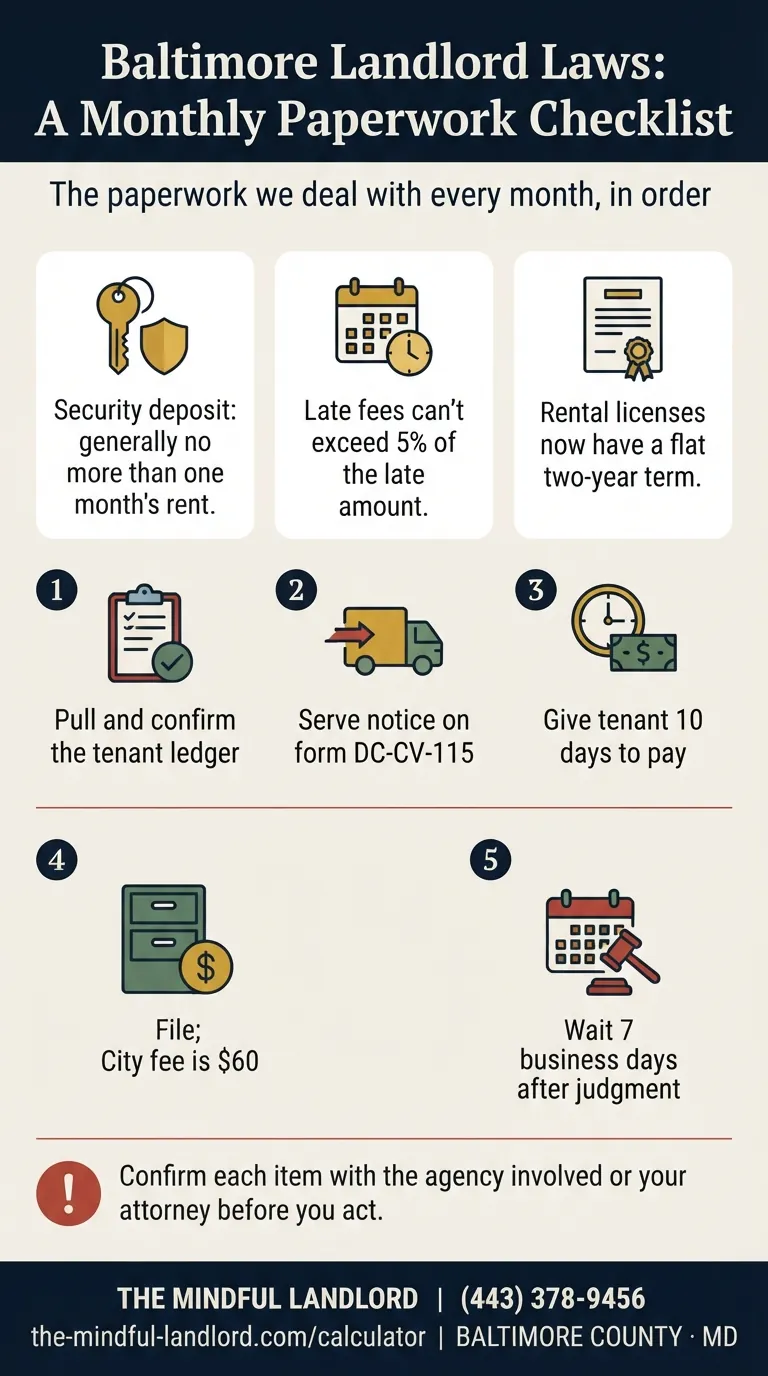
You give the tenant a notice of intent on form DC-CV-115, and it has to state the rent due and give the tenant 10 days to pay. Before you fill it out, pull the tenant ledger and confirm the balance matches what you plan to write. Keep a copy of the notice and a note of how and when you delivered it.
The filing fee for a failure-to-pay-rent case is $60 in Baltimore City.
In failure-to-pay-rent cases, eviction can’t begin until 7 business days after the judgment for possession. The landlord has to tell the tenant the eviction date ahead of time. Hypothetical example: a tenant falls behind, you serve the notice, the notice period passes without payment, and you file. Keep every step in one folder: the ledger, the notice, proof of delivery, the filing receipt, the judgment, and your eviction-date notice to the tenant. If the tenant offers a partial payment midway, ask the court clerk or your attorney how accepting it could affect the case before you deposit it.
The License Comes Before the Lawsuit
Baltimore City Code Article 13, § 5-4 bars renting or offering to rent without a current license, except for dwellings owned and operated by the Housing Authority of Baltimore City. With the same exception, it also bars charging or collecting rent unless you were licensed both when the unit was offered and when it was occupied.
Registration comes first. Every non-owner-occupied property in the City has to be registered every year, whether or not it’s rented, and registration is due by January 1. Calendar it in December.
For multifamily dwellings, the MFD chart sets how many units must be inspected. The license application also requires current lead certification information for each unit.
The Strengthening Renters’ Safety Act took effect January 1, 2026, and replaced the old tiered system with a flat two-year term for every rental license. Licenses can’t be transferred anymore, so a buyer needs a new license. If you’re buying a tenant-occupied house, start the license application at closing. Under the same Act, owners of high-violation properties have to show their rental license number in common areas, leases and ads, and failing to post it is a $250 citation. Put the number on the first page of your lease template and in the opening line of every listing you write. Then a turnover can’t slip past it. The Act also created “priority dwellings,” which are rentals with 20 or more units that met at least two violation criteria in the prior year. The ones selected as high-violation priority dwellings get priority inspections at least twice a year and can have their license denied, suspended or revoked. If you own a larger building, ask your manager for a quarterly list of open violations and close the oldest ones first.
Security Deposits
A landlord generally can’t charge a security deposit of more than one month’s rent per unit. There’s a limited exception tied to DHS utility assistance. At move-in, write the amount, the date received, and the account it went into on the lease file.
Don’t run deposits through your operating account, even briefly. Keep them separate.
If you withhold without a reasonable basis, the tenant can sue for up to three times the amount withheld plus reasonable attorney’s fees. If you don’t mail an itemized list of damages within the required time, you lose the right to withhold anything for damages. Take photos the day the keys come back. Hypothetical example: a tenant moves out leaving a stained carpet and a broken blind. You’d photograph both, compare them against the move-in photos and condition report, get a written repair estimate, and mail the itemized list with the estimate attached before keeping any of the deposit.
Questions about your own property? Call The Mindful Landlord at (443) 378-9456. You can also price your rental with our free calculator: https://the-mindful-landlord.com/calculator.
Older Rowhouses, Lead Paint and Summer Cooling
SB 12 requires covered rental units to have air conditioning that can cool the unit to 80°F or lower from June 1 to September 30. Covered units include those built after June 1, 2026. Our licensed general contractor on staff handles these repairs with no maintenance markups, which matters when a compressor fails in July. Each spring, test every system with a thermometer and book servicing before the first hot week instead of waiting for a breakdown.
What Annapolis Changed for Baltimore Leases
The Fair Chance Housing Act took effect October 1, 2026. It applies to providers with five or more units who run criminal background checks, excluding owner-occupied rental units. Those landlords generally have to make a conditional offer before checking criminal history, and violations carry penalties. Reorder your screening steps. Hypothetically, that order could be: application, income and rental history review, a written conditional offer, then the criminal background check. Ask your attorney to review your written criteria and offer letter. Our post on what can disqualify a tenant in Maryland covers the order of the screening steps.
DHCD published proposed regulations for on-time rent reporting in the Maryland Register on October 16, 2026, with comments due by November 16, 2026. If you plan to comment, read the full proposed text first. Either way, watch for the final version before changing your process.
The Tenants’ Bill of Rights says late fees apply only to the unpaid part of the rent and can’t exceed 5% of the late amount.
HB 774 of 2026 would have let counties adopt good-cause eviction for certain landlords. It passed the House 84-41 but stopped in Senate Rules, so it did not become law.
Crossing the Line Into Baltimore County
We run City and county properties under one flat fee of 10% of rent collected, and our portfolio had zero rent escrow losses in 2025. If your properties are on the county side, our Baltimore County management page explains how we handle owners there. If you own on both sides of the line, keep a separate checklist for each and confirm every step with the county before assuming the City process carries over.
If you’d rather hand this off, call (443) 378-9456 or tell us about your property at https://the-mindful-landlord.com/contact. The free calculator at https://the-mindful-landlord.com/calculator shows what management would look like for your unit.