In Maryland, landlords can legally deny applicants for insufficient income, poor credit, prior evictions, or qualifying criminal convictions. What most Baltimore City landlords don’t know: the city layers additional rules on top of state law — a 3-year criminal lookback limit, a ban on using arrest records, and a prohibition on rejecting Section 8 voucher holders. Get any of these wrong and you’re facing a Fair Housing complaint. Get them right in writing and you’re protected.
What Maryland Law Actually Allows Landlords to Screen For
Income, credit, rental history, and employment: the legal baseline
Maryland does not restrict landlords from running credit checks, criminal background checks, rental history verification, or income checks. The baseline screening criteria that courts have consistently upheld:
- Income ratio: 2.5x to 3x monthly rent. A $1,750/month Hampden unit means $4,375–$5,250/month in verifiable gross income.
- Credit score floor: Landlords set their own minimum, typically 580–650+ for Baltimore rentals.
- No prior evictions: Most policies exclude applicants with any eviction judgment in the last 3–5 years.
- Employment verification: Consistent employment or documented alternative income.
- Rental history: Prior landlord references, no pattern of lease violations or property damage.
All of this is legal. The problem isn’t the criteria — it’s the absence of documentation. Oral decisions, inconsistent application, and ad-hoc exceptions are where Fair Housing exposure lives.
Why written screening criteria are your first Fair Housing shield
A Fair Housing complaint will immediately ask: how did you make this decision, and did you apply the same standard to everyone? If the answer lives only in your head, you lose the documentation battle before the facts are reviewed. Written criteria applied identically to every applicant is the only reliable defense.
The Restrictions Baltimore City Adds That Most Landlords Don’t Know
State law sets the floor. Baltimore City ordinance goes further — and these are the rules that catch landlords off guard.
Baltimore City Fair Chance Housing law: the 3-year criminal lookback limit
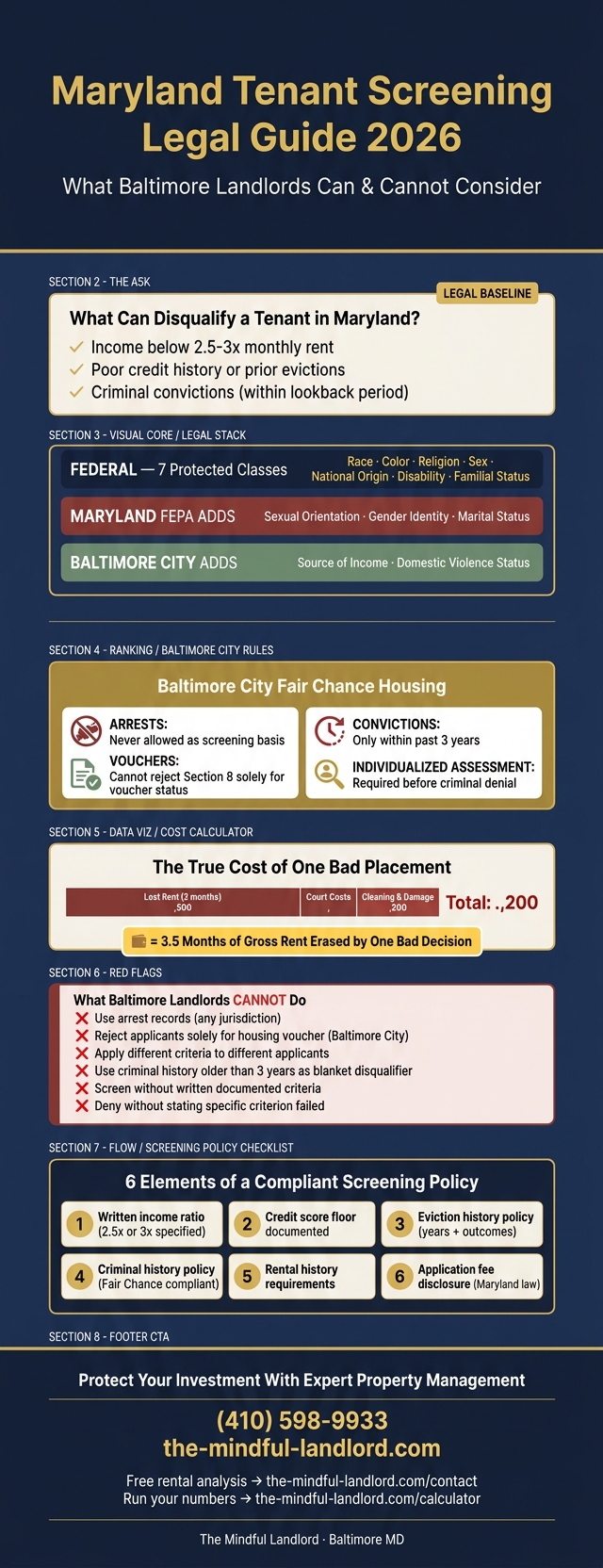
Baltimore City’s Fair Chance Housing Ordinance (enacted 2020) places three specific limits on criminal screening for properties within city limits:
- No blanket disqualification: An individualized assessment is required before any denial based on criminal history.
- 3-year lookback limit: For most offenses, only convictions within the past 3 years can factor into the decision. A 2019 conviction cannot be a blanket disqualifier in 2026.
- Arrests are always prohibited: An arrest without conviction — regardless of charge or recency — cannot be used in any screening decision.
Source-of-income protection: why you cannot reject Section 8 in Baltimore City
Baltimore City prohibits rejecting applicants solely because of their source of income, including Housing Choice Vouchers. A landlord who declines a voucher holder while accepting otherwise identical applicants without one is violating city ordinance. This does not make income criteria disappear — if an applicant doesn’t meet your documented income ratio counting both the voucher and tenant-share, you can decline on income grounds. The voucher itself cannot be the reason. This protection applies within Baltimore City limits only.
Arrest records: always prohibited statewide
Under Maryland’s Equal Opportunity in Housing law, arrest records are prohibited screening criteria statewide — not just in Baltimore City. An arrest without a conviction cannot be used anywhere in Maryland.
Protected Classes: The Maryland and Baltimore City Stack
Federal Fair Housing Act: the 7 protected classes
Race, color, national origin, religion, sex, disability, and familial status. Penalties for a first-time violation start at $21,663 in federal civil fines. Disparate impact — where a neutral-looking criterion disproportionately affects a protected class — creates liability even without discriminatory intent.
Maryland FEPA and Baltimore City additions
Maryland’s Fair Employment and Housing Act adds sexual orientation, gender identity, and marital status. Baltimore City further adds source of income and domestic violence status — meaning a landlord cannot use an applicant’s status as a domestic violence survivor as grounds for denial or to require a higher deposit.
The practical rule: run every applicant through the same documented checklist. Consistency is the protection.
What a Bad Placement Really Costs a Baltimore Landlord
The full accounting for a Hampden unit at $1,750/month
Landlord skips income verification to fill a vacancy quickly. Month 3: tenant stops paying. Maryland eviction timeline: 6–8 weeks from filing to writ. The cost breakdown:
- Lost rent (2 months): $3,500
- Court filing and attorney costs: $500
- Cleaning, damage, and turnover: $2,200
- Total: $6,200 — 3.5 months of gross rent erased by one bad screening decision
With 98% occupancy across our portfolio, TML’s screening rigor isn’t a formality — it’s the direct driver of portfolio returns.
Building a Maryland-Compliant Written Screening Policy
The 6 elements every Baltimore landlord’s written criteria must include
- Minimum income ratio — specify 2.5x or 3x in writing.
- Credit score floor — state the minimum and any documented exceptions.
- Eviction history lookback — define the period and what triggers disqualification.
- Criminal history policy (Baltimore City) — individualized assessment, 3-year lookback, no arrests.
- Rental history requirements — prior landlord references and lease violation standards.
- Application fee disclosure — required under Maryland law before collection.
Denial letters and consistent application
Every denial must reference the specific criterion not met. “Did not meet the income requirement of 3x monthly rent” is defensible. “Not a good fit” is not. Document each decision with the criteria applied. If you approved a 580 credit score last month, you cannot deny a 610 this month without a documented reason tied to a different criterion.
How Professional Property Management Handles Tenant Screening in Maryland
TML’s 21-day placement guarantee: the screening rigor behind it
TML’s 21-day tenant placement guarantee is backed by a screening pipeline refined over 20+ years across 50+ properties in Baltimore City and County. We run the full criteria, document every decision, and place tenants who stay — which is why we maintain a 98% occupancy rate. With $0 vacancy fees, we have no financial incentive to rush a bad placement.
The documentation trail that protects you from discrimination claims
Every application we process generates a file: income documentation, credit report, rental history references, a criminal background check within Baltimore City Fair Chance Housing guidelines, and a written decision memo. If a denied applicant files a complaint months later, the file is already built. Call (443) 378-9456 or visit the-mindful-landlord.com/contact to learn how we manage screening for your Baltimore property. Run your property’s numbers first at the-mindful-landlord.com/calculator.
Frequently Asked Questions
What can disqualify you from renting an apartment in Maryland?
Insufficient income (below 2.5–3x monthly rent), poor credit, prior evictions, or criminal convictions within the lookback period. In Baltimore City, arrests are prohibited and convictions older than 3 years cannot serve as a blanket disqualifier.
Can Baltimore landlords reject Section 8 tenants?
No. Baltimore City’s source-of-income protection prohibits denying tenants solely because they hold a housing voucher. Income, credit, and rental history criteria still apply — but the voucher itself cannot be the reason for rejection.
Can a landlord check criminal history in Maryland?
Yes throughout most of Maryland. In Baltimore City, the Fair Chance Housing law limits screening to convictions (not arrests) within the past 3 years for most offenses, and requires an individualized assessment before any denial.
What credit score do landlords require in Maryland?
Maryland sets no state minimum. Landlords may set their own threshold — typically 580–650+ in Baltimore — in written screening criteria, applied consistently to every applicant.
What happens if a Baltimore landlord violates Fair Housing rules?
Federal civil penalties up to $21,663 for a first offense, plus potential private lawsuits with actual and punitive damages. Undocumented screening decisions are the highest-risk exposure.