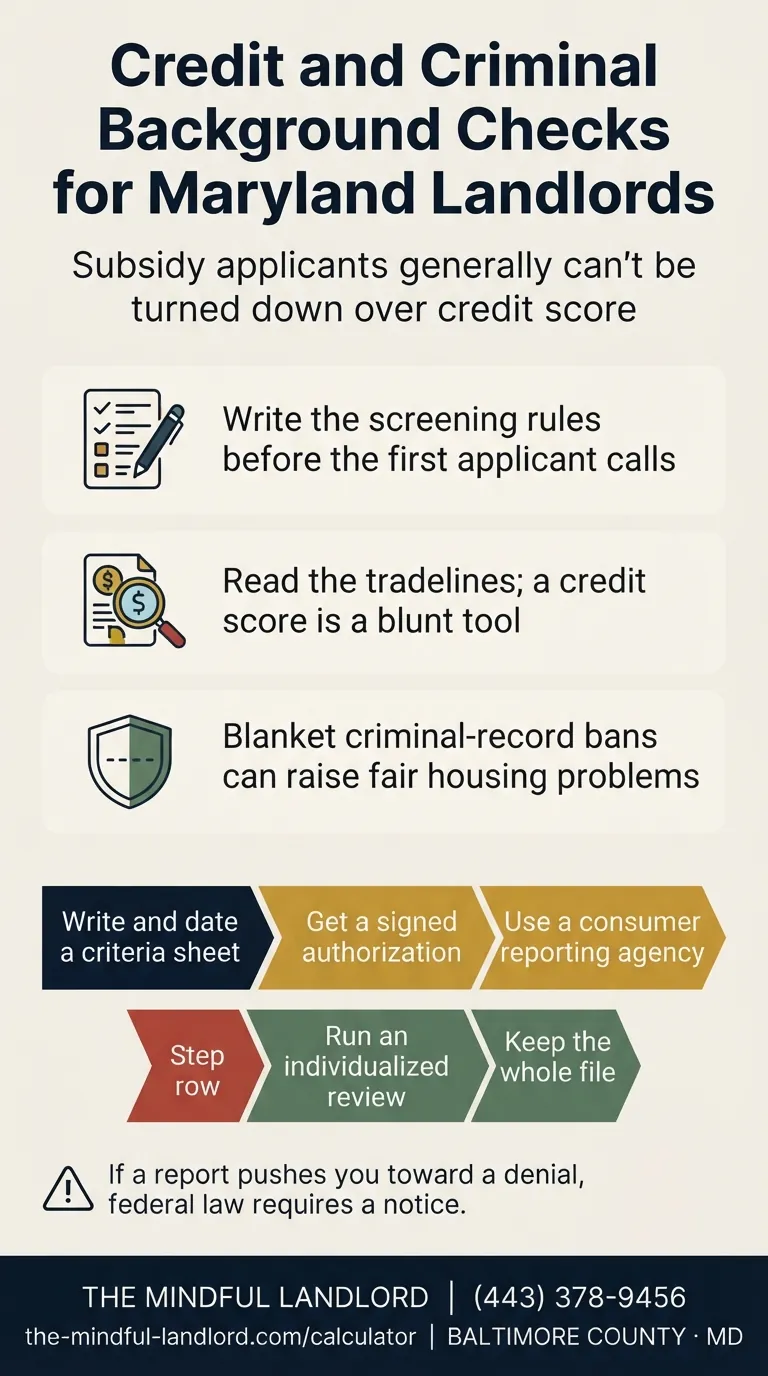
A credit and criminal background check for landlords in Maryland should run through a consumer reporting agency, use a signed authorization from the applicant, and measure every applicant against criteria you put on paper before advertising the unit. If anything in a report pushes you toward a denial, federal law requires a notice.

Write the screening rules before the first applicant calls
One applicant gets a pass on a thin credit file, the next one doesn’t, and now you’re explaining the difference to an investigator. A one-page criteria sheet fixes most of that. Put down your income test, the credit problems you’ll count, which criminal convictions you’ll review and how far back you’ll look, and what you need to hear from prior landlords. Date it. Drop a copy in every applicant file, and leave it alone until the unit is rented.
Fees belong on the sheet too. Pricing the fee at your actual screening cost is a sensible policy.
Decide ahead of time whether you’ll take reusable tenant screening reports. A reusable report is one the applicant pays a consumer reporting agency to prepare, and it has to contain a credit report, employment and income verification, rental history, and 7 years of eviction history. Its criminal history lookback dropped from 7 years to 3.
Reading a credit report without tripping over voucher rules
A credit score is a blunt tool for a rental decision. A 590 built on old medical collections tells you something very different from a 590 built on an unpaid balance to a prior landlord and a utility shutoff. Read the tradelines. Money owed to past landlords, utility collections, and landlord judgments bear directly on whether this person will pay you each month, while student loans in deferment and hospital bills mostly don’t. If your criteria say you’ll look at housing-related debt over a set number of years, apply exactly that and jot a short note in the file about what you found.
When the applicant will cover rent with an income-based housing subsidy, you generally can’t turn them down over income, a low or missing credit score, or poor credit from a stretch when they weren’t receiving a subsidy. You’re still allowed to confirm they can cover the part of the rent the subsidy leaves to them. References are fair game, as is any record of lease violations, unpaid utilities, nuisance, or property damage.
Criminal history under the new state rules
The Maryland Fair Chance Housing Act adds a new Subtitle 2A to Title 8 of the Real Property Article covering how landlords may use criminal history in screening.
DHCD’s Office of Tenant and Landlord Affairs released three optional model forms on October 6, 2026: a pre-application notice, a denial letter, and an individualized assessment worksheet. Using them is optional, and compliant versions you write yourself are allowed. Unless a lawyer drafts your forms, go with the state’s.
On August 31, 2026, the Maryland Attorney General’s Civil Rights Division settled with Bay Management Group over ads using phrases like “clean criminal background check”. The company agreed to pull the language, adopt an approved individualized-assessment policy, waive application fees for certain applicants it had previously turned down, and pay civil penalties. The AG’s statement also says blanket bans on renting to people with criminal records may violate state and federal fair housing law.
Take a hypothetical owner with a two-unit building in Highlandtown and nothing else. A “no felonies, period” rule still carries fair housing risk under the AG’s reading. A defensible review asks what the conviction was, how it relates to living in your building and paying rent, how much time has passed, and what the person has done since.
For landlords with five or more units, and outside owner-occupied units, a landlord’s decision to rent to someone with a criminal history, or to skip a criminal check altogether, can’t be the basis of a claim against the landlord. So in a hypothetical where you’re a covered landlord and approve an applicant with an old conviction for a unit that isn’t owner-occupied, that approval can’t itself be grounds for a claim against you.
If you’d rather hand this off, call (443) 378-9456 or tell us about your property at https://the-mindful-landlord.com/contact. The free calculator at https://the-mindful-landlord.com/calculator shows what management would look like for your unit.
Eviction records and what a filing tells you
Every reusable report includes eviction history.
Ask the applicant about anything you see, then call the prior landlord and ask how the case ended.
A bill that would have required landlords to provide certain written disclosures before taking a fee passed the House 96-36 but is still sitting in the Senate and isn’t law. Sharing your criteria up front costs you nothing now: post your criteria with the listing, and give applicants a printed copy before you take their money.
Denial letters, file retention, and when to bring in help
Adverse action based on anything in a credit or background report triggers a notice, which can be oral, written, or electronic. That notice has to give the reporting agency’s name, address, and phone number, state that the agency didn’t make the decision, and tell the applicant they can get a free copy of the report and dispute anything wrong in it. Ask your screening vendor for its template.
Keep the whole file for every applicant, approved or denied. That means the criteria sheet in effect at the time, the signed authorization, the report, your notes, the assessment worksheet if you used one, and a copy of any denial notice. Organize it so you can pull any applicant’s folder by property address and application date. A labeled banker’s box works fine if that’s your system.
Handling this yourself makes sense with a handful of units, applicants with ordinary histories, and time to read every report line by line. Voucher-heavy submarkets, older records, and several vacancies at once all raise the odds of an inconsistent call. The Mindful Landlord screens for 50+ properties across Baltimore City and Baltimore County out of our office on West Redwood Street, and you can see how our tenant placement process works if you’d like to hand screening off. If you keep it in-house, have someone else read your criteria sheet and denial letter before the next vacancy.
Questions people ask
Can I put “no criminal record” or “clean background” in my listing? The Attorney General’s Bay Management Group settlement went after ad phrases like “clean criminal background check”. If you’re covered by the Fair Chance Housing Act, the state’s pre-application notice is an optional model, and compliant versions you write yourself are allowed.
How much can I charge for an application fee? Charge what your screening vendor bills you per applicant and keep the invoice in the file.
Does the Fair Chance Housing Act apply if I own one rowhouse in Pigtown? Blanket criminal-record bans can raise fair housing problems, so run an individualized review.
Own a rental in Baltimore City or Baltimore County? Tell us about it at https://the-mindful-landlord.com/contact or call (443) 378-9456. To see the numbers first, use the free calculator at https://the-mindful-landlord.com/calculator.