In Maryland, a guest can legally become a tenant in as little as 30 days — and once that happens, you cannot remove them without a District Court eviction. Most Baltimore landlords don’t learn this until they’re already staring down an unauthorized occupant and a two-month timeline they didn’t plan for. This guide explains exactly when the guest-to-tenant line gets crossed, what triggers it, and what lease language prevents it.

Why This Question Matters More Than You Think
A Charles Village landlord rents a two-bedroom rowhouse to one tenant. Six months in, the tenant’s sibling moves in “temporarily.” Contributes $400 a month toward rent. The landlord looks the other way. Six months later the original tenant breaks the lease and leaves — and now the landlord has an unauthorized occupant with mail at the address, a key to the unit, and no intention of moving. That is not hypothetical. It repeats across Baltimore every year.
When a guest becomes a de facto tenant, your options narrow sharply. You cannot change the locks. You cannot remove their belongings. You cannot cut utilities. Maryland law treats all of those as illegal self-help, regardless of whether the person has a signed lease. Your only legal path is Baltimore District Court, and the average contested eviction runs 60 to 90 days from filing to writ of possession — according to estimates from Maryland Legal Aid and the Baltimore Community Law Center. There’s also an insurance angle: Baltimore City Code Article 13 requires rental registration based on the number of listed occupants. An undisclosed long-term occupant is a compliance gap that can affect your rental license and liability coverage if something goes wrong.
Maryland Law: The Official Line on Guest vs. Tenant
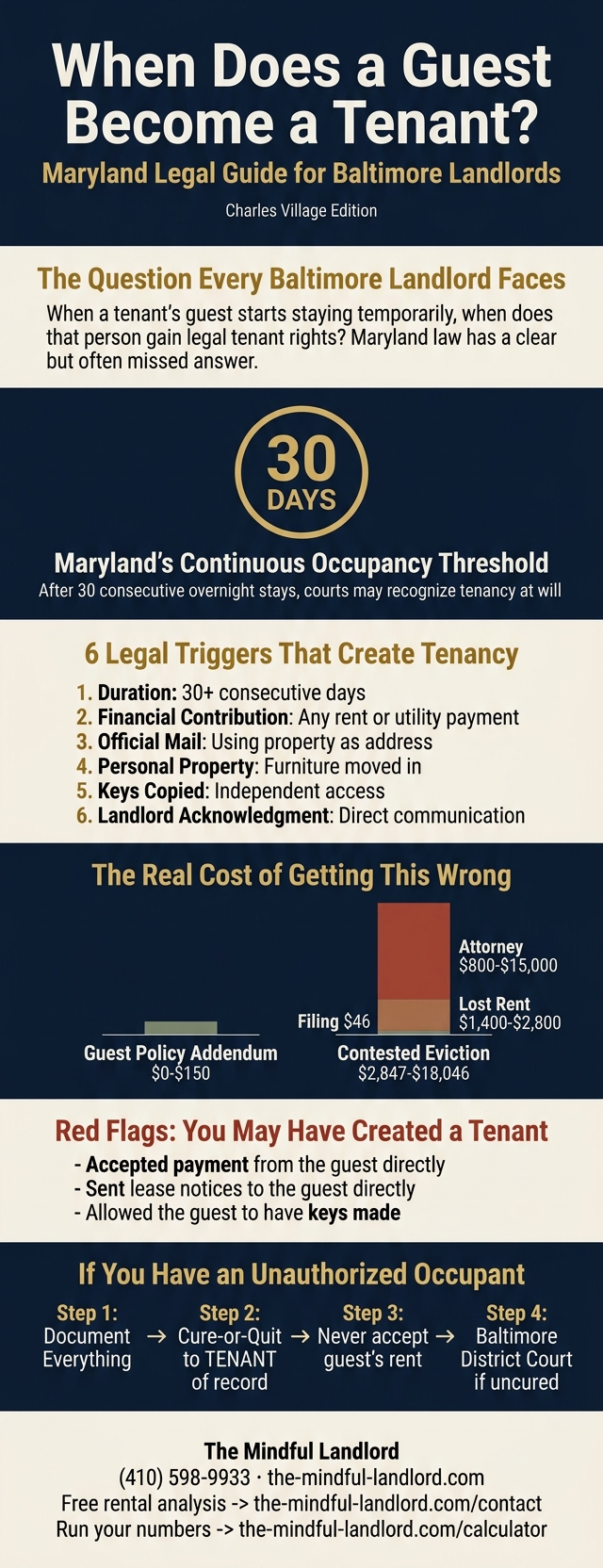
Maryland Real Property Article §8-401 establishes tenancy at will — the legal form of tenancy that applies when there is no written lease or when someone occupies a property with the owner’s knowledge but without a formal agreement. Maryland courts have consistently held that consistent overnight occupancy beyond 30 days, especially where the occupant contributes to household expenses, creates a de facto tenancy at will.
The 30-day benchmark is the most frequently cited standard, but the law looks at the totality of facts: duration, financial contribution, possession of keys, official use of the address, and whether the landlord acknowledged the person’s presence. Any one of those factors alone may not be enough — but several in combination will be.
The legal categories matter too. A guest can be asked to leave at any time. A licensee has permission to occupy but no possessory rights. A tenant can only be removed through formal process under Maryland Real Property Article §8-402. Misclassifying a licensee as a “guest” and acting accordingly is an illegal eviction claim waiting to happen.
The Six Triggers That Turn a Guest Into a Tenant
No single factor is automatically decisive, but each one materially strengthens an unauthorized occupant’s claim to tenancy. Multiple overlapping triggers make the case much stronger:
- Duration past 30 consecutive days. The baseline. Daily occupancy for more than 30 days triggers Maryland’s tenancy-at-will analysis with or without a lease.
- Financial contribution. Paying any portion of rent or utilities — even indirectly through the tenant — begins to establish a financial stake. If the payment reaches you directly, you’ve implicitly acknowledged the occupancy.
- Official use of the address. Receiving mail, updating a driver’s license, registering to vote — each is a public assertion of residency that courts treat as evidence.
- Moving personal property in. Furniture, a bed, a dresser. These signal permanence that a visiting guest does not have.
- Having keys copied. A copied key demonstrates autonomous access the original tenant cannot revoke unilaterally. Courts notice this detail.
- Landlord acknowledgment. This is the trigger landlords create themselves. Texting the guest about a maintenance issue, accepting payment from them, or mentioning them in any lease-related communication is evidence of tenancy. Always route through the tenant of record.
What Your Numbers Actually Look Like
The Maryland Judiciary District Court Civil Fee Schedule sets the residential eviction filing fee at $46 — the cheapest part by far. Attorney fees for contested cases run $800 to $3,000. During the 60 to 90 days the case is pending, a Baltimore landlord collecting $1,800 per month is potentially losing $3,600 to $5,400 in rent plus any property damage. Total exposure on a single unauthorized-occupant dispute: $6,000 to $9,000.
Model your own exposure. Use The Mindful Landlord’s free Baltimore ROI Calculator to see exactly how a 60-day eviction delay hits your annual return on a specific unit. Enter your rent and occupancy rate and the calculator shows the vacancy cost in real dollars. Then consider: a properly drafted guest addendum costs $0 to write yourself, or roughly $150 for an attorney review. The math is not close. Questions? Call us at (443) 378-9456.
Lease Language That Actually Protects You
Your lease should define a “guest” as any person not listed on the lease who occupies the premises, and set enforceable limits. A guest policy addendum that holds up in Baltimore District Court typically includes: (1) a maximum of 14 consecutive nights per guest visit, (2) a cap of 30 cumulative nights per calendar year per guest, (3) a written approval requirement for any stay exceeding 14 days, (4) a prohibition on guests receiving mail at the property without consent, and (5) a prohibition on guests having keys.
Attach this as a signed addendum at lease signing, not buried in the main body. Judges notice when a tenant has separately initialed a guest policy — it signals genuine mutual understanding rather than fine print the tenant never read.
For tenants who ask for legitimate long-term accommodations — a recovering parent, a partner transitioning in — a short occupant addendum can approve the stay for a defined term with no right of renewal and a clear acknowledgment that the guest acquires no independent tenancy rights. This gives good tenants flexibility while keeping you legally protected and the occupancy on record. In Charles Village, where approximately 75% of households are renter-occupied according to U.S. Census Bureau American Community Survey estimates, roommate and guest transitions are constant. A clear policy discussed at lease signing prevents most disputes before they start.
When You Already Have an Unauthorized Occupant: Your Step-by-Step Response
If you discover an unauthorized long-term occupant already in the unit, work through these steps in order:
- Document before you act. Build a dated file: observations, mail deliveries, any payments received. Take photographs of common areas if accessible. Do not enter the unit without proper 24-hour notice.
- Issue written notice to the tenant of record. Cite the specific lease clause violated and give the cure period your lease specifies — typically 30 days. Under Maryland Real Property Article §8-402, proper written notice is required before any tenancy termination. Send certified mail and keep your receipt.
- Do not accept rent from the unauthorized occupant. This is the single fastest way to create a tenancy you did not intend. Return any payment from a non-lease-signatory in writing, and document that you did so.
- File in Baltimore District Court if the cure period lapses. Name the tenant of record as respondent. Hearings typically schedule within 30 to 45 days. If you prevail, the court issues a judgment for possession. At no point in this process should you change locks, remove belongings, or cut utilities — all of which carry civil penalties in Maryland regardless of the occupant’s status.
Call (443) 378-9456 if you need guidance navigating Baltimore District Court or a referral to a Baltimore housing attorney who handles landlord-side cases.
Preventing the Problem in Charles Village and Across Baltimore
Prevention is far cheaper than remediation. At the application stage, ask every prospective tenant who else will be living in the unit and include all intended occupants on the lease by name. This establishes a clear baseline and opens a natural conversation about your guest policy while the relationship is positive. Pair this with a detailed move-in inspection signed by all lease signatories — not just as a security deposit document, but as an occupancy baseline you can compare against if new furniture or personal items appear later. Finally, use annual lease renewal as an occupancy audit: reconfirm who is living in the unit, handle any requested additions through a formal addendum, and run a background check on any new co-occupants. The properties TML manages across Baltimore with the fewest unauthorized occupancy issues are the ones where the landlord set clear expectations at move-in and checked in at renewal. Consistent processes, not confrontation, are what protect your investment.
Frequently Asked Questions
Can a landlord in Maryland evict a guest who has never signed a lease?
If the guest has lived at the property for 30 or more consecutive days, Maryland courts may recognize them as a tenant at will under Maryland Real Property Article §8-401, requiring formal District Court eviction proceedings. Self-help removal — changing locks or removing belongings — is illegal in Maryland regardless of whether the person has a signed lease.
Does Maryland have a specific law defining when a guest becomes a tenant?
Maryland Real Property Article §8-401 governs tenancy at will. Courts apply a facts-and-circumstances test; 30 days of continuous occupancy is the most commonly cited threshold, but financial contribution, mail delivery, and landlord acknowledgment can also establish tenancy rights before the 30-day mark.
What should I do if my tenant has an unauthorized occupant in Baltimore?
Issue a written lease violation notice to the tenant of record giving them a cure period — typically 30 days in Maryland — to remedy the breach. If uncured, file in Baltimore District Court naming the tenant of record as respondent. Never attempt to remove the occupant directly or via self-help measures.
Can I charge extra rent when a tenant wants a long-term guest?
Yes. Many Baltimore landlords use a written occupant addendum that approves extended stays with a modest monthly fee covering increased wear and utilities, while confirming the guest acquires no independent tenancy rights. This is cleaner than refusing outright and keeps everything on record.
How does Baltimore’s rental registration requirement interact with unauthorized occupants?
Baltimore City Code Article 13 requires rental registration based on the number of listed occupants. An unauthorized long-term occupant can create a compliance gap affecting your rental license and liability coverage if an incident occurs at the property.
Ready to protect your Baltimore rental investment? Run your numbers with our free ROI calculator or schedule a free consultation with The Mindful Landlord team today. Call us at (443) 378-9456.