Landlording in Baltimore isn’t a game for the faint of heart. It means keeping up with the rules, and those rules change, or at least they get enforced differently over time. Fair housing laws are a big one. They’re not just some federal thing. Maryland has its own strict rules, and Baltimore City adds even more layers. If you’re screening tenants, you better know what you’re doing, especially looking ahead to 2026. The penalties for getting it wrong can hit your wallet hard, and nobody wants that.

We’re here to talk straight about fair housing, what it means for your tenant screening, and how to stay on the right side of the law. This isn’t about finding loopholes. It’s about running a legal, profitable business.
What Does Maryland’s Fair Housing Act Mean for Your Rental on Eastern Avenue?
The federal Fair Housing Act sets a baseline. It protects people based on race, color, religion, sex, national origin, familial status, and disability. But Maryland doesn’t stop there. Our state law, the Maryland Fair Housing Act, adds even more protected classes. We’re talking about marital status, sexual orientation, gender identity, source of income, family responsibility, and genetic information. That’s a lot more ground to cover.
What does “source of income” mean? It means you can’t refuse to rent to someone just because they’re using a housing voucher, like a Section 8 voucher, or social security benefits, or any other legal form of income. You have to treat it like any other income. This is a common trip-up for landlords who aren’t paying close enough attention. You can still have income requirements, but you must apply them fairly to all income sources.
Baltimore City has its own specific ordinances too. For instance, Baltimore City Ordinance 17-0096, passed a few years back, puts limits on how you can use criminal background checks. You can’t ask about criminal history on the initial application. This is a big deal. You need to delay that kind of check until later in the process, and even then, there are rules about what you can and can’t consider. Ignoring these local laws is a quick way to get yourself into hot water. Knowing your stuff helps you avoid costly legal battles and keeps your properties rented.
Are You Screening Right on Lombard Street?
Tenant screening is where the rubber meets the road. It’s your first line of defense against bad tenants, but it’s also where discrimination charges often start. The key is consistency. You need clear, written rental criteria, and you have to apply those criteria to every single applicant, every single time. No exceptions.
Let’s say you require a credit score of 600 and income three times the rent. That’s fine. But if you waive it for one person because you “like their vibe” and deny another who meets the criteria, you’re looking for trouble. Someone could argue you discriminated based on a protected class, even if you didn’t mean to.
Criminal background checks are tricky, especially in Baltimore City. As mentioned, you can’t ask about criminal history on the initial application. You need to wait until you’ve pre-qualified the tenant on other criteria. Even then, you can’t have a blanket ban on anyone with a criminal record. HUD guidance, which Maryland largely follows, says you need to consider the nature and severity of the crime, how old the conviction is, and what the individual has done since. A twenty-year-old misdemeanor for shoplifting is very different from a recent conviction for violent assault. Treat each case individually. Have a policy, but make sure it’s flexible enough to avoid disparate impact on protected groups.
It’s not just about what you ask, but how you ask it. If your application asks for “married or single,” you’re okay. If it asks “Are you married, divorced, or widowed?” you might be stepping into marital status discrimination. Be careful with your language. The Mindful Landlord helps filter through these details so you get good tenants without the legal headaches. Call us at (443) 378-9456 to talk about how we handle screening for our clients.
How Do You Handle Income and Credit Checks Fairly Near Patterson Park?
Financial stability is crucial for a landlord. You need to know your tenant can pay the rent. But you have to go about assessing that fairly. Income and credit checks are standard tools, but they need to be used properly.
When it comes to income, remember Maryland’s “source of income” protection. If an applicant gets a housing voucher, social security, or disability benefits, you must count that income towards your requirements. You can’t treat it differently than income from a job. If your policy is that an applicant’s gross income must be three times the rent, then apply that same multiple to all legal income sources. Don’t add extra hoops for voucher holders. That’s discrimination.
Credit checks are another area. A low credit score doesn’t automatically mean a bad tenant. It can be a flag, sure. But life happens. Medical bills, divorce, student loan debt, these can all ding a credit score without making someone a deadbeat. Look beyond just the number. Are there evictions on their record? Outstanding utility bills? Frequent late payments for past housing? Those are bigger red flags than a high credit card balance.
We use a consistent, fair process to evaluate all applicants. Our goal is to find reliable tenants quickly. Our 21-day placement guarantee means we work fast. We don’t mess around with unfair practices. You can get an idea of what your property could earn by checking out our rental income calculator.
What About Reasonable Accommodations on Fort Avenue?
Disability is a federally and state-protected class. The Fair Housing Act requires landlords to make “reasonable accommodations” and “reasonable modifications” for tenants with disabilities. This isn’t optional.
A reasonable accommodation is a change to your rules, policies, or services. For example, if your building has a “no pets” policy, you might have to allow a service animal or an emotional support animal, even if you don’t consider it a pet. You can’t charge extra pet fees for these animals. Another example: a tenant with a disability might need an assigned parking spot closer to their unit. If you have unassigned parking, you might need to make that accommodation.
A reasonable modification is a physical change to the property. This could be adding a ramp, installing grab bars in a bathroom, or lowering light switches. Generally, the tenant pays for the modification, but they must be allowed to make it. And they might have to restore the property to its original condition when they move out, if it’s reasonable to do so. However, some modifications, like a ramp, might be considered a permanent improvement.
It’s crucial to engage in an “interactive process” with the tenant. Don’t just say no. Ask for documentation of the disability and the need for the accommodation or modification. But don’t ask for specific medical details. Our licensed general contractor on staff means we handle repairs without markups, so if a modification is needed, we can help facilitate it fairly and efficiently, without adding unnecessary costs. This helps you stay compliant and keeps your tenants happy.
What’s Changing for Tenant Screening by 2026?
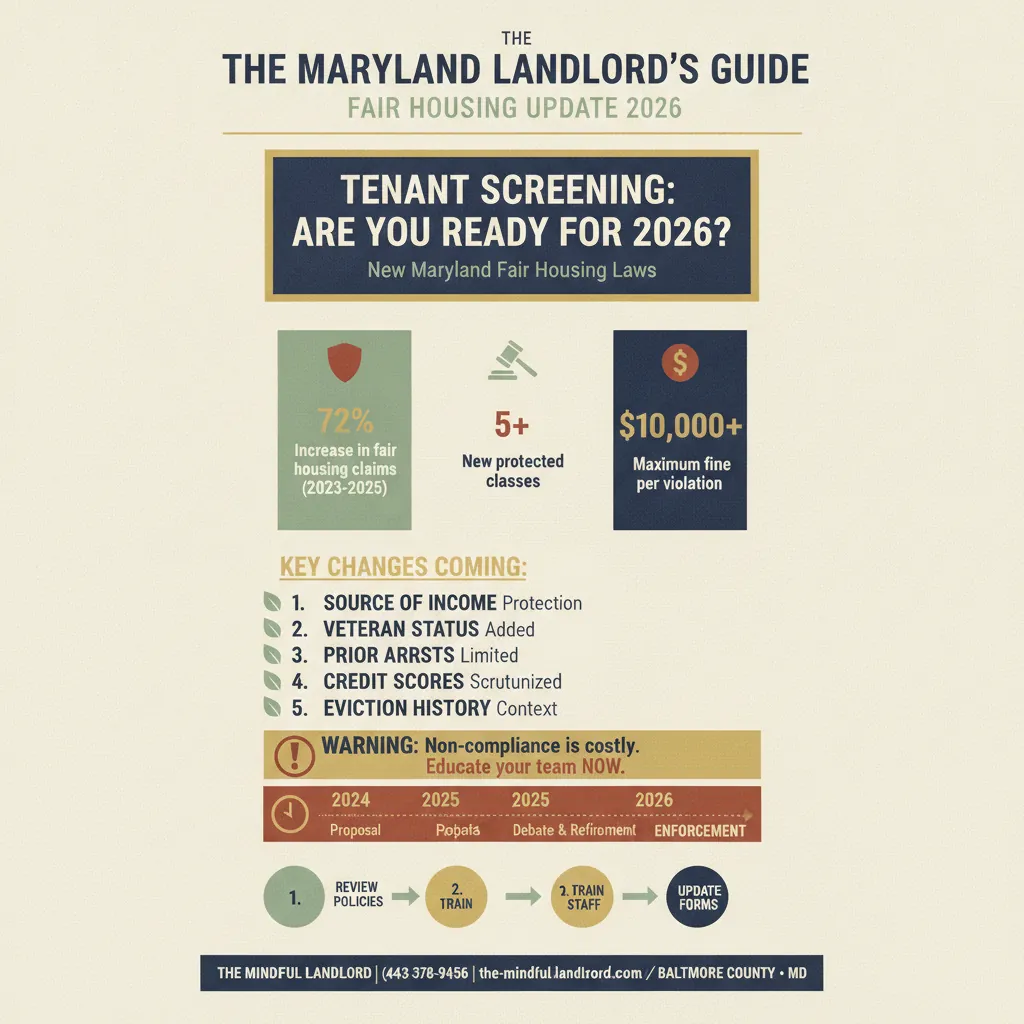
The biggest “change” for 2026 isn’t necessarily a brand-new law, but the continued emphasis and strict enforcement of existing ones. Maryland and Baltimore City are not backing down on fair housing. If anything, the trends show a continued push for broader protections and stricter oversight. Landlords who aren’t staying updated, or who think they can cut corners, are going to find themselves in trouble.
We’re seeing more scrutiny on criminal background checks, source of income discrimination, and how landlords handle applications from people with disabilities. The push for equity means that regulators are actively looking for patterns that suggest discrimination, even if it’s unintentional.
For example, if you consistently deny applicants from certain zip codes, or if your application process is so complicated that it disproportionately affects people with language barriers or disabilities, you could face a fair housing complaint. The expectation is that you’ll have a clear, objective, and non-discriminatory process from start to finish.
Prepare for 2026 by tightening up your current practices. Review your application forms. Make sure your screening criteria are objective and applied equally. Train anyone who interacts with prospective tenants. Don’t wait for a complaint to force you to get your house in order. Being proactive now saves you headaches and money later.
Staying Out of Trouble on Light Street
Staying compliant with fair housing laws isn’t just about avoiding lawsuits. It’s about good business. When you treat all applicants fairly and professionally, you expand your pool of potential tenants. You find good people who will pay rent on time and take care of your property.
Here’s how to keep yourself out of hot water:
- Standardize Everything: Use the same application form, the same screening criteria, and the same process for every single applicant.
- Document, Document, Document: Keep detailed records of every applicant, including who applied, when, why they were approved or denied, and any communications. This is your best defense if a complaint arises.
- Know Your Laws: Stay current on federal, state, and local fair housing laws. They do change.
- Train Your Staff: If you have employees who show properties or handle applications, make sure they understand fair housing rules.
- Don’t Ask Unnecessary Questions: Stick to questions directly related to an applicant’s ability to pay rent and abide by lease terms. Avoid questions about family plans, religion, or health.
At The Mindful Landlord, we handle all of this for you. We screen tenants thoroughly, fairly, and legally. Our 21-day placement guarantee and $0 vacancy fees mean we’re motivated to find you a great tenant fast. And with no long-term contracts, you’re not locked in. We believe in earning your business every day. Ready to simplify your life? Call us at (443) 378-9456. You can also figure out what your property could be making with our rental income calculator.
Don’t let the complexities of tenant screening and fair housing laws keep you up at night. The Mindful Landlord is here to help Baltimore landlords succeed. We focus on finding quality tenants quickly and keeping your properties well-maintained, with a licensed general contractor on staff and no maintenance markups. Get in touch with us today to discuss your property management needs. Visit our contact page to learn more.
FAQ
Q? How many protected classes does Maryland’s Fair Housing Act add beyond federal law? A: Maryland adds 6 protected classes beyond federal law.
Q? What is the maximum number of days The Mindful Landlord guarantees to place a tenant? A: The Mindful Landlord guarantees tenant placement within 21 days.
Q? How many specific Baltimore City ordinances should landlords be aware of regarding criminal background checks? A: Landlords should be aware of at least 1 specific Baltimore City ordinance (17-0096) regarding criminal background checks.
Q? How many times does The Mindful Landlord charge a vacancy fee? A: The Mindful Landlord charges $0 in vacancy fees.