We’re talking lead paint today. It’s a headache for every landlord in Baltimore, no matter if you own one rowhouse in Hampden or a dozen units downtown. The rules keep changing, and 2026 is bringing more adjustments we all need to prepare for. You can’t just ignore this stuff. The fines are real, and so are the health risks.

We’re here to break down what’s happening, what you need to do, and how The Mindful Landlord can make it less of a burden. We’re Baltimore landlords ourselves. We get it.
What’s the Deal with Lead Paint Laws on North Avenue?
If you own a rental property on North Avenue, or anywhere else in Baltimore City built before 1978, you’re dealing with lead paint regulations. This isn’t new. Maryland’s Lead Risk Reduction Law, also known as Title 6, Subtitle 8 of the Environment Article, has been around since 1994. It was put in place to protect children from lead poisoning, which was a serious problem in older housing stock, especially in cities like ours.
The law requires landlords to address lead hazards in pre-1978 rental units. It’s not about removing every trace of lead paint. It’s about reducing the risk of exposure, particularly to chipping, peeling, or otherwise deteriorated paint that children can ingest. This means getting your property inspected and certified by a Maryland Department of the Environment (MDE) accredited inspector. You need to keep up with these certificates. Fail to do so, and you’re looking at potential fines and legal trouble.
It’s a hassle, sure. But it’s also the law, and it’s for a good reason. We’ve seen firsthand the damage lead poisoning can do to families. We want to help you keep your tenants safe and your properties compliant.
Got questions about your specific property? Give us a ring. We can walk you through it. Call us at (443) 378-9456.
The History of Lead Paint in Baltimore City Code 7-201
Baltimore City has always had its own layer of rules on top of the state law. City Code Article 7, Subtitle 2, “Lead Paint Poisoning Prevention,” mirrors much of the state’s intent but adds local enforcement mechanisms. The city council recognized early on that our older housing stock, much of it built before World War II, presented a particularly high risk.
For decades, lead paint was common. It was durable, easy to clean, and had a nice finish. Nobody knew the danger then. Once the science caught up, the government started banning its use. But that didn’t magically remove it from the walls and windows of millions of homes. It just meant landlords had to deal with the existing hazards.
The laws have evolved over time. What started as simple requirements for visual inspections became more stringent, demanding specific testing and certified risk reduction treatments. The goal has always been to move towards safer housing without bankrupting landlords. It’s a tricky balance. But the trend is clear: the requirements are only getting stricter, not looser.
If you’re wondering how much these compliance efforts might cost you, check out our calculator. You can estimate potential expenses and see how our zero maintenance markups can save you money: [The Mindful Landlord Calculator URL].
Understanding the Current Lead Paint Certificate Requirements for Rental Properties Near Patterson Park
Let’s talk about what you need right now for your rentals, whether they’re near Patterson Park or up in Roland Park. If your rental property was built before 1978, you need an MDE Lead Paint Risk Reduction Certificate. This is non-negotiable.
There are a few types of certificates, but the most common one landlords aim for is the “Full Risk Reduction Certificate.” To get this, you need to perform specific lead hazard reduction treatments. These include things like fixing deteriorated paint, cleaning up dust, and sometimes replacing windows or doors. After the work is done, an MDE-accredited inspector comes in, takes dust wipe samples, and visually inspects the property. If it passes, you get the certificate.
You need to renew this certificate every two years, or whenever there’s a tenant turnover, whichever comes first. This means if a tenant moves out after a year, you need to get the unit re-inspected and re-certified before a new tenant moves in. This is called a “Modified Risk Reduction Certificate.” It’s generally less extensive than the full one, often just requiring a visual inspection and dust wipes if the previous full certificate is still relatively recent.
It’s a process. It takes time. It costs money. But it keeps you compliant and protects your tenants. And honestly, it protects you from serious liability down the road.
What Changes Are Coming in 2026 for Rentals in Fells Point?
Here’s the big one. The reason we’re all talking about this now. The Maryland Lead Risk Reduction Law is getting a significant update that will impact properties across Baltimore, from the historic homes of Fells Point to the brick townhouses of Pigtown.
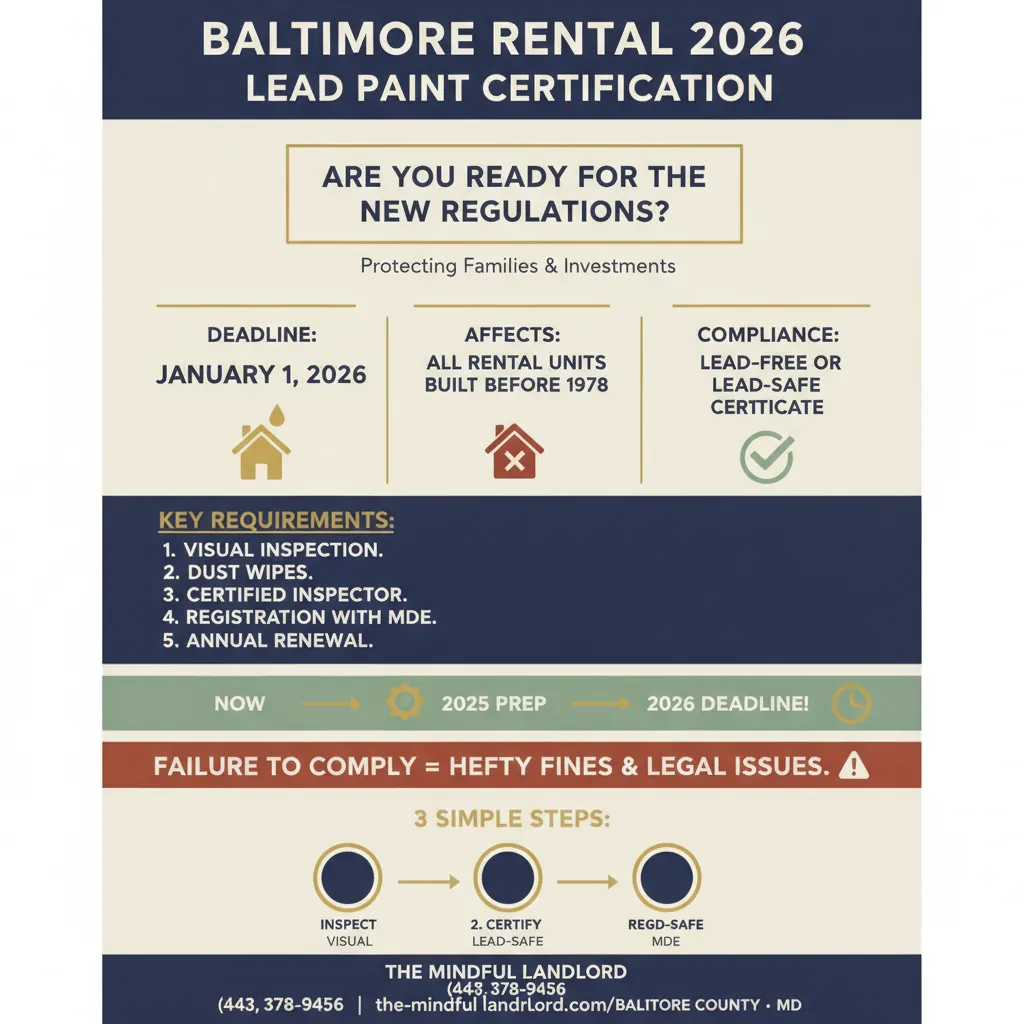
Starting January 1, 2026, the law is changing the definition of what constitutes a “lead-affected property” and, more importantly, expanding the scope of properties that require lead risk reduction treatment. The current law primarily focuses on properties where a child with elevated blood lead levels has lived, or properties built before 1950. The new law is broadening this.
The key change for landlords is that all rental properties built before 1978 will require a full risk reduction certificate at every tenant turnover, regardless of the property’s previous history or whether a child has lived there. This means the “Modified Risk Reduction Certificate” might become less common, as the bar for full compliance will be raised at each new lease. It simplifies things in one way, but it also means more frequent, potentially more extensive, lead hazard reduction work for many properties.
This is a big shift. It means proactive planning is more critical than ever. Don’t wait until late 2025 to figure this out. Start assessing your properties now.
Getting Your Lead Paint Certificate: The Process and Why It Matters for Your Rowhouse in Butcher’s Hill
So, you own a classic Baltimore rowhouse in Butcher’s Hill, or maybe one near the Inner Harbor. What does getting that certificate actually involve?
- Lead Hazard Reduction Treatments: First, you need to address any deteriorated paint surfaces. This means scraping, sanding, patching, and repainting. You also need to clean thoroughly, especially dust. Windows and doors are common problem areas. Sometimes, this involves replacing components if they can’t be safely encapsulated or removed.
- MDE-Accredited Inspection: Once the work is done, a certified lead paint inspector comes to your property. They perform a visual inspection, looking for any remaining deteriorated paint. They also take dust wipe samples from floors, window sills, and window wells. These samples are sent to a lab for analysis.
- Certificate Issuance: If the samples come back below the MDE-established lead dust hazard levels and the visual inspection passes, the inspector will issue a Lead-Free or Lead-Safe Certificate. You then need to submit this to MDE.
- Registration: You also need to make sure your property is registered with MDE as a lead-affected property. This is a separate, ongoing requirement.
Why does this matter beyond just avoiding fines? It’s about protecting yourself. If a tenant’s child gets lead poisoning in your rental property and you don’t have the proper certificate, you are in a world of trouble. Lawsuits, huge medical bills, and a ruined reputation. It’s not worth the risk. Getting the certificate is a shield. It shows you’ve done your due diligence.
We know it’s a lot to manage. That’s why we offer our services. We have a licensed general contractor on staff. This means we can handle all the necessary repairs and renovations to get your property up to code for lead paint certification, without any maintenance markups. You pay what we pay for the work. No hidden fees.
Give us a call to chat about your properties and how we can help you prepare for 2026: (443) 378-9456.
How The Mindful Landlord Helps with Lead Paint Compliance in Federal Hill
Managing rental properties in Federal Hill, or anywhere in Baltimore, means staying on top of a lot of regulations. Lead paint is a big one. At The Mindful Landlord, we take this seriously. We help Baltimore landlords navigate these complex requirements, not just for 2026 but for every year.
Our team understands the MDE regulations inside and out. We know what it takes to get a property certified. When you partner with us, we can coordinate the necessary lead hazard reduction work using our in-house licensed general contractor. This is a huge advantage. Most property management companies outsource this work and then add a markup. We don’t. You get quality work at cost. That saves you money.
We also keep meticulous records of all your lead paint certificates and renewal dates. We’ll remind you when it’s time for re-inspection and help you schedule it. This way, you never miss a deadline and always stay compliant. No more scrambling at the last minute.
Beyond lead paint, we offer full-service property management designed specifically for Baltimore landlords. We aim for 21-day tenant placement. We charge $0 vacancy fees. And we don’t lock you into long-term contracts. We believe in earning your business every day.
Don’t let the upcoming 2026 lead paint changes stress you out. Let us handle the heavy lifting. We’re here to help you run your rental business smoothly and profitably.
Ready to see how much you can save and how much simpler property management can be? Visit our online calculator today: [The Mindful Landlord Calculator URL].
Preparing for the 2026 lead paint certificate changes is smart business. It protects your investment, your tenants, and your peace of mind. The Mindful Landlord is your partner in making sure your properties are safe and compliant, without unnecessary costs. We understand the Baltimore market because we’re part of it. Contact us today to discuss your specific needs and learn how we can help you thrive as a Baltimore landlord.
Contact us to learn more: [The Mindful Landlord Contact URL]
FAQ
Q: How many years is a Full Risk Reduction Certificate valid? A: A Full Risk Reduction Certificate is valid for 2 years.
Q: How many days do you have to get an MDE certificate after tenant turnover? A: You generally have 30 days after tenant turnover to get the required certificate.
Q: How many types of lead paint certificates does MDE issue? A: MDE issues 3 main types of certificates: Full Risk Reduction, Modified Risk Reduction, and Lead-Free.
Q: How many days does The Mindful Landlord aim for tenant placement? A: The Mindful Landlord aims for 21-day tenant placement.
Q: How many Maryland properties built before 1978 are affected by lead paint laws? A: Approximately 500,000 rental properties in Maryland were built before 1978 and are potentially affected by lead paint laws.