You bought a Baltimore rowhouse, you live in it, and your tenant’s rent check covers most of your mortgage. Now imagine two tenant checks. That’s the triplex house hack. You own the whole building. You occupy one unit. Two tenants fund your equity while you live rent-free or close to it. It’s not a loophole. It’s what the FHA 203(b) program was built for, and Baltimore’s rowhouse stock makes the math work better here than in most mid-Atlantic markets.
If you’re running the numbers on a Baltimore triplex and the math isn’t clicking, call us at (443) 378-9456. We’ve helped landlords structure these deals from initial inspection through DHCD licensing, and we can walk you through what to expect before you make an offer.
What Is House Hacking and Why Baltimore Triplexes Make Sense
House hacking is simple: buy a multifamily property, live in one unit, rent the others. Done well, it drops your effective monthly housing cost near zero.
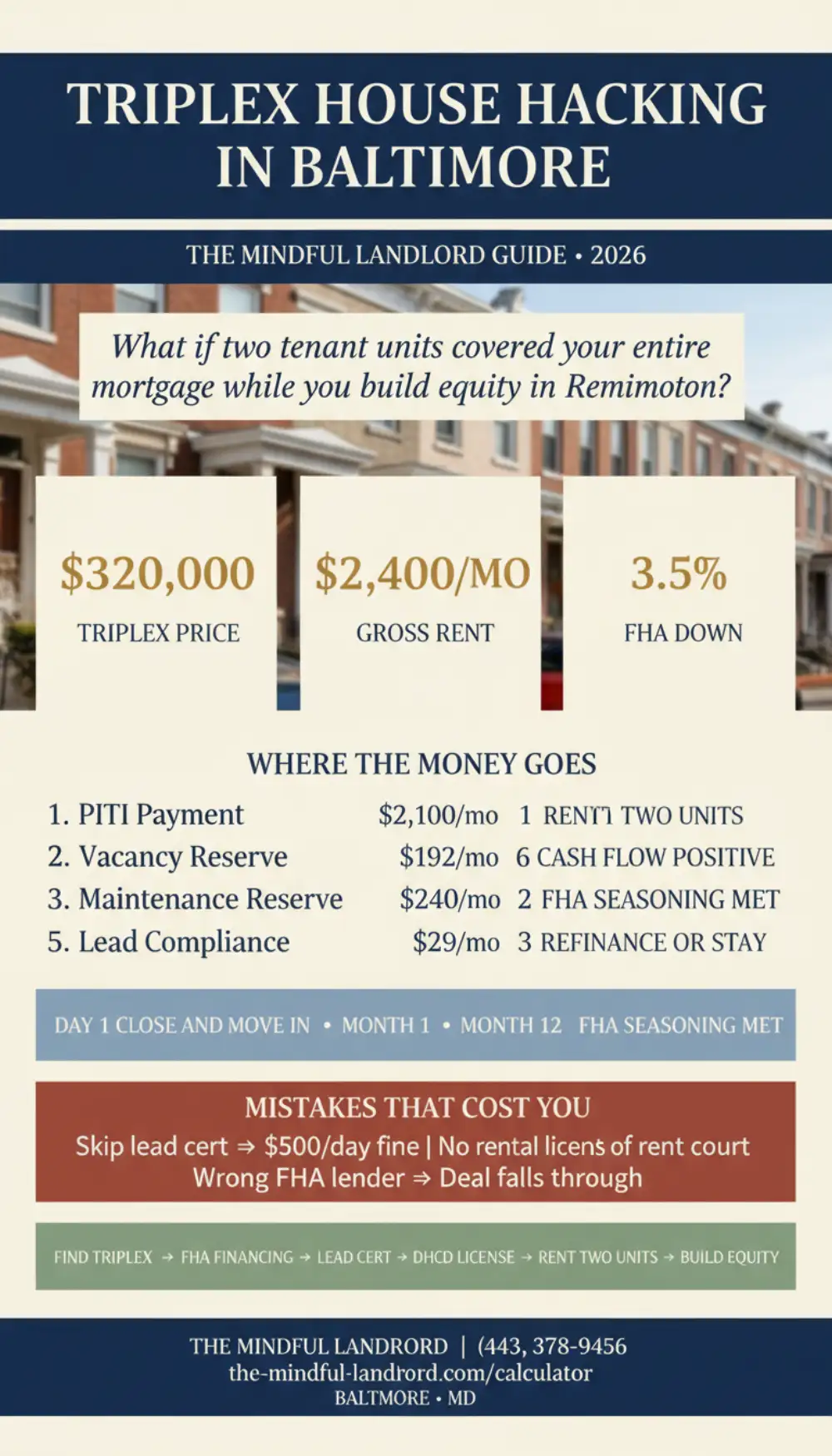
Baltimore triplexes make this work better than most markets. The city has a large stock of pre-war brick rowhouses priced between $280,000 and $380,000. Remington sits about a mile from Johns Hopkins Medical, so demand from graduate students, nurses, and young professionals keeps those units occupied. Two rented units at $1,200 each generate $2,400 per month. Principal, interest, taxes, and insurance on a $320,000 FHA purchase at 2026 rates runs roughly $2,100. The math favors you before you account for appreciation or equity paydown.
FHA 203(b) under HUD Handbook 4000.1 allows 3.5% down on 2-4 unit owner-occupied properties. The 2026 FHA loan limit for a 3-unit property in Baltimore City is $1,000,650, covering nearly any triplex at current city price points.
Best Baltimore Neighborhoods for Triplex House Hacking
How do you find the right block? The answer depends on your risk tolerance.
Tier one: Remington and Charles Village. Proximity to Johns Hopkins, triplex prices $300,000-$380,000, 1BR units renting at $1,100-$1,400 per month. The demand base is institutional and stable. Cap rates are tighter, but vacancy risk is lower and tenant selection is easier.
Tier two: Greenmount West and Oliver. Purchase prices drop to $180,000-$260,000. Higher potential returns, more renovation exposure. The Baltimore City Housing Department has designated both as reinvestment corridors with city incentives, though navigating that process takes time. Better suited to landlords with construction experience.
Tier three: Pigtown and Southwest Baltimore. Lowest entry prices in the city for triplexes. The Healthy Neighborhoods and CHAP programs offer rehabilitation grants and historic tax credits. Higher risk, higher ceiling. Not a first deal for most buyers.
Financing a Baltimore Triplex as an Owner-Occupant
What does lender selection look like for a Baltimore triplex? More complicated than a single-family purchase. You need a lender with genuine FHA multifamily experience.
FHA 203(b): 3.5% down, minimum 620 FICO, primary residence required for at least 12 months. The Baltimore City DHCD Buying Into Baltimore program offers up to $5,000 in down payment assistance for qualified owner-occupants. Live Near Your Work grants can layer on top. Some buyers enter a Remington triplex with under $8,000 in cash to close.
Conventional financing runs 5% down for owner-occupied multifamily at 680+ FICO. Mortgage insurance is cancelable at 20% equity. FHA mortgage insurance runs for the life of the loan on down payments under 10%. One often-missed detail: rental income on the non-occupied units can count toward qualifying income under FHA guidelines at 75% of market rents documented by the appraiser, which helps borderline buyers clear the debt-to-income threshold.
Your Deal, Modeled End-to-End
Why does the math work, and when does it stop? Here is the full model for a Remington triplex.
Purchase price: $320,000. FHA down payment at 3.5%: $11,200. Estimated PITI at 6.8% over 30 years: $2,100 per month. Two rented units at $1,200 each: $2,400 gross rent per month. Net housing cost before reserves: negative $300. You collect $300 per month simply by living there.
Apply reserves. Vacancy at 8%: $192 per month. Maintenance at 10%: $240 per month. Effective monthly carrying cost with reserves: roughly positive $32. Near zero, and it turns negative (in your favor) if your units run above the vacancy assumption. Now run the non-owner scenario: move out before the 12-month FHA seasoning period and you’re refinancing at investment property rates. Add 50-75 basis points. The same deal generates about negative $192 per month cash flow. The house hack only works while you’re in it.
Use our calculator at the-mindful-landlord.com/calculator to run your specific numbers. Plug in purchase price, rental comps, and your down payment scenario. Run it before the offer, then run it again at the-mindful-landlord.com/calculator after you see the inspection report. Repair costs change the math fast.
Baltimore Landlord Licensing in an Owner-Occupied Triplex
Does living in the building exempt you from landlord licensing? It does not.
Baltimore City Code Article 13 §13-6 requires rental registration for every rented unit, including units in owner-occupied buildings. You live in unit one. Units two and three are rented. Both require a DHCD license. The 2026 fee is $50 per unit per year, so $100 per year for the two rented units. Budget two to three months for the application process.
Pre-1978 buildings, which covers most Baltimore triplexes, carry a lead paint compliance requirement before DHCD will issue the license. You need MDE registration and a full risk reduction certificate or lead-free certification for each non-owner unit. Initial lead compliance runs $250-$400 per unit. Two units at $350 each is $700 upfront, and you cannot collect rent lawfully until the license is in hand.
Without a valid license, you cannot maintain a rent court action in Baltimore City District Court at 501 E. Fayette Street. If a tenant stops paying and your license is lapsed, you cannot file for unpaid rent. Licensing is not bureaucratic formality. It’s your access to the court system.
Tenant Selection and Self-Management When You Share a Building
What happens when your tenant is also your neighbor?
Owner-adjacent tenants flag maintenance faster. A slow water heater a distant landlord might miss for three months becomes a same-day call from the tenant upstairs. Proximity can cut your maintenance costs by catching problems early. The flip side: you’ll hear every noise complaint and late-night situation directly.
Apply identical screening criteria to every applicant under Maryland Code Article 49B and the Federal Fair Housing Act. Living in the building doesn’t give you extra latitude to discriminate. Document every screening decision in writing. Month-to-month leases are worth considering for years one and two, giving you flexibility if a placement doesn’t work out. Baltimore City Code Article 13 §13-9 covers anti-retaliation protections for tenants even in owner-occupied buildings. Know those rules before a dispute, not after. If self-management starts creating friction with your day job, call (443) 378-9456 and we’ll talk through what a handoff looks like.
Exit Strategies: From House Hack to Pure Investor
When does the house hack end, and what comes next?
FHA requires 12 months of owner-occupancy before you can refinance into non-owner terms and move out. After that seasoning period, refinance at investment property rates, vacate, and convert to a fully cash-flowing three-unit investment.
The primary residence exclusion under 26 U.S.C. §121 allows $250,000 in capital gains exclusion (single filer) or $500,000 (married filing jointly) on a property owned two years and occupied two of the past five. The owner-occupied unit qualifies. The two rented units do not. A portion of the gain will be taxable. Talk to a Maryland CPA before you sell.
The rented portion, units two and three, can roll into a 1031 exchange to defer capital gains tax within the 45-day identification and 180-day closing windows. See our post on 1031 exchange rules for Baltimore rental property for the full breakdown.
Use the calculator at the-mindful-landlord.com/calculator to model your deal before the offer stage. For a second set of eyes on the numbers or questions about licensing, reach out at the-mindful-landlord.com/contact or call (443) 378-9456. We work with Baltimore landlords at every stage, from first purchase through portfolio exit.
Can I use an FHA loan to buy a triplex in Baltimore?
Yes. FHA 203(b) allows 3.5% down for 2-4 unit properties if you occupy one unit as your primary residence for at least 12 months. The 2026 FHA loan limit in Baltimore City for a 3-unit property is $1,000,650 per HUD Handbook 4000.1.
How much can two rented units cover on a Baltimore triplex mortgage?
At $1,200 per unit in Remington, two units yield $2,400 per month gross, typically covering the full PITI on a $320,000 FHA-financed triplex and driving your effective monthly housing cost near zero before reserves.
Do I need a landlord license if I live in one unit of my Baltimore triplex?
Yes. Baltimore City Code Article 13 §13-6 requires rental registration for all rented units including those in owner-occupied buildings. The 2026 DHCD fee is $50 per unit per year. Two rented units cost $100 per year plus initial lead compliance of $250-$400 per unit for pre-1978 buildings.
What is the best Baltimore neighborhood for triplex house hacking in 2026?
Remington and Charles Village offer the best balance of price, demand, and proximity to Johns Hopkins. Triplex prices range $300,000-$380,000, with 1BR units at $1,100-$1,400 per month, running 15-20% above the city median.
How long do I have to live in a Baltimore triplex before refinancing as an investor?
FHA 203(b) requires 12 months of owner-occupancy before you can refinance into investor-rate terms and move out. Conventional lenders may allow a shorter seasoning period depending on lender overlays, but 12 months is the standard FHA floor.