A Cherry Hill landlord turned down a housing voucher applicant last spring. The unit sat empty for 47 days. Then the HCD complaint arrived. By the time attorney fees cleared and the civil fine landed, that single application rejection cost more than $18,000. The applicant was qualified on every standard screen. The rejection was illegal.
This happens more than it should in Baltimore. If your screening criteria or listing language puts you in murky water on housing vouchers, call (443) 378-9456 now. We help landlords work through this question every week. Getting it right before a complaint is filed is a lot cheaper than after.

What ‘Source of Income’ Means Under Maryland Law
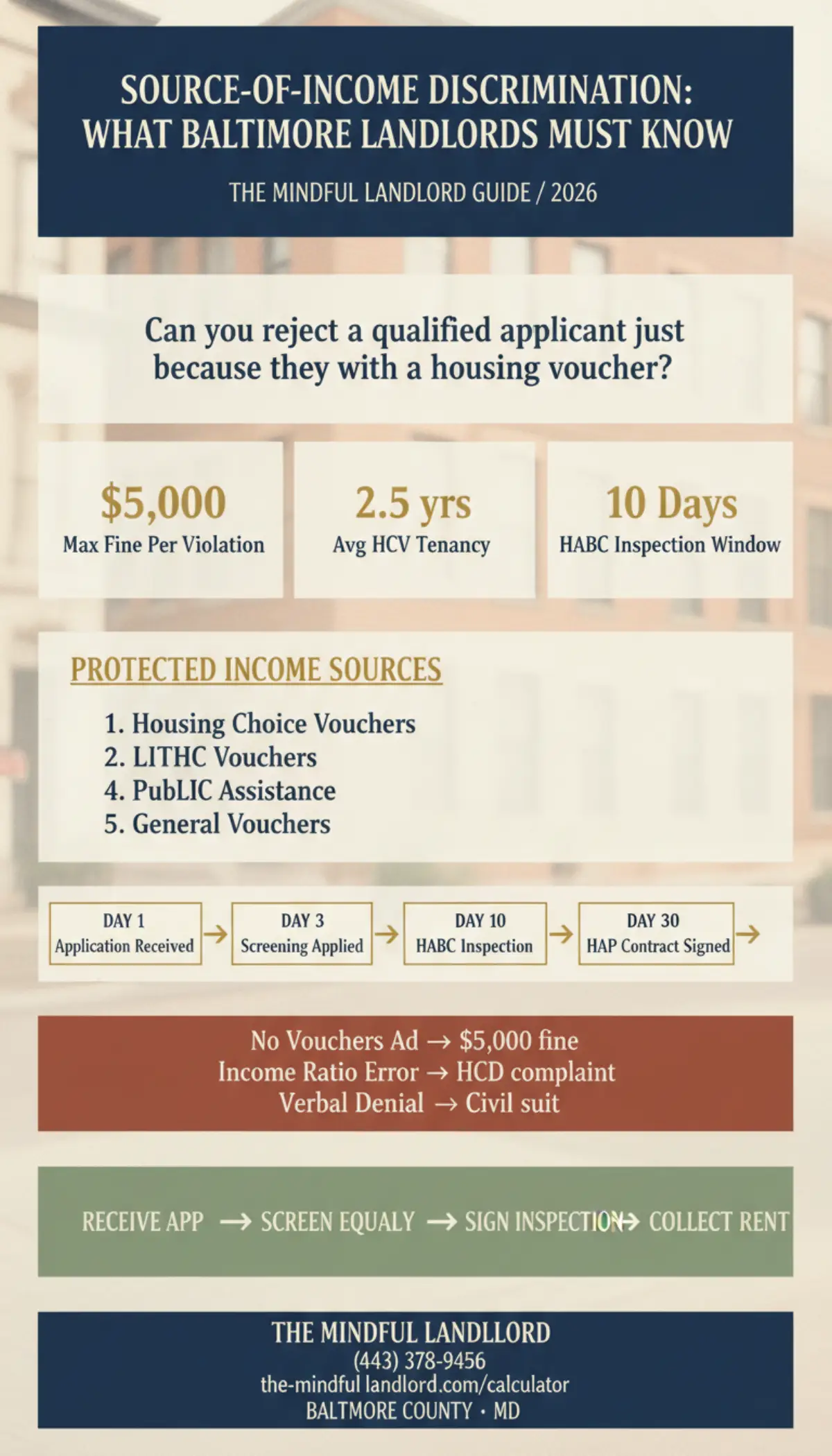
Maryland Code Article 49B §19 prohibits source-of-income discrimination in residential housing across the entire state. That is the baseline. Baltimore City Code Article 4 then layers local enforcement on top, with a civil penalty structure under §3-15 that reaches $5,000 per violation per instance.
Source of income under these laws is broader than most landlords assume. Protected income sources include Housing Choice Vouchers (HCVP, the program most people call Section 8), Veterans Affairs Supportive Housing (VASH) vouchers, Low Income Housing Tax Credit subsidies, and general public assistance. The protection applies at every point in the rental transaction: advertising, applications, screening decisions, lease terms, and eviction.
A Canton landlord who writes “no vouchers” in a Zillow listing has already violated the law before a single application arrives. The law does not wait for a signed lease to apply. It applies the moment you put your listing up.
Both state and city law carry one key exemption: owner-occupied residential properties of 3 units or fewer. A landlord living in a 2-unit Waverly rowhouse who rents the upstairs apartment is likely exempt. Four units in the building, or the owner does not live there? That exemption does not apply.
Which Baltimore Landlords Are Covered
How do you know if Baltimore City Code Article 4 §3-1 applies to your property? Start with geography.
Baltimore City landlords fall under city code unless they meet the owner-occupancy exemption above. The analysis is straightforward: count the units, check whether you live there, and check the address. If the address is in Baltimore City and you do not occupy one of 3 or fewer units, you are covered.
Baltimore County operates on different rules. As of 2026, Baltimore County has not adopted a countywide source-of-income ordinance. A landlord in Towson, Dundalk, Essex, or Catonsville falls under Maryland state law (Art. 49B §19) only. The state exemption mirrors the city’s: owner-occupied buildings of 3 or fewer units.
One question that comes up repeatedly at HABC landlord workshops held at Reisterstown Road Plaza: what about a portfolio that includes both Baltimore City and Baltimore County properties? Each property is analyzed under the law governing its physical address. A Dundalk duplex where you live: state law, owner-occupant exemption potentially applies. A Mount Vernon rowhouse you do not occupy: city code, no exemption.
What You Can and Cannot Say in a Rental Listing
“No Section 8.” “Vouchers not accepted.” “Employment income only.”
Those phrases in a listing for a Baltimore City rental property are violations on their face. Baltimore’s Department of Housing and Community Development runs periodic audits of online listings on Zillow, Craigslist, and Facebook Marketplace. A screenshot of your listing is enough to open an HCD complaint. The tenant does not have to apply first.
Lawful listing language focuses on what tenants must demonstrate, not where the funds come from. “Verifiable income required” is fine. “Minimum credit score 620” is fine. “Income must come from W-2 employment” is a problem. Even without naming vouchers, it functions as a screen against voucher holders in a city where a significant share of renters along the Greenmount Avenue corridor and through East Baltimore pay with housing assistance.
Write your listing the same way you would for a market-rate tenant who happens to pay out of pocket. If you would accept those terms for a W-2 employee, make sure the same language also covers a qualified voucher holder.
Legitimate Screening vs. Discriminatory Rejection
How do you apply a 3x income requirement to a housing voucher holder? Most Baltimore landlords get the math wrong the first time they try it.
Say your policy is that tenant income must be at least 3 times the monthly rent. The contract rent is $1,400. HABC pays $950 through the HAP contract; the tenant pays $450. Under Maryland Attorney General guidance, a published income-ratio policy must be applied to the full contract rent, not selectively to the tenant’s share. Three times $1,400 is $4,200 in monthly income. Document that you apply this standard consistently to every applicant: voucher holders and non-voucher holders alike.
What you can screen for without violating the law: credit history, prior evictions, prior tenancy record, criminal history within the limits of Baltimore City’s fair chance housing ordinance, and income documentation. The same criteria, applied identically to every applicant who walks in.
Documentation is your protection. Save your written screening criteria, the application form, and every rejection letter. If a complaint is filed, the hearing officer at Baltimore City District Court (111 N. Calvert St.) will ask you to show that you applied your stated criteria equally. A paper trail showing consistent application of neutral standards is the difference between a dismissed complaint and a $5,000 fine plus attorney fees.
The Real Cost of Getting This Wrong
What if an HCD complaint lands on your desk? Walk through the realistic exposure before you decide it won’t happen to you.
Baltimore City Code Article 4 §3-15: civil fine up to $5,000 per violation. That is just the fine. The full picture looks like this:
- Attorney fees to defend an HCD administrative hearing: $8,000 to $15,000
- Lost rent while the unit sits vacant during the complaint period (60-day average): approximately $2,800 at $1,400 per month
- Civil lawsuit exposure: compensatory damages plus punitive damages if bad faith is shown
- HUD investigation running in parallel if the tenant files a federal fair housing complaint
Five thousand dollars in fines, $8,000 in attorney fees, and $2,800 in lost rent puts you at $15,800 before any civil award. The math matters.
Run your own numbers at the-mindful-landlord.com/calculator. The calculator models vacancy cost, lost rent per day, and compliance exposure so you can see what a single compliance mistake costs against your actual unit economics. Use the-mindful-landlord.com/calculator to model your specific unit before your next tenant decision, or call (443) 378-9456 to walk through the numbers with us directly.
HCVP Inspection Practicalities for New Voucher Holders
When a voucher tenant selects your unit and you accept their application, HABC schedules a Housing Quality Standards inspection under 24 CFR §982.401. That inspection typically happens within 10 business days of the tenant submitting their packet.
Baltimore City rowhouses in high-utilization neighborhoods like Harlem Park and Sandtown-Winchester fail HQS inspection for the same handful of items every time:
- Smoke detectors missing, dead, or inoperative
- Hot water temperature below 110 degrees Fahrenheit at the tap
- Window locks missing on second-floor and above units
- Peeling paint (automatic lead paint review trigger in pre-1978 stock)
- Missing or damaged stair handrails
Emergency defects (no heat during heating season, active gas leak, no running water) must be cured within 24 hours. Non-emergency items get 30 days. Miss either deadline and HABC suspends HAP payments until the unit passes re-inspection.
The practical fix: self-inspect against the HABC HQS checklist before your tenant submits their packet. Passing on the first HABC visit means an earlier HAP contract start date, which means rent begins sooner.
Best-Practice Lease Language for Voucher Tenants
The HAP contract (HUD form HUD-52641) governs the relationship between HABC and the landlord. It runs alongside your standard lease. Where the HABC addendum and your lease conflict, the addendum controls. That is not negotiable.
Three lease clauses that create problems for Baltimore City voucher tenancies:
- Late fee structures that exceed what the HAP contract permits
- Provisions requiring the tenant to cover the full contract rent if HABC suspends or terminates the HAP payment
- Entry-notice provisions below Maryland’s minimum 24-hour requirement
HABC uses a standard addendum that addresses most common conflicts. The trouble starts when landlords add their own clauses on top without checking them against HUD Handbook 7420.10G, which is the controlling document for what fees, charges, and lease terms are permissible alongside a HAP contract.
Before signing your first voucher tenant at a Baltimore City property, have a knowledgeable person walk through your lease template against the HABC addendum. Mismatched terms do not just create tenant disputes. They can void the conflicting provisions and leave you without legal recourse on those points.
Our team reviews lease templates for Baltimore City and County landlords and flags conflicts before they become post-signing problems. Reach us at the-mindful-landlord.com/contact or call (443) 378-9456.
Source-of-income compliance comes down to consistent criteria, plain listing language, and a lease that matches the HABC addendum. The rules are fixed. The exposure for getting them wrong is real. Run your unit-level cost numbers at the-mindful-landlord.com/calculator, then reach out at the-mindful-landlord.com/contact or call (443) 378-9456 to talk through your specific situation.
Can I reject a Section 8 applicant in Baltimore City?
No. Baltimore City Code Article 4 §3-1 prohibits source-of-income discrimination. You may reject an applicant for legitimate, consistently-applied screening reasons (credit, prior evictions, income documentation), but the voucher itself cannot be the reason. A violation carries up to $5,000 in civil fines under Article 4 §3-15, plus attorney fees and potential civil liability.
What is the fine for source-of-income discrimination in Baltimore City?
Up to $5,000 per violation under Baltimore City Code Article 4 §3-15. Beyond the civil fine, you face compensatory and punitive damages in a civil suit. Full exposure including attorney fees and vacancy typically runs $15,000 to $25,000 per complaint that proceeds to a hearing.
Does Maryland state law protect housing voucher holders statewide?
Yes. Maryland Code Article 49B §19 prohibits source-of-income discrimination statewide in residential housing. The protection covers all rental properties, with limited exceptions for owner-occupied buildings of 3 or fewer units. Baltimore County landlords fall under state law even without a county ordinance, covering all HCVP, VASH, and public assistance income types.
How do I apply an income requirement to a housing voucher holder?
Apply your income threshold to the combined contract rent, not to the tenant’s portion alone. If your policy is 3 times monthly rent and the contract rent is $1,400 per month, the threshold is $4,200 per month in income. HABC pays $950 and the tenant pays $450. Your published policy applies to the $1,400 contract rent. Document that you apply this ratio consistently to every applicant to support your screening file.