Cherry Hill duplex, 3BR rowhouse on Benson Avenue. The market-rate offer came in at $1,150 per month. The Section 8 applicant arrived two days later, HABC payment standard of $950, Housing Choice Voucher locked in. Which one do you take?
Most Baltimore landlords answer that question by instinct. A few do the math. The math usually surprises them.
The right answer depends on your neighborhood, your actual vacancy experience, and how much inspection overhead you can stomach. Before you commit to either path, run your numbers at the-mindful-landlord.com/calculator or call us at (443) 378-9456. We have worked with Baltimore investors across Cherry Hill, Park Heights, and Harford Road, and the spreadsheet tells a different story in each one.

How HABC Payment Standards Work and What They Mean for Your Rent
What if you could guarantee rent got paid every month, but only up to a ceiling HABC sets? That is the core Section 8 trade-off. Baltimore Housing’s 2026 payment standards cap what a landlord can collect from a voucher holder. For a 2-bedroom, that range runs from roughly $700 to $950 per month depending on ZIP code. In Cherry Hill (ZIP 21225) and Park Heights, you are near the lower end of that range. In Locust Point or Roland Park, the unit probably does not pencil for Section 8 at all because market rents are already $400 above the cap.
The HAP contract, the agreement between you and HABC, locks in your effective rent ceiling. Federal rent reasonableness rules under 24 CFR §982.507 require that your rent be comparable to unassisted units in the same submarket. If similar 2BRs on Pimlico Road are renting for $1,050 and you are asking $1,200, HABC will push back. Annual adjustments move slowly and only within updated payment standards.
The Section 8 Vacancy Advantage: Guaranteed Payment vs. Reality
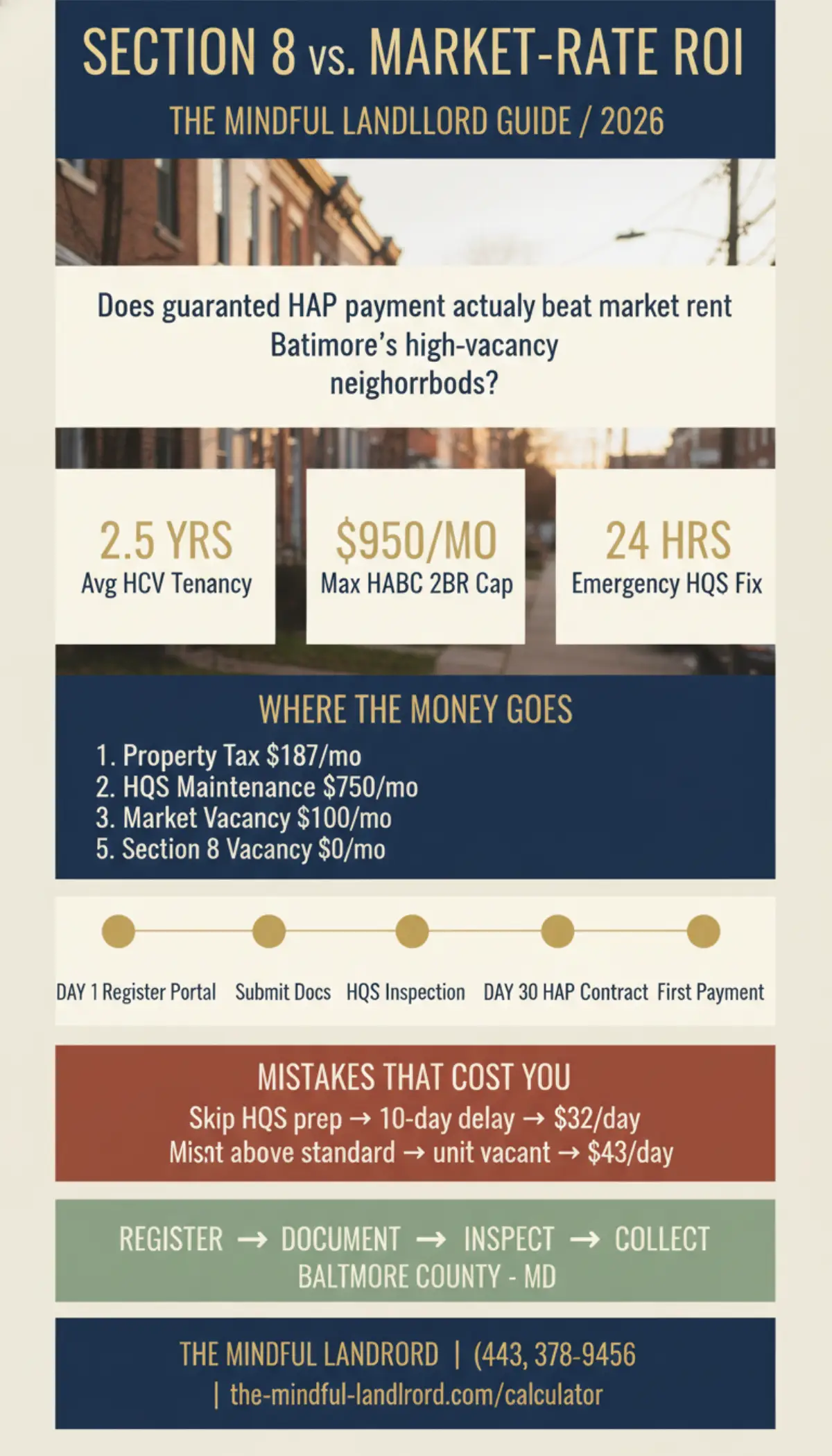
How do you price in 45 days of empty unit between tenants? That is the number most Baltimore landlords undercount. The HUD 2023 Moving to Work report puts the median Housing Choice Voucher Program tenancy at approximately 2.5 years, compared to 1.1 years for comparable unassisted market-rate tenants. HCV tenants stay more than twice as long.
Run that out on a Sandtown-Winchester 3BR. At a 1.1-year average market-rate tenancy with 45 days vacancy between turns, you lose roughly $1,688 per turn. Amortized, that is about $128 per month in vacancy drag. The Section 8 HAP payment is backed by the federal government as long as the tenant maintains eligibility and the unit passes HQS. If HABC terminates a voucher mid-lease, the tenant stays and you collect directly, or you begin a standard eviction under Maryland Real Property §8-401. That is the same District Court, same notice timeline as any other Baltimore tenancy.
The $200-per-month gap between market and Section 8 often vanishes once you run the real vacancy math.
HABC Inspection Requirements and the True Maintenance Premium
What happens at a Broadway East rowhouse when your unit fails HQS inspection the first time? HABC issues a deficiency notice after the initial inspection, typically scheduled within 10 business days of your request. Emergency defects must be cured within 24 hours. Non-emergency items get 30 days under 24 CFR §982.404. Miss that window and HABC suspends HAP payments.
Common failure points in Baltimore City properties: window locks, peeling paint (lead paint disclosure is mandatory under Article 12A of the Baltimore City Code regardless), and HVAC serviceability. Budget $50 to $75 per month in your model for ongoing HQS readiness. One failed annual re-inspection can cost you a full month of HAP. The math on staying proactive is simple.
Initial inspection timelines also create a time-to-lease delay. If you need the unit occupied in 30 days and the first inspection fails one item, you are looking at re-inspection, another 10-business-day scheduling window, and potentially 50 or more days before the HAP contract executes. Market-rate can move in days.
Your Deal, Modeled End-to-End
Let us put real numbers on a Cherry Hill 3BR rowhouse. Purchase price $135,000, 25% down, 7.5% DSCR loan rate, Baltimore City property tax at $2.248 per $100 assessed value (2026). That is $253 per month in property tax on a $135,000 assessment.
Section 8 scenario: HAP rent $950 plus $200 tenant portion equals $1,150 gross. PITI roughly $835. Property tax $253. Maintenance with HQS buffer $125. Insurance $95. Monthly NOI: approximately $342 with zero vacancy drag.
Market-rate scenario: Same $1,150 gross. Same fixed costs. With a 1.1-year average tenancy and 45-day turns, amortized vacancy runs $128 per month. Monthly NOI drops to roughly $214.
Section 8 outperforms by $128 per month in Cherry Hill, roughly $1,536 per year. Over five years that is more than $7,500 in additional cash flow before any appreciation.
Pull up the-mindful-landlord.com/calculator and model your specific property with your ZIP code’s payment standard and your actual financing. The calculator handles both scenarios side by side. Then call us at (443) 378-9456 and we will walk through it with you in 15 minutes. We have run this math on properties from Cherry Hill to Harford Road. Use the calculator first, then call.
Tax and Financing Implications of Section 8 Income
How does a DSCR lender treat HAP rent? Better than you would expect. Most DSCR lenders accept an active HAP contract as documented, predictable income without requiring a 12-month rental history. The contract itself functions like a rent roll. That makes Section 8-occupied properties attractive for BRRRR strategies in Park Heights and along the Pimlico Road corridor where values are still below replacement cost.
Depreciation is standard: 27.5-year residential schedule, same as any rental property. The Baltimore City property tax rate ($2.248 per $100 assessed value in 2026) hits both Section 8 and market-rate deals equally. If you are building a portfolio of five or more units with HCV tenants, ask your CPA about Low-Income Housing Tax Credit eligibility. LIHTC is not automatic for market-participant Section 8, but it is worth understanding the threshold before you scale.
Neighborhood-by-Neighborhood Fit: Where Section 8 Wins in Baltimore
Section 8 outperforms in high-vacancy-risk neighborhoods: Cherry Hill, Park Heights, Sandtown-Winchester, and Broadway East. In these ZIP codes, HABC payment standards are close enough to market rent that the vacancy protection tips the math solidly toward HCV tenants. A 3BR in Cherry Hill at $950 HAP beats a 3BR at $1,150 market when you factor in a realistic 45-day turn every 14 months.
Market rate wins on the Fells Point waterfront along the Aliceanna Street corridor, in Canton, and in Federal Hill where market rents run $400 to $600 above HABC caps and vacancy rates are under 5%. The higher achievable rent more than compensates for faster tenant turnover.
Mixed strategies work well in duplexes along Harford Road and Erdman Avenue. One Section 8 unit provides guaranteed cash flow and long tenancy stability. One market-rate unit captures upside rent. Diversified vacancy risk across a single mortgage. Baltimore investors have run this structure successfully for a decade or more.
How to List Your Baltimore Property for HABC Voucher Holders
Register on the HABC landlord portal at habc.org before you have a vacancy, not after. The steps are not complex but each one has a wait time: landlord account creation, unit listing with bedroom count and requested rent, and rent reasonableness documentation (typically three comparable lease comps from the same submarket). HABC reviews against 24 CFR §982.507 and approves or negotiates the rent.
Once a voucher holder contacts you and you both agree to proceed, HABC schedules the initial HQS inspection. From accepted application to executed HAP contract, budget 30 to 45 days. If your unit needs prep work, factor that into your acquisition timeline.
Have questions about whether your property qualifies or how to price it under the payment standard? Call (443) 378-9456. We help Baltimore investors navigate HABC landlord registration, rent reasonableness documentation, and cash-flow modeling every week. You can also reach us at the-mindful-landlord.com/contact or run your numbers first at the-mindful-landlord.com/calculator before you pick up the phone.
What is the HABC payment standard for a 2-bedroom in Baltimore in 2026?
HABC 2BR payment standards range from approximately $700 to $950 per month depending on ZIP code. Cherry Hill and Park Heights run near the lower end of that range. HABC updates these figures annually, so confirm the current standard at habc.org before you sign a HAP contract.
Is Section 8 more profitable than market rate in Baltimore?
In high-vacancy neighborhoods like Park Heights and Cherry Hill, Section 8 typically produces higher effective NOI once vacancy drag is factored in. The HUD 2023 Moving to Work report puts the median HCV tenancy at 2.5 years versus 1.1 years for unassisted comparable tenants. On a $1,150 unit with 45-day turns, that vacancy drag runs about $128 per month.
What happens if HABC fails my property at inspection?
HABC issues a deficiency notice. Emergency defects must be cured within 24 hours. Non-emergency items have a 30-day cure window under 24 CFR §982.404. Miss the deadline and HABC suspends HAP payments until re-inspection passes. Most common failure points: window locks, peeling paint, HVAC serviceability.
Can a Section 8 tenant be evicted in Baltimore?
Yes. Maryland Real Property §8-401 applies equally to Housing Choice Voucher tenants. You file in District Court, serve proper notice, and proceed through the same failure-to-pay-rent hearing timeline as any other Baltimore tenancy. There is no separate HCV eviction process.
Does Section 8 rent count as income for a DSCR loan?
Yes. Most DSCR lenders treat an active HAP contract as documented, predictable income, often without requiring a 12-month rental history. The HAP contract functions as a lease equivalent for underwriting purposes. Confirm specifics with your lender since individual policies vary.