Your tenant has a dog. You said sure, fine, when they moved in. That verbal agreement is worth nothing in a Maryland courtroom.
Pet damage claims fail at Baltimore City District Court constantly because the landlord had no written addendum. Maryland Real Property §8-211 requires itemized written documentation to support any deduction from a security deposit. Without a signed pet addendum that describes the specific animal and defines damage terms, a judge hands the deposit back. It doesn’t matter what the dog destroyed.
The fix takes 20 minutes. Call The Mindful Landlord team at (443) 378-9456 to talk through your lease setup first. We work with Baltimore landlords on addendums, pet policies, and deposit structuring. This post walks you through building one that holds up.

Why a Verbal Pet Agreement Isn’t Enough in Maryland
You shook hands on it. Your tenant knows there’s a $300 pet fee. None of that matters at Baltimore City District Court, District 1, 501 E. Fayette St., where landlord-tenant cases run hundreds of times a week.
Without written terms, you cannot deduct pet damage from the security deposit under Maryland Real Property §8-211, enforce pet rules that were never in the lease, or win a breach-of-lease case for an unauthorized animal you verbally allowed. Photographs of the damage help, but you need the signed addendum to establish the tenant’s financial responsibility. Landlords with paper win. Landlords relying on memory lose.
What Goes in a Maryland Pet Addendum
What if you only write down the breed and skip the rest? You still have a problem. A Maryland pet addendum needs six elements to be enforceable in Baltimore County or City.
1. Pet description. Species, breed, weight, name, color. Vague terms like “one dog” get challenged when the tenant adds a second animal.
2. Fee structure. Pet deposit amount (refundable, counts toward 2-month cap), non-refundable pet fee (not a deposit, no cap), and monthly pet rent if applicable.
3. Behavior rules. Outdoor waste disposal, noise standards, leash requirements, areas off-limits in the unit.
4. Liability clause. Tenant is responsible for all property damage and injury caused by the animal, including damage to other residents’ property.
5. Move-in condition reference. Attach or reference the move-in inspection report as the documented baseline.
6. Violation and termination clause. What constitutes a violation and what notice process applies.
Baltimore City-specific note: the Baltimore City Health Code does not permit breed-specific restrictions in lease terms. Breed-weight limits (no pets over 50 lbs) have held up in court. Breed bans have not. Baltimore County has no equivalent rule, so confirm which jurisdiction your property sits in.
Pet Deposits vs. Pet Fees: What Maryland Law Allows
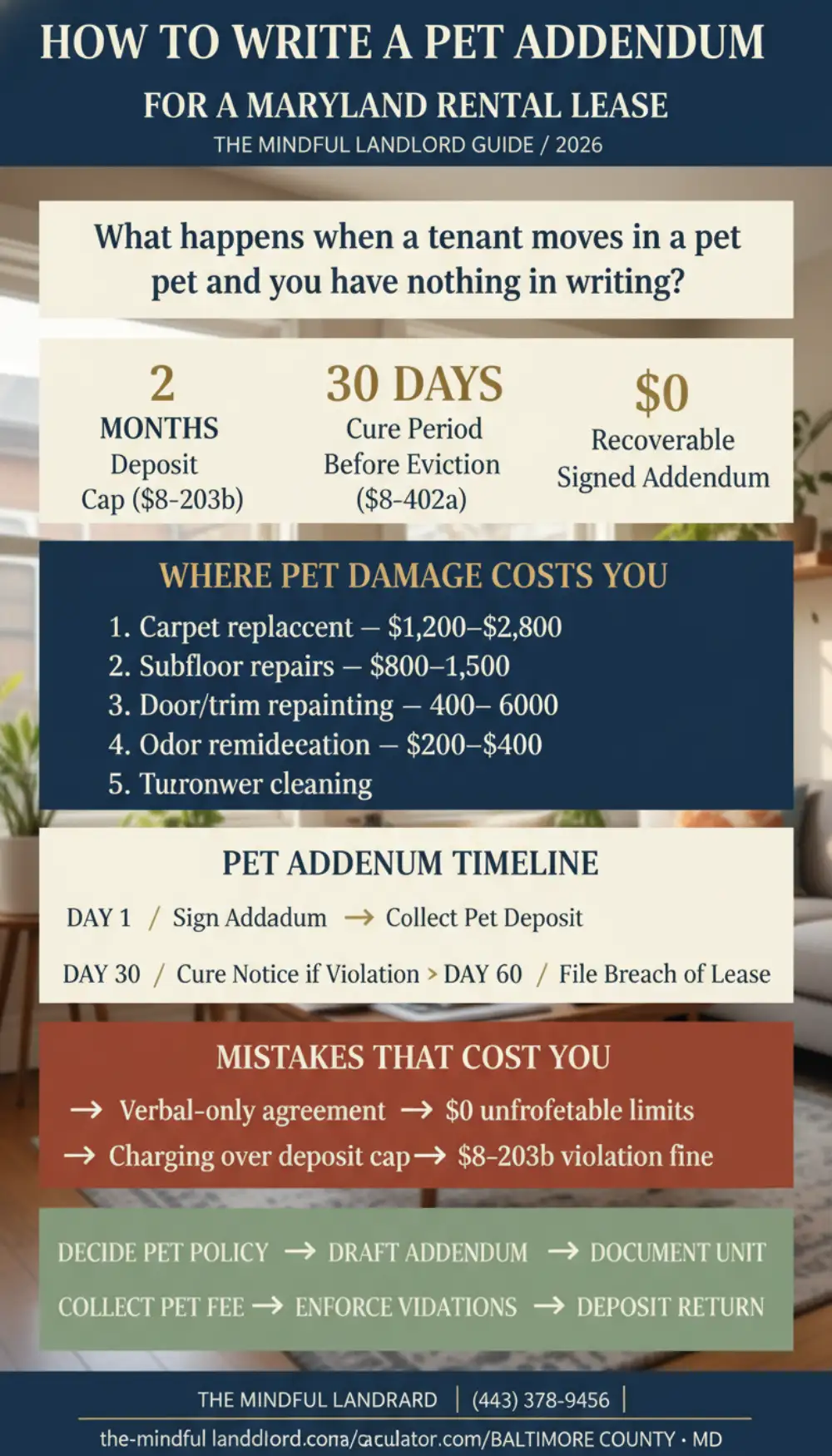
How do you charge for pet risk without hitting the deposit cap? Maryland Real Property §8-203(b) caps all security deposits combined at two months’ rent. A pet deposit counts toward that cap. A non-refundable pet fee does not.
On a $1,600/month rowhouse in Federal Hill or Pigtown: two-month cap is $3,200. Standard security deposit is $1,600. Remaining room for a refundable pet deposit is $1,600. Non-refundable pet fee has no cap, typically $150 to $300.
Charge $1,600 security plus $500 pet deposit and you’re at $2,100. Fine. Reach for $2,000 as the pet deposit and you’re at $3,600, violating §8-203(b). Maryland courts award double damages for excess deposits.
Cleanest structure: $200 non-refundable pet fee at signing plus a $300 to $500 refundable pet deposit under §8-203 rules, interest-bearing if held more than 13 months.
Assistance Animals vs. Pets: The Fair Housing Line You Can’t Cross
What if a tenant applies with a therapist’s letter saying their dog is an emotional support animal? Your no-pet policy does not apply.
Federal Fair Housing Act 42 U.S.C. §3604(f) requires reasonable accommodations for persons with disabilities. HUD guidance FHEO-2020-01 extended this to emotional support animals directly: no pet policy, no pet deposit, no pet fee, no breed or weight restriction. Maryland Art. 49B §19 mirrors the federal standard.
You can request documentation of the disability-related need from a licensed provider (not a diagnosis, just confirmation of the need). You cannot charge any fee, deny the application based on the animal, or apply standard addendum terms imposing a deposit. Draft your assistance animal accommodation process separately from your pet addendum. Mixing the two creates liability.
Run the Numbers Before You Start
What does allowing pets actually cost over two years on a Federal Hill rowhouse? Know the figure before you set your fee structure.
Average pet-related damage on a 2BR with carpet and hardwood entry: carpet replacement runs $1,200 to $2,800; subfloor odor treatment, $400 to $800; door and trim repainting, $350 to $600; cleaning premium at turnover, $200 to $400. Total exposure per tenancy: $2,150 to $4,600.
A $300 pet deposit plus $200 non-refundable fee gets you $500 upfront. Add $50/month pet rent over 24 months and you collect $1,200 more. You’re at $1,700 against $2,150 to $4,600 in potential damage. The deposit is still at risk.
Run your specific numbers at the-mindful-landlord.com/calculator. The Mindful Landlord rental calculator lets you model pet fee structures against damage exposure and tenancy length before you commit to any policy.
Enforcement: Cure Periods and Eviction for Pet Violations
You find out your tenant has an unauthorized second dog. What happens next?
Maryland Real Property §8-402(a) gives the tenant 30 days to cure a lease violation after written notice. You cannot file for eviction the day you find the animal. Send a written cure notice citing the lease clause and the specific violation. Unauthorized animal removed within 30 days, matter resolved. Not removed, you file a Breach of Lease complaint at Baltimore City District Court or the appropriate county court.
Document everything first: date of discovery, photographs of the animal, copy of the pet addendum showing the animal was not authorized, and the full communication record.
Landlords in Hampden and Waverly miss this constantly: the cure notice must be in writing, delivered by certified mail or hand delivery with signature. A text message does not start the 30-day clock under Maryland law.
Sample Clause Language and Red Flags to Avoid
Three compliant clauses for a Baltimore County or Federal Hill property:
Pet authorization: “Tenant is authorized to keep one domestic dog, [Breed], [Name], approximately [weight] lbs., at the premises. Tenant has paid a refundable pet deposit of $[amount] included in the total security deposit under Maryland Real Property §8-203. Tenant is responsible for all property damage and injury caused by said animal.”
Fee structure: “Tenant has paid a non-refundable pet fee of $[amount] at lease execution. This fee is not a deposit and is not subject to the cap under §8-203(b). Tenant also pays monthly pet rent of $[amount] beginning [date].”
Unauthorized animal: “Any animal not listed in this Addendum or an executed amendment is unauthorized. Tenant receives 30 days’ written notice to cure per Maryland Real Property §8-402(a). Failure to cure is a material breach.”
Red flags to remove from any template: a “no pets of any kind” clause paired with FHA accommodation language (self-contradictory); any clause purporting to waive the tenant’s assistance animal rights (void, FHA violation risk); breed-specific bans in Baltimore City (Health Code conflict); and any pet deposit that pushes total deposits above two months’ rent.
Fix your current addendum before the next tenant signs. Contact us at the-mindful-landlord.com/contact for a clause review.
A solid pet addendum takes 20 minutes and protects every tenancy that follows. Without it you’re relying on the goodwill of a judge at 501 E. Fayette St. to recover what a tenant’s dog cost you. Call (443) 378-9456 to talk through your lease structure, or model your pet fee economics at the-mindful-landlord.com/calculator before you commit. Reach us at the-mindful-landlord.com/contact and we’ll build the right policy for your specific units.
Can I charge a pet deposit on top of a security deposit in Maryland?
Yes, but the total of all deposits combined cannot exceed 2 months’ rent under Maryland Real Property §8-203(b). A $1,600/month unit has a $3,200 total cap, and your pet deposit counts toward it.
Can I prohibit pets entirely in my Maryland rental?
Yes for standard pets. You cannot deny an assistance animal on the basis of a no-pet policy. That is a fair housing violation under Federal Fair Housing Act 42 U.S.C. §3604(f) and Maryland Art. 49B. The exception is mandatory.
What is the cure period for an unauthorized pet in Maryland?
30 days. Maryland Real Property §8-402(a) requires written notice before you can file for eviction on a lease violation. The 30-day clock starts on delivery of the written notice, not on the day you discover the animal.
Do I have to accept an emotional support animal if I have a no-pet policy?
Yes. Under HUD guidance FHEO-2020-01 and the federal Fair Housing Act, landlords must make reasonable accommodations for assistance animals including ESAs. You may request a letter from a licensed provider confirming the disability-related need, but you cannot charge pet fees or deny the accommodation.