Your tenant’s ceiling fan falls. Catches a pile of clothes on the dresser. Fire tears through the bedroom before anyone smells smoke. Your DP-3 covers the structural damage. The tenant’s $4,200 laptop, $800 guitar, and $1,200 couch? Gone. No renter’s insurance means no coverage for any of it. You’re not legally liable for their stuff, but you’ll hear about it for months. Possibly from an attorney.
Renter’s insurance is one lease clause most Baltimore landlords skip entirely. Then one incident changes the math. The good news: Maryland law lets you require it. This guide walks you through exactly how to draft that clause, enforce it when a policy lapses, and what the coverage actually protects. Call The Mindful Landlord Team at (443) 378-9456 if you want to walk through your specific lease before you add the clause.

Can Baltimore Landlords Require Renter’s Insurance?
Maryland doesn’t mandate renter’s insurance. But landlords absolutely can make it a lease condition. The requirement has to be in your written lease or a signed addendum before it carries any weight. A verbal agreement on move-in day won’t hold up at Baltimore City District Court on North Calvert Street, or anywhere else in the Maryland court system.
Mid-lease? You can still add it. Maryland Real Property §8-208 requires 30 days written notice before modifying lease terms during an active tenancy. Hand-deliver that addendum with a signed receipt, or send it certified mail. The clock starts on delivery, not on the date you wrote it. Once the tenant signs the addendum, the clause is enforceable on day 31.
What if a tenant refuses to sign? Their refusal is a material breach of a lease modification you’ve properly noticed. That path leads to a 30-day notice to vacate under §8-402 for month-to-month tenants. A Pigtown rowhouse tenant who’s digging in doesn’t change the statute. Not every landlord wants to go there, but the legal option exists. Document everything.
What Renter’s Insurance Actually Covers (and What It Doesn’t)
Why does a tenant’s HO-4 policy matter to you if it’s their insurance? Because your property coverage was never designed to cover tenant belongings. A standard DP-1 or DP-3 landlord policy protects the building structure, your appliances, your liability as the property owner. A tenant’s $3,000 television? Their guitar collection? The dining set they hauled in from Federal Hill? Not your policy’s job. Not even close.
A standard HO-4 renter’s policy covers three buckets:
- Personal property: typically $20,000–$30,000 replacement cost for furniture, electronics, clothing, and other belongings
- Liability: usually $100,000 if a guest trips on a loose step, a kitchen fire spreads to a neighboring unit, or a tenant’s dog bites someone walking past on the Greenmount Avenue sidewalk
- Additional living expenses: hotel costs, meals, and temporary housing if the unit becomes uninhabitable while repairs are made
What it does NOT cover: flooding (that requires a separate NFIP flood policy), bedbugs, structural damage to the building itself, or intentional damage. And it won’t back up code violations. If a tenant causes a fire through illegal DIY electrical work, their HO-4 pays their contents claim. You still fight your own structural damage battle on your DP-3. The policies run parallel, not overlapping.
How to Write the Requirement into Your Baltimore Lease
An enforceable renter’s insurance clause needs four pieces. Miss any one of them and you have decorative text with no enforcement mechanism:
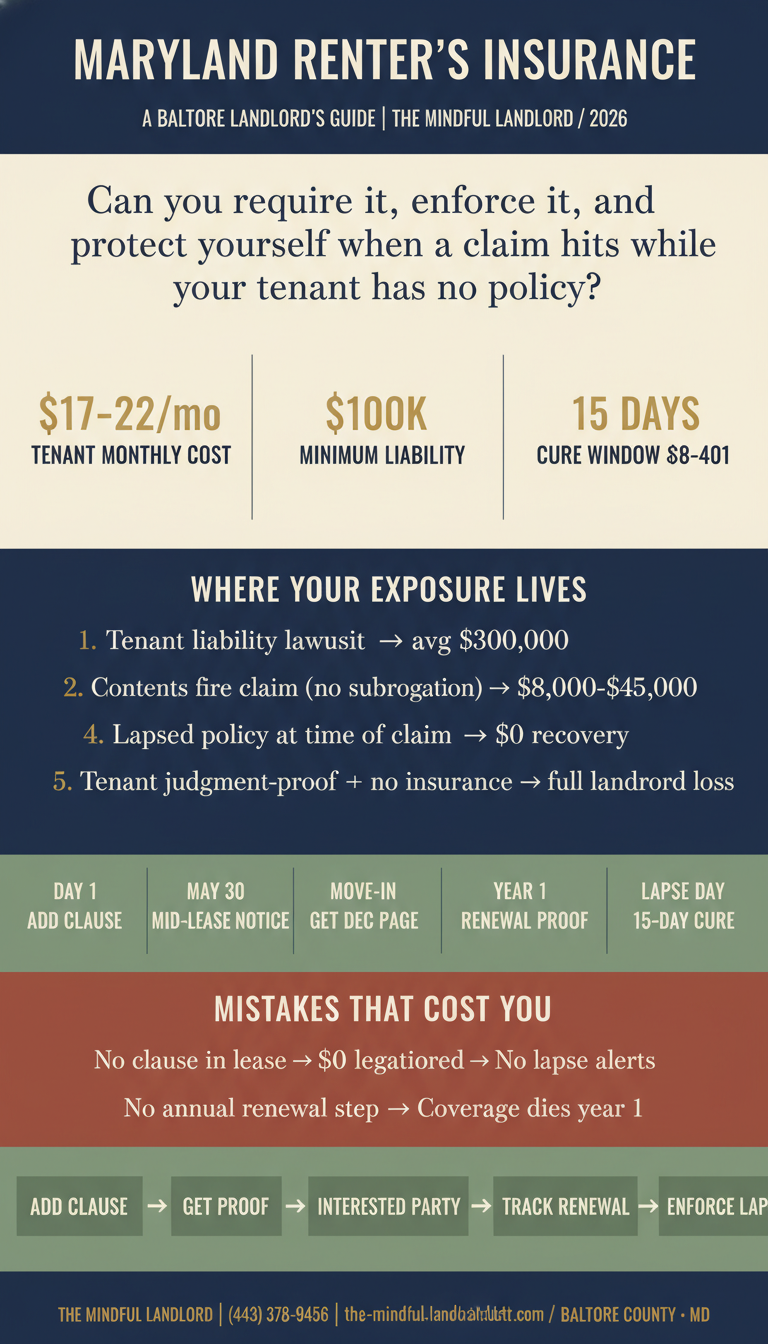
- Minimum coverage amounts. Require at least $100,000 liability and $20,000–$30,000 personal property coverage. The Insurance Information Institute puts the average personal liability lawsuit at $300,000, so $100,000 is the floor, not the goal. If a tenant’s guest injures themselves on your Charles Village property and sues, $100K is the minimum buffer between you and a complicated coverage dispute.
- Landlord as interested party. This language matters. NOT “additional insured,” which creates a different and more complicated legal relationship. “Interested party” or “additional interest” means the insurer automatically notifies you if the policy is cancelled or lapses before the renewal date. That is your enforcement mechanism. You learn about the lapse before the tenant knows you know. Without it, you find out when there’s a claim and no active policy.
- Proof of coverage before move-in. Require the tenant to submit a declarations page (the one-page policy summary), before handing over the keys. No declarations page, no keys. This takes 20 minutes for a tenant who has a policy. If they stall, that tells you something.
- Annual renewal documentation. Renter’s policies renew every 12 months. Add a lease covenant requiring the tenant to provide updated proof of coverage on each anniversary date. Without this step, a tenant can let the policy lapse after month two and technically argue they complied with the original move-in requirement.
Include a cure provision in the clause: if you discover a lapse, the tenant has 15 days to reinstate the policy or obtain equivalent coverage and provide proof. That’s the Maryland Real Property §8-401 cure window for breach of a lease covenant. After 15 days without action, you’ve satisfied the statutory notice requirement and can proceed with termination. Without the cure provision in writing, your enforcement path is murkier.
What Your Numbers Actually Look Like
Here’s how the math shifts on a real claim. A pipe bursts in a 3-unit Bolton Hill rowhouse after a tenant left a window open in February. Water tracks through two floors over eight hours before anyone notices. Structural repairs: $45,000. The tenant’s affected unit had a gaming setup, laptop, monitors, clothing, and furniture totaling about $8,000 in contents.
With renter’s insurance in place: your DP-3 covers the structural damage and you pay your deductible. The tenant’s HO-4 covers their $8,000 in contents, no argument, no side conversations about who owes what. Your insurer’s subrogation team has a path to pursue the tenant’s insurer if tenant negligence caused the pipe burst. Clean separation.
Without renter’s insurance: the structural path is the same: your DP-3, your deductible. The contents question is different. Technically, the tenant’s belongings aren’t your legal obligation. But that conversation rarely stays clean. If they lawyer up and claim you failed to maintain the pipes, now you’re answering a counterclaim while the contents dispute is still running. No subrogation path against a judgment-proof tenant who has no assets. You absorb more of the real cost even when you win on the law.
Run your specific property through the TML calculator at https://the-mindful-landlord.com/calculator, enter your units, purchase price, rent, and deductible. Model the same scenario with and without a renter’s insurance enforcement process as a line item. The calculator also handles single-unit rowhouse comparisons, so it works whether you have one rental or six.
Enforcing the Requirement and What Happens When a Tenant Lapses
What do you do the moment you discover the policy lapsed? Start the clock immediately. Most Baltimore landlords go passive on enforcement after move-in, they required the policy, got the declarations page, filed it, and forgot it. Fourteen months later the tenant let it lapse without a word. This is how you find out at the worst possible moment.
The “interested party” designation on the policy prevents this scenario. You receive a cancellation notice directly from the insurer, typically 10–30 days before the lapse takes effect, giving you time to act before there’s a gap. Omit this designation and the insurer has no obligation to contact you at all.
When a lapse is confirmed, the steps are straightforward. Send a written cure notice: cite the specific lease covenant, identify the lapse date, state the 15-day window to reinstate or obtain equivalent coverage, and require proof delivered in writing. Baltimore City District Court expects documented cure notices, keep your certified mail receipt and a copy of the notice in the tenant file.
Two things that consistently fail in court: claiming the tenant is “self-insured” (Maryland courts don’t accept self-insurance as satisfying a written contractual insurance requirement), and oral reminders. Everything goes in writing. Certified mail with a return address on Calvert Street or wherever you base your operation creates the paper trail you’ll need.
Baltimore-Area Renter’s Insurance: Typical Costs in 2026
What does this actually cost your tenant? In Baltimore City, premiums run $17–$22/month for a standard HO-4 with $100,000 liability and $25,000 personal property, above the Maryland state average because Baltimore’s crime risk scoring affects underwriting in certain ZIP codes. Sandtown-Winchester and parts of East Baltimore see the upper end. Federal Hill and Canton land in the $15–$18 range.
The cost is real but not prohibitive. A $17/month tenant expense (less than a streaming service) creates a subrogation path, gives you advance lapse notification, and removes one post-incident argument from your plate. A $45,000 structural claim deductible scenario is not hypothetical. It happens. The renter’s insurance requirement is one of the lowest-cost lease clauses with the highest potential payoff.
Make it easy. Include a one-pager with three provider options in the lease packet: USAA for military and veteran tenants, State Farm for traditional coverage, and Lemonade for digital-first tenants. Remove the “I don’t know where to start” excuse and you get the declarations page within 24 hours instead of chasing it for two weeks.
Ready to add this clause or roll it out across multiple Baltimore properties? Call The Mindful Landlord Team at (443) 378-9456 or reach us at https://the-mindful-landlord.com/contact. Run your property numbers first at https://the-mindful-landlord.com/calculator, knowing your baseline makes the lease conversation much more targeted.
Q: Can I require renter’s insurance in a Maryland lease?
Yes. Maryland landlords can make renter’s insurance a lease condition. The requirement must be in the signed lease or a separate addendum. Adding it mid-tenancy requires 30 days written notice per Maryland Real Property §8-208. A tenant’s refusal to comply after proper notice is a breach of lease covenant.
Q: What minimum coverage should I require from Baltimore tenants?
Require at least $100,000 liability and $20,000–$30,000 personal property coverage. Name yourself as an interested party rather than additional insured, that designation triggers automatic policy lapse notifications from the insurer, which is your primary enforcement tool.
Q: What happens if my Baltimore tenant doesn’t obtain renter’s insurance?
Serve a 15-day written cure notice under Maryland Real Property §8-401. If the tenant fails to obtain coverage and provide proof within 15 days, you may proceed with lease termination for breach of a lease covenant. Keep the certified mail receipt as your proof of notice.
Q: Does my landlord property insurance cover tenant belongings in Baltimore?
No. A landlord policy (DP-1 or DP-3) covers the structure, your appliances, and your liability as the property owner. It never covers a tenant’s personal property. Only the tenant’s own HO-4 renter’s policy covers their contents. Average personal property claim runs approximately $30,000 per Insurance Information Institute data.