You bought a Patterson Park rowhouse. The rent covers everything, or so you thought. Then a lender pulls your DSCR and says you’re at 0.81. Deal dead. That number, that decimal, that ratio is the whole game with DSCR loans. Miss it and you don’t close. Understand it and you can engineer your way past the wall most investors hit blind.
Before you spend another hour on Loopnet, call us at (443) 378-9456. We work with Baltimore investors every week and we can walk through the numbers on your specific property before you go to a lender and take a hard credit pull.

What a DSCR Loan Actually Is (and Why Baltimore Investors Use One)
Why this loan type matters so much in a rowhouse market like Patterson Park, Canton, or Locust Point comes down to one thing: qualifying on the property’s income, not yours. If you’re self-employed, or your W-2 income doesn’t fit what conventional lenders want, DSCR loans size the deal on what the rental earns.
DSCR stands for Debt Service Coverage Ratio. The lender compares what the property nets against what the mortgage costs. No W-2 needed. No two years of personal tax returns. Your rent roll is the application.
Non-bank DSCR lenders operating in Maryland fall under oversight of the Maryland Commissioner of Financial Regulation. They’re licensed and regulated, but they underwrite very differently than a bank. For Baltimore investors carrying multiple properties with complex returns, that flexibility is worth the slightly higher rates DSCR products typically carry.
How Lenders Calculate DSCR on a Baltimore Rowhouse
The formula is simple. NOI divided by annual debt service. If your property generates $1,200 a month in net operating income, that’s $14,400 a year. If your mortgage payment (principal and interest only, not taxes or insurance) is $12,000 a year, your DSCR is 1.20. You hit the standard threshold.
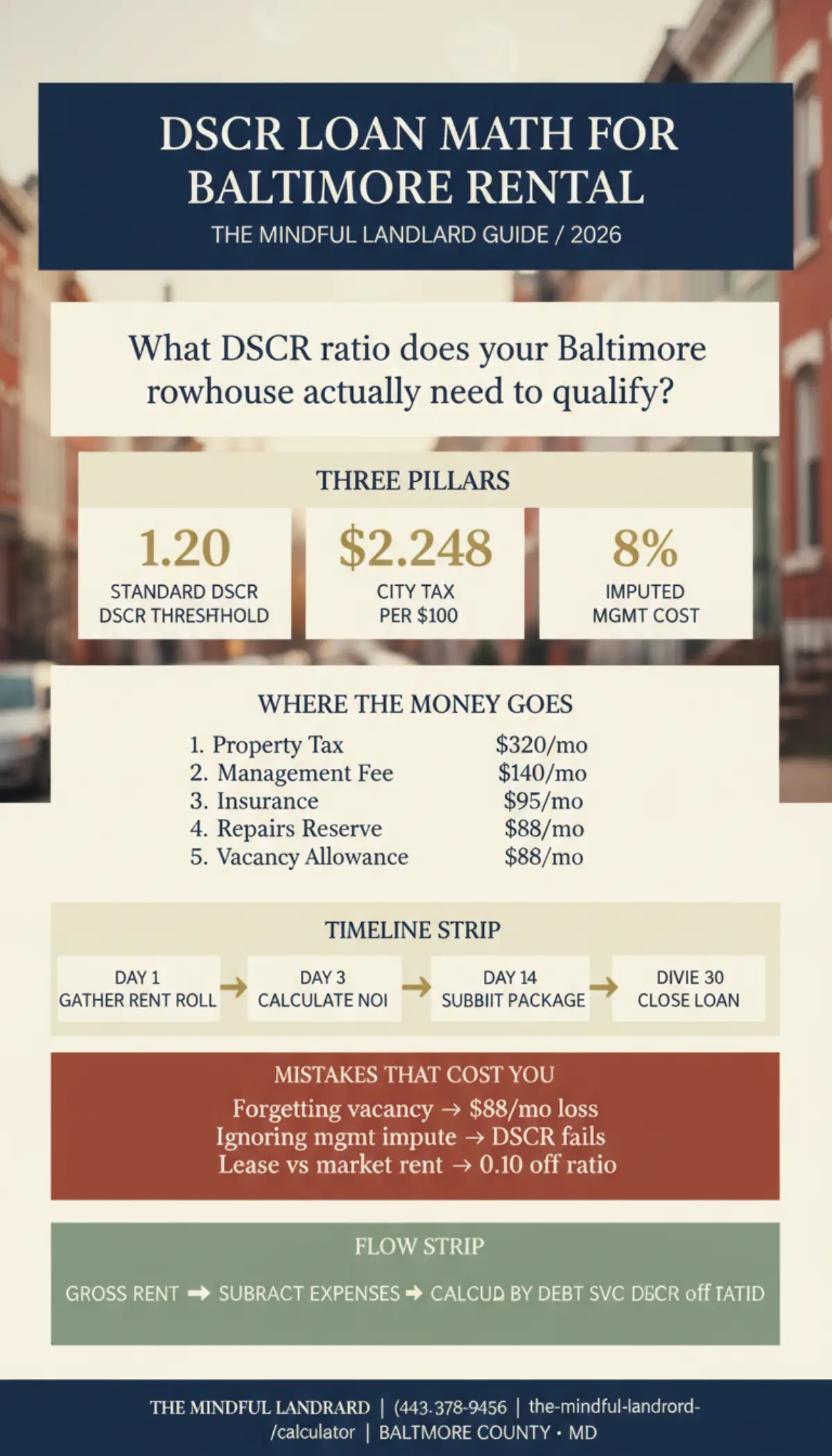
Here’s where Baltimore investors get caught. The lender uses the lower of your appraised market rent or your actual lease rent. Not whichever benefits you. The lower one. If your lease is $150 below current market, that’s $1,800 a year out of your NOI before you start calculating anything. One Locust Point investor learned this the hard way: a below-market lease dropped his ratio from 1.22 to 1.09, surfacing during the rent dispute that ended up at 501 E. Fayette St. District Court in Baltimore City.
Standard threshold: 1.20. Some lenders accept 1.10 but charge 0.25 to 0.50 percent more on the rate and require 25% down. The rate premium feeds back into debt service, so borrowing at 1.10 often tightens the math circularly.
What Counts as NOI vs. What Lenders Strip Out
What if you self-manage and assume that removes management cost from the calculation? It doesn’t. Lenders impute 8 to 10 percent of gross rent as a management expense whether you use a property manager or not. It’s a standard haircut on a Hampden rowhouse or anywhere else in Baltimore City.
Here’s the full NOI stack a lender builds: start with gross rent, subtract vacancy at 5%, subtract the actual property tax bill, subtract insurance, subtract any HOA, subtract imputed management at 8 to 10% of gross, subtract a repairs reserve at 5% of gross.
What you do not subtract: your mortgage payment. Principal and interest are the denominator in the DSCR formula, not a line in NOI. Many investors who build their own pro formas mix this up and underestimate how low the lender’s NOI figure will run.
Baltimore City property tax runs $2.248 per $100 of assessed value in 2026. Baltimore County runs $1.10 per $100. On the same $250,000 assessed property, that’s $5,620 per year in the city versus $2,750 in the county. A $240/month swing in NOI with nothing else changing. If you’re comparing a city rowhouse to a county property, model this explicitly before shopping lenders.
Your Deal, Modeled End-to-End
Let’s work a Patterson Park rowhouse. $1,750 a month gross rent. Here is what the lender actually sees:
Gross rent: $1,750. Vacancy at 5%: subtract $87.50. Adjusted gross: $1,662.50 a month, or $19,950 a year.
Property tax at Baltimore City rate: $220,000 assessed, times $2.248 per $100, equals $4,946 a year ($412/month). Insurance: $95/month ($1,140/year). Management at 8%: $140/month ($1,680/year). Repairs reserve at 5%: $87.50/month ($1,050/year).
Total annual expenses: $8,816.
NOI: $19,950 minus $8,816 equals $11,134 a year, or about $928 a month.
Debt service on $175,000 at 7.50% over 30 years: $1,224/month, $14,688/year.
DSCR: $11,134 divided by $14,688 equals 0.76.
Not a typo. This deal, at 2026 market rates, does not qualify at 1.20. Pull your own numbers first at the-mindful-landlord.com/calculator before sitting across from a lender.
To hit 1.20 with that same $11,134 NOI, annual debt service can’t exceed $9,278. That’s a monthly P&I of $773. At 7.50%, that mortgage size is roughly $108,000. On a $220,000 purchase, you’d need 51% down. Most investors don’t go there. Raising rent, extending amortization, using an interest-only period, or putting more down each move the number. Run those combinations at the-mindful-landlord.com/calculator before you walk into a lender conversation.
Common Pitfalls That Kill Your Baltimore DSCR
Three things consistently knock out Baltimore DSCR applications that investors thought were solid.
First: rental license costs. Baltimore City Code Article 13 requires a rental license at $50 per unit per year, renewable every two years. DSCR lenders familiar with the Baltimore market may add this to your expense projection. If you didn’t budget it, your NOI is overstated. Small number, but it signals to a lender that you’re not modeling the actual city costs.
Second: lead paint compliance reserve. Any pre-1978 property in Baltimore City requires MDE lead certificate compliance under Maryland Code Environment §6-815 before it can legally be rented. That’s $175 to $275 per certification cycle. Budget it as a recurring expense. Missing it isn’t just a DSCR error. It’s a regulatory exposure a lender’s attorney may flag in due diligence.
Third: the security deposit cap. Maryland Real Property §8-203(b) limits your security deposit to two months’ rent. On a $1,750/month unit, your deposit maximum is $3,500. Some investors plan to use deposit funds as an operating capital buffer. It’s capped. Model working capital separately from deposit balances.
Together these costs clip $50 to $80 a month from the NOI a lender calculates. On a deal sitting at 1.22, that’s the margin between a clean approval and a conditional denial.
How to Engineer the Numbers If You’re Below 1.20
Six tactics with real numbers.
Raise the rent. Under Maryland Real Property §8-402, month-to-month tenants require proper written notice before a rent increase. If your current lease is $150 below the Patterson Park market rate, closing that gap adds roughly $1,260 to annual NOI after expense haircuts. That moves a 0.76 DSCR to about 0.85. Better. Not fixed.
Get an interest-only period. A 5-year IO period on $175,000 at 7.50% drops your monthly payment from $1,224 to $1,094. Annual debt service falls from $14,688 to $13,125. DSCR moves from 0.76 to 0.85. Stack an IO period with a rent increase and you get further.
Put more cash down. Cutting the loan from $175,000 to $108,000 hits DSCR 1.20 on our example property. If you’re recycling equity from a Baltimore County property sale or a 1031 exchange, this is a real path.
Shop a different lender. Some DSCR lenders run vacancy at 6% instead of 5%, or impute management at 7% instead of 10%. Each underwriting assumption shifts the final number. Get three DSCR term sheets before committing to one lender.
Try a longer amortization. A 40-year term on $175,000 at 7.50% drops monthly P&I to $1,107. That saves $117/month on debt service and moves DSCR from 0.76 to 0.85 in isolation.
Combine tactics. Raise rent $100, run an IO period for 5 years, put 30% down instead of 20%. Small moves stack into a qualifying DSCR.
Walking Into Your Lender Conversation Prepared
What to bring. What to ask.
Your packet: current rent roll with signed leases (not verbal agreements), a 12-month profit and loss statement for each rental property, three comparable lease comps from similar neighborhoods (Roland Park and Mount Washington frequently serve as comp markets for northern Baltimore rowhouses in DSCR underwriting), current SDAT tax bills pulled from sdat.maryland.gov, and insurance declarations pages.
Ask four questions before you submit anything: one, what is your minimum DSCR threshold? Two, what rate premium applies between 1.10 and 1.20? Three, do you offer an interest-only period and for how long? Four, what does the prepayment penalty structure look like? Some DSCR lenders carry a 5-year step-down prepay. If you plan to refinance when rates drop, that structure matters more than the headline rate.
A prepared packet cuts the underwriting timeline from 30 days to 12. Lenders who do Baltimore rowhouses know the city tax rates, the rental license requirements, and the lead cert rules. Walk in knowing those numbers yourself and you skip the revise-and-resubmit cycle that kills deals when rate locks expire.
Call (443) 378-9456 before you apply. We work with Baltimore City and Baltimore County investors on DSCR scenarios every week. Model your numbers first at the-mindful-landlord.com/calculator, then reach out through the-mindful-landlord.com/contact and we’ll review your rent roll and tell you within about 20 minutes whether your deal pencils at current rates. (443) 378-9456.
What DSCR ratio do most lenders want for a Baltimore rental?
1.20 to 1.25 is the standard. Some lenders accept 1.10 but add 0.25 to 0.50 percent to the rate and typically require a 25% minimum down payment.
Does the appraisal use my actual lease rent or market rent?
Whichever is lower. If your lease is $200/month below current market, that’s $2,400 a year out of your NOI. On a $175,000 loan at 7.50%, that $2,400 drop in annual NOI moves DSCR down roughly 0.16 points.
How much does Baltimore City property tax affect DSCR?
Significantly. Baltimore City’s effective rate is $2.248 per $100 of assessed value in 2026. Baltimore County runs $1.10 per $100. On a $250,000 assessment, that’s $5,620/year in the city versus $2,750 in the county, a difference of $240/month in NOI.
Can I improve my DSCR by self-managing?
Not in underwriting. Lenders impute 8 to 10% management cost regardless of whether you self-manage. You keep that cash if you do it yourself, but the DSCR ratio on your loan application doesn’t change.