Most investors think the BRRRR play is dead in Baltimore. Too many competing buyers, too little distressed inventory, too tight a spread between acquisition and after-repair value. They’re wrong. Patterson Park is still producing deals, and the numbers, when you run them honestly, still work.
Questions about whether a specific property pencils out? Call us at (443) 378-9456. We walk Baltimore investors through the math on real deals every week. If you want to run the numbers yourself first, start at the-mindful-landlord.com/calculator.
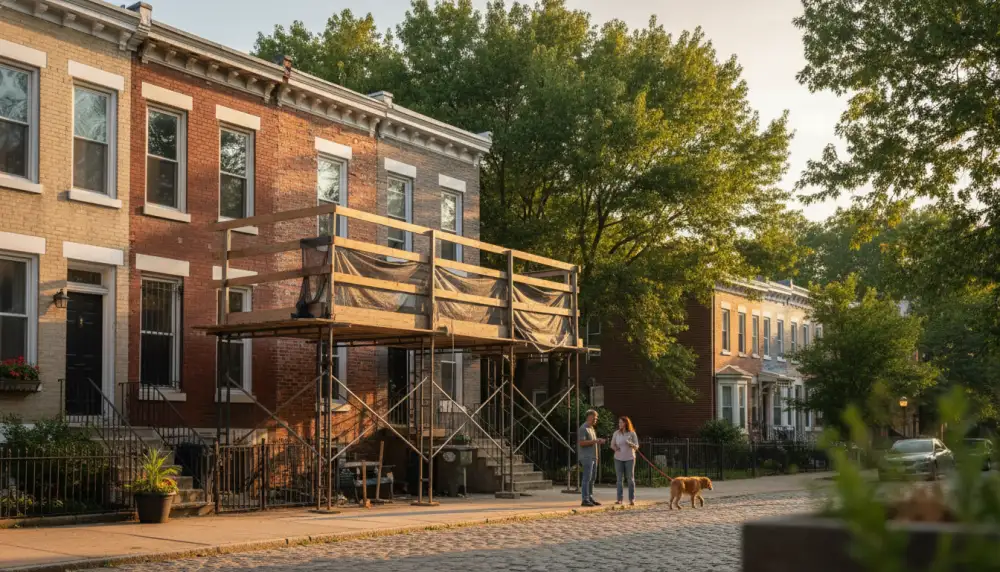
Why Patterson Park Is a BRRRR Candidate in 2026
ZIP 21224 sits at the sweet spot where renovation makes financial sense. Renovated rowhouse median: $250,000 to $320,000. Distressed properties still available at $80,000 to $150,000. That spread is your margin.
Baltimore rowhouse appreciation in 21224 rose approximately 14% from 2022 to 2025 per Bright MLS data. That matters because your ARV assumptions aren’t guesswork. The comps are recent and plentiful. You’re not modeling off one outlier sale from 2019 that nobody can replicate today.
What drives the renter demand? Three things. Hopkins Medical Campus is a 10-minute commute from Patterson Park. I-95 at Boston Street in Canton puts you inside the Beltway in 20 minutes. The park itself, 155 acres of trails, sports fields, and a historic pagoda, draws young professionals who want a neighborhood with character. Federal Hill, Canton, and Highlandtown all funnel overflow renters into Patterson Park when those markets run tight. Consistent demand is the whole game.
When is a BRRRR candidate actually a BRRRR trap? Foundation movement, environmental liens, and active code violations. Walk the alley before you write the contract.
Step 1: Buy. Finding Distressed Rowhouses in Patterson Park
How do you find the deal in 21224 before someone else does? Three sources consistently produce.
Baltimore City’s annual tax sale, typically held each May at the Baltimore Convention Center, lists every property with two or more years of delinquent taxes. You’re buying a lien certificate at auction, not the deed. Converting a tax lien to a clear title takes 12 to 18 months through the foreclosure process. Not fast, but that’s the point. The wholesaler who bought the last dozen deals off Zillow is not your competition at the tax sale.
The DHCD vacant building registry for 21224 is free and public. Filter the list and mail the owners. Owners of long-vacant rowhouses, particularly out-of-state heirs who inherited a problem they don’t want, respond to direct cash offers faster than you’d expect.
Wholesalers who work east-side Baltimore, people you’ll meet at your local REIA meetups, often get assignment deals before they hit the MLS. Margins are thinner but the title work is usually cleaner.
Two things to check before you write a contract. First: environmental liens. Prior remediation work under Maryland Environment Article can attach to the deed and transfer to the buyer. Order a full municipal lien search. Second: foundations. Patterson Park rowhouses that have sat vacant three or more years often show rear foundation movement you cannot see from the street. Walk the alley. Look at the rear wall.
Step 2: Rehab. Baltimore Rowhouse Renovation Costs in 2026
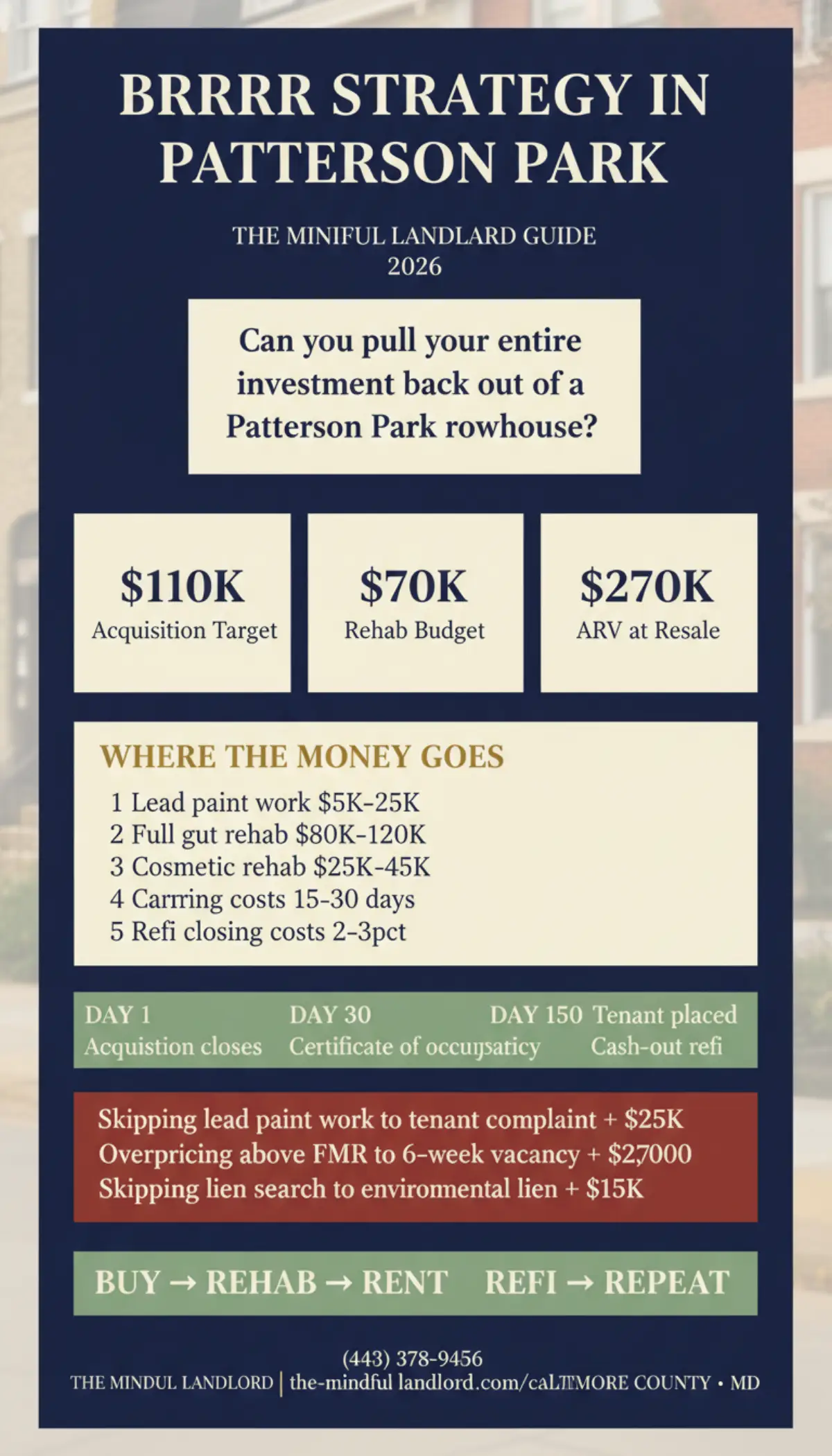
Every Patterson Park rowhouse predates 1978. That means every one of them requires MDE-licensed lead paint work before a tenant can occupy the unit. Maryland Environment Article §6-819 requires either lead-safe interim controls or full abatement. Budget $5,000 to $25,000 depending on scope and square footage. This is not optional, and it is not a DIY line item. Hire a licensed MDE contractor and pull the permit. Inspectors check.
Beyond lead, Baltimore contractor labor has risen roughly 12% since 2023. Get three bids and expect them to vary widely. A light cosmetic rehab, new flooring, paint, kitchen refresh, bathroom update, minor electrical, runs $25,000 to $45,000. Full gut of a vacant rowhouse, new HVAC, plumbing, electrical, drywall, windows, runs $80,000 to $120,000. That range is wide because Patterson Park has everything from fire-damaged shells to structurally sound period homes that just need finishes.
Two line items that catch first-time Baltimore renovators off-guard. Baltimore City building permits for major work run $1,000 to $2,500 depending on scope. DHCD’s post-renovation inspection can take two to four weeks. Factor both into your carrying-cost model.
Step 3: Rent. What Patterson Park Rents Support in 2026
Renovated 3-bedroom units in 21224 are asking $1,700 to $2,000 per month right now. HUD’s FY2026 Fair Market Rent for a 3-bedroom in Baltimore City is approximately $1,850 per month. That FMR is relevant if you plan to accept Housing Choice Vouchers through HABC. On a DSCR underwriting analysis, $1,850 is the conservative number to model.
After a quality renovation, expect three to six weeks of vacancy if you price at or slightly below comparable listings. At $1,850 per month, six weeks of vacancy costs you approximately $2,700. That calculation should make you think hard about pricing $200 over market to “make it back.” You won’t. Price competitively, lease faster, lose less.
One pricing note specific to Ellwood Avenue and Fait Avenue, the streets closest to the park: renovated units there command a 5% to 8% premium over the broader 21224 ZIP. A $1,850 model for those blocks may be conservative by $100 to $150.
Your Deal, Modeled End-to-End
Here is the BRRRR math on a real Patterson Park scenario. $110,000 acquisition on a distressed 3-bedroom, $70,000 full rehab including $15,000 for MDE-licensed lead paint work and permits, equals $180,000 all-in. After renovation, the ARV on comparable renovated 3BR sales in 21224 runs approximately $270,000.
Cash-out refi at 75% LTV equals $202,500. You pull back $22,500 above your total cost. You own a renovated, cash-flowing Patterson Park rowhouse with roughly $22,000 back in your pocket to seed the next acquisition.
Monthly rent: $1,850. DSCR loan refi at 7.5%: monthly principal, interest, taxes, insurance, and association costs come to approximately $1,450. Debt service coverage ratio: 1.28x. That is comfortably above the 1.20x DSCR minimum most Baltimore-area portfolio lenders require to close. The deal covers itself, and the returns are real.
What if the rehab runs $90,000 instead of $70,000? All-in becomes $200,000. The refi still pulls $202,500. Recovered capital drops to $2,500. The deal still works, but the margin for error shrinks. Every $10,000 of cost overrun matters. That’s why the pre-contract walk and MDE scope check are not optional steps.
Run your specific numbers before committing to an acquisition. Use the calculator at the-mindful-landlord.com/calculator to model acquisition cost, rehab budget, ARV, and post-refi cash flow in real time. Change one variable and see exactly how DSCR and equity recovered move. That feedback is faster and more honest than a spreadsheet you built two years ago.
Step 5: Repeat. Scaling from Patterson Park
Once you’ve executed the refi and recaptured capital, the question is what comes next. The pulled proceeds go into the next acquisition. Patterson Park itself, or the adjacent 21224 corridors in Highlandtown and Greektown, share the same cost basis and the same renter demand pool. Three or four deals and you have a real east-Baltimore portfolio.
At three or more units, the math on self-management softens. You’re tracking multiple MDE lead paint registration renewals, multiple DHCD inspection cycles, and multiple tenant maintenance timelines, all while finding and closing the next deal. DSCR loan applications don’t care that you spent 40 hours on maintenance calls last month. They care that your portfolio produces clean rent rolls.
Baltimore County Circuit Court on Washington Avenue handles lease enforcement for county properties. The DHCD rental license renewal calendar is annual for city properties. The MDE lead paint registry is ongoing for all pre-1978 units. Managing those compliance layers across multiple units is a real time commitment. Property managers who know these systems take that weight off so you stay focused on acquisition and growth.
Ready to talk through what professional management looks like for a 2 to 4 unit Baltimore portfolio? Call (443) 378-9456 or reach out at the-mindful-landlord.com/contact. Before your next deal closes, run the portfolio numbers at the-mindful-landlord.com/calculator.
Does the BRRRR strategy work in Baltimore in 2026?
Yes. Baltimore’s combination of low distressed acquisition prices in east-side ZIPs like 21224, stable renter demand near Hopkins Medical Campus, and rising ARVs in neighborhoods like Patterson Park makes BRRRR viable. Mandatory MDE-licensed lead paint work on all pre-1978 stock adds $5,000 to $25,000 to every rehab budget and must be treated as a fixed cost, not a variable.
What is the average after-repair value for a renovated Patterson Park rowhouse?
A fully renovated 3-bedroom Patterson Park rowhouse sold for $250,000 to $320,000 in 2025 and 2026 per Bright MLS data, with units immediately adjacent to the park on Ellwood Avenue and Fait Avenue exceeding $350,000.
What rehab costs should I budget for a Patterson Park BRRRR?
Light cosmetic rehab runs $25,000 to $45,000. Full gut of a vacant rowhouse runs $80,000 to $120,000. Add $5,000 to $25,000 for MDE-licensed lead paint work, required under Maryland Environment Article §6-819 before any tenant can occupy a pre-1978 unit.
What loan type is best for the refinance step in a Baltimore BRRRR?
DSCR loans are the most common refinance vehicle for Baltimore investors. No personal income verification, LLC-compatible, and available from multiple portfolio lenders at rates typically 1 to 1.5 percentage points above conventional. Most lenders require a minimum 1.20x DSCR ratio, calculated as gross monthly rent divided by PITIA.
How do I find distressed properties in Patterson Park to start a BRRRR?
Baltimore City’s annual tax sale, usually held each May, lists every property with 2 or more years of delinquent taxes. The DHCD vacant building registry for 21224 and direct mail to vacant rowhouse owners are two other consistent lead sources that reach motivated sellers before the wholesaler network does.