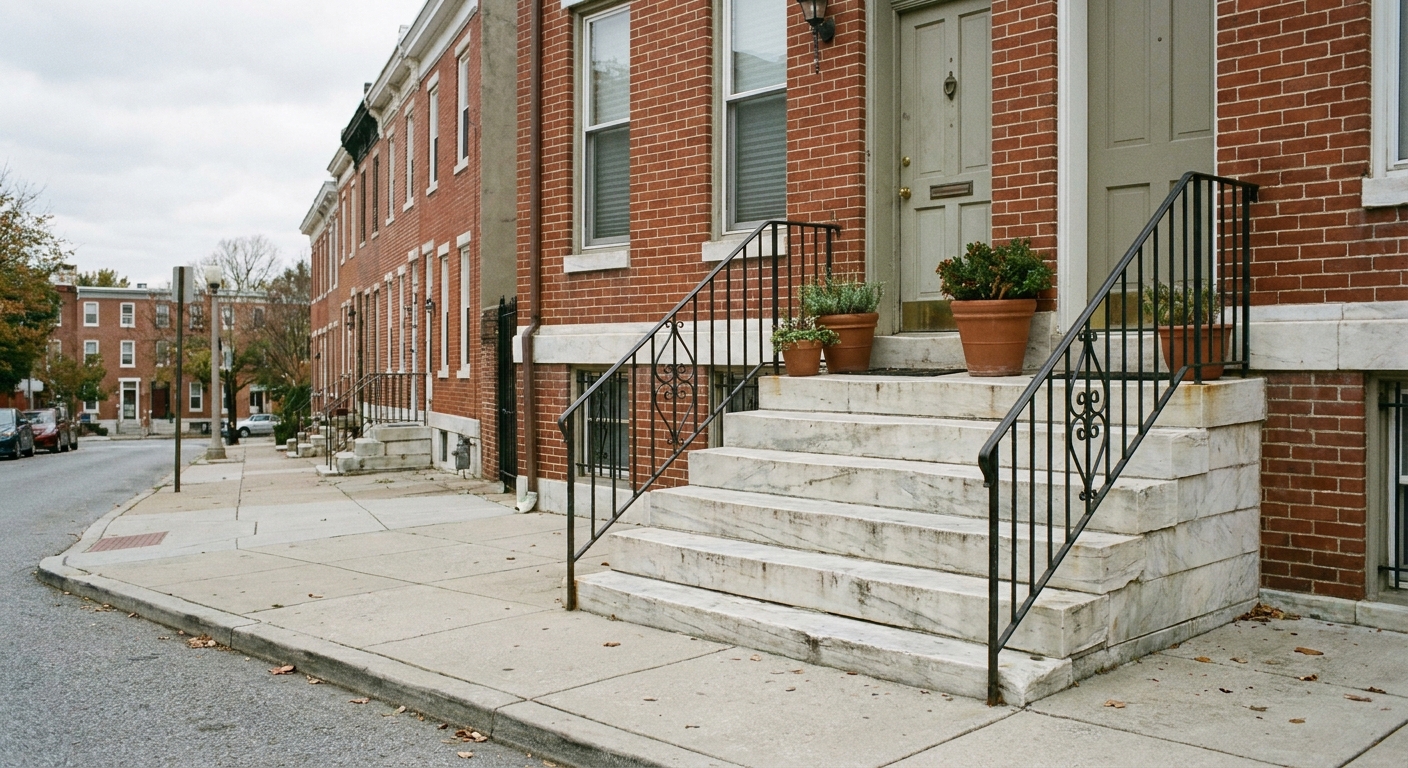
The best Baltimore neighborhoods for rental ROI in 2026 are Hampden, Pigtown, and Remington — where lower acquisition costs produce cap rates of 7–9%. Canton and Federal Hill remain strong long-term holds but have compressed to 4–6% as prices rose. Here is how each major neighborhood stacks up, and what the numbers actually mean for your cash flow.
How to Read Rental ROI: Cap Rate vs. Cash-on-Cash
Before ranking neighborhoods, two numbers matter most:
- Cap rate — annual net operating income divided by purchase price. Ignores financing. Good for comparing properties apples-to-apples.
- Cash-on-cash return — annual pre-tax cash flow divided by your actual cash invested (down payment + closing costs + repairs). Reflects the impact of your mortgage.
A property with a 6% cap rate and 20% down at today’s rates can still deliver a 10–12% cash-on-cash return because rent covers the mortgage and then some. Both metrics matter. A neighborhood with a sky-high cap rate but 15% chronic vacancy is worse than a neighborhood with a modest cap rate and 2% vacancy.
That vacancy point is not theoretical. The Mindful Landlord manages 50+ properties across Baltimore City and County and maintains a 98% occupancy rate — which means the vacancy drag most landlords budget for is largely eliminated when properties are professionally managed.
Canton: Steady Appreciation, Compressed Yield
Canton is one of Baltimore’s most desirable neighborhoods for renters — waterfront access, walkable retail on O’Donnell Street, and strong young-professional demand. That demand has a price.
2026 median rowhome price: approximately $310,000–$380,000
Achievable monthly rent (2BR): $1,750–$2,100
Estimated cap rate: 4.5–5.5%
Canton makes sense as a buy-and-hold play if you expect continued appreciation, but it is a thin cash-flow neighborhood at today’s prices. Investors who bought in Canton before 2020 at $180,000–$220,000 are sitting on much stronger yields. New acquisitions need to pencil carefully.
What works in Canton
Short-term rentals (where permitted), high-end gut renovations targeting $2,200+/month two-bedrooms, and multi-unit rowhouses where you can stack rental income. Single-unit buy-and-holds at full market price are marginal.
Federal Hill: Similar Story, Slightly Better Entry Points
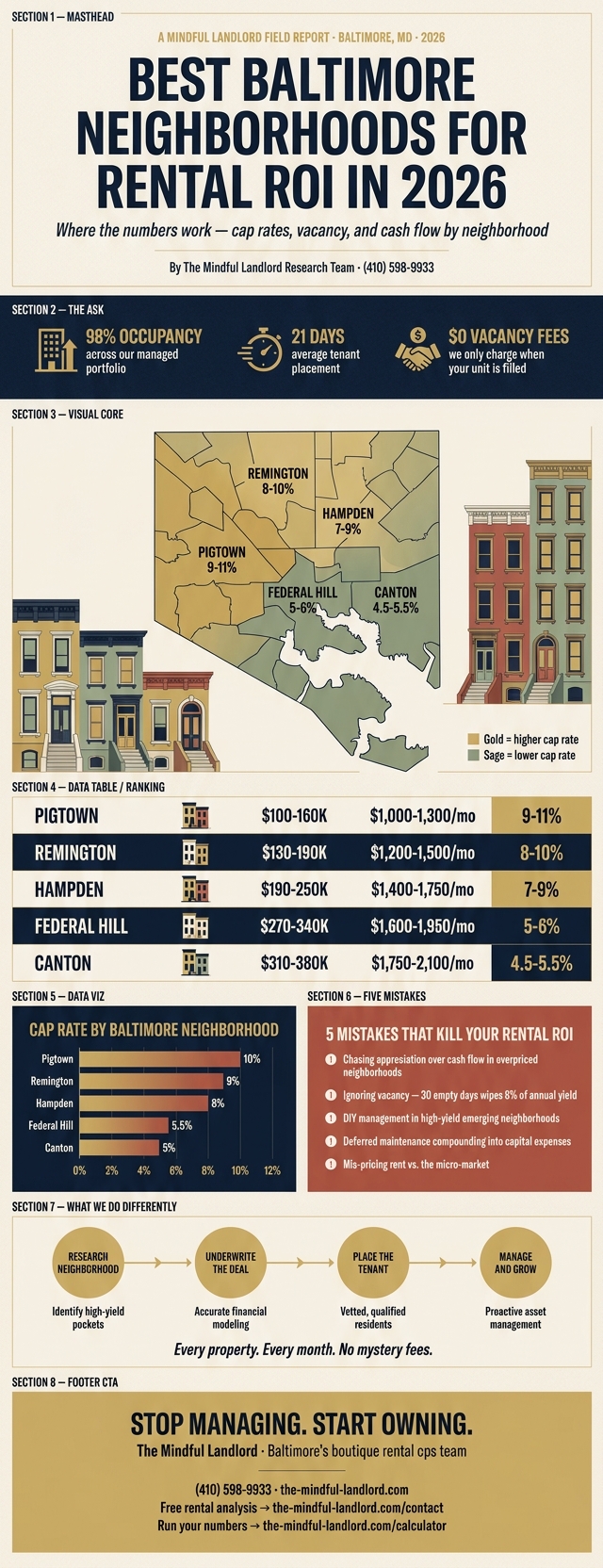
Federal Hill shares Canton’s appeal — proximity to the Inner Harbor, strong walkability scores, and a tenant pool of young professionals and healthcare workers from nearby UMMC. Prices are slightly lower than Canton in most blocks.
2026 median rowhome price: $270,000–$340,000
Achievable monthly rent (2BR): $1,600–$1,950
Estimated cap rate: 5–6%
Federal Hill’s slightly lower price point compared to Canton makes it modestly better for cash flow, while offering similar demand fundamentals. Light Street and Cross Street corridors command a premium; blocks further south toward Riverside offer better cap rates.
Key risk in Federal Hill
Some blocks have historic district overlays and strict renovation rules. Factor permit timelines and materials costs into any value-add underwriting. A basic kitchen refresh that takes 6 weeks in Hampden can take 4 months in a Federal Hill historic district.
Hampden: Baltimore’s Best Cash-Flow Neighborhood in 2026
Hampden is where the math works best for most Baltimore landlords in 2026. The neighborhood sits on the north side of the Jones Falls Valley, anchored by “The Avenue” (36th Street) with independent restaurants, shops, and consistent foot traffic.
2026 median rowhome price: $190,000–$250,000
Achievable monthly rent (2BR): $1,400–$1,750
Estimated cap rate: 7–9%
The Mindful Landlord has managed properties in Hampden for years. The tenant pool skews toward long-term renters — teachers, healthcare workers, tradespeople — who value the neighborhood’s character and relative affordability. That means less turnover and more predictable income.
With a 21-day tenant placement guarantee, properties we manage in Hampden rarely sit vacant longer than two to three weeks between tenants. Combined with $0 vacancy fees (you only pay management fees when a tenant is in place), the true net yield in Hampden is significantly better than the raw cap rate suggests.
Hampden’s appreciation trajectory
Hampden appreciated roughly 18% over 2022–2025 as Canton and Federal Hill priced out value buyers. That appreciation has not yet fully compressed yields the way it did in the waterfront neighborhoods — creating a window for investors who move in 2026.
Remington and Pigtown: The Emerging-Yield Play
For investors willing to accept slightly more execution risk, Remington and Pigtown offer the highest raw cap rates in the Baltimore market today.
Remington (just west of Hampden, north of Johns Hopkins) has benefited from Hopkins-adjacent tenant demand — grad students, researchers, and hospital staff. Rowhomes in the $130,000–$190,000 range routinely rent for $1,200–$1,500/month, producing cap rates of 8–10%.
Pigtown (south of M&T Bank Stadium) is further along in its revitalization arc. Prices are still low ($100,000–$160,000 for solid 2BR rowhouses) and rents are rising as the stadium district redevelopment continues. Cap rates of 9–11% are achievable for investors who buy well and maintain properties correctly.
The execution risk caveat
Higher cap rates in emerging neighborhoods reflect higher management intensity. Tenant screening, maintenance response, and property condition matter more — not less — in these neighborhoods. A 10% cap rate with chronic vacancy, delayed repairs, and a turnover every 10 months performs worse than a 7% cap rate with professional management and stable long-term tenants.
This is exactly why The Mindful Landlord’s 4-hour emergency response standard and proactive maintenance approach is especially valuable in higher-yield neighborhoods. Fast repairs prevent small problems from becoming big ones, and big problems are what destroy cash flow.
Roland Park and Towson: Suburban Stability at Lower Yields
Baltimore County neighborhoods like Roland Park and Towson attract a different investor profile — those prioritizing stability and appreciation over yield. Cap rates typically run 4–5%, but vacancy is extremely low and tenant quality (in terms of income stability and lease adherence) is high.
These markets make sense for investors with a long time horizon who want minimal management intensity. The Mindful Landlord manages properties across both Baltimore City and Baltimore County, with over 20 years of experience navigating the different regulatory environments of each jurisdiction.
How to Choose: A Decision Framework
Here is a straightforward way to think about which neighborhood fits your investment goals:
- Maximum cash flow today: Hampden, Remington, or Pigtown. Budget for active management.
- Balanced cash flow + appreciation: Federal Hill or Hampden. The sweet spot for most Baltimore investors.
- Long-term appreciation, lower yield: Canton, Roland Park, Towson. Better suited for investors with significant equity who want stability.
- Highest potential yield, highest execution risk: Pigtown, Remington, parts of Govans. Only pursue with experienced local management in place.
To speak with a local Baltimore property manager about which neighborhood fits your portfolio goals, call us directly at (443) 378-9456 — we manage 50+ properties across the city and can walk you through real numbers from current units.
Regardless of which neighborhood you choose, the single biggest variable in actual realized ROI is not the neighborhood — it is whether the property is managed to minimize vacancy, maximize tenant retention, and prevent deferred maintenance from compounding into major capital expenses.
Frequently Asked Questions
- Which Baltimore neighborhood has the highest rental ROI in 2026?
- Hampden and Pigtown currently offer the strongest cap rates for single-family and rowhome rentals in Baltimore, typically ranging from 7–9%, due to lower acquisition costs relative to achievable rents.
- What is a good cap rate for a Baltimore rental property?
- A cap rate of 6–8% is considered solid for Baltimore City. Neighborhoods like Canton and Federal Hill tend to run 4–6% due to higher purchase prices, while emerging areas like Hampden and Pigtown can reach 7–9%.
- Does hiring a property manager reduce rental ROI in Baltimore?
- Not necessarily. A full-service property manager typically charges 8–10% of monthly rent. That fee is often offset by lower vacancy (The Mindful Landlord maintains a 98% occupancy rate), faster tenant placement (21-day guarantee), and $0 vacancy fees — meaning you only pay when a tenant is in place.
- What Baltimore neighborhoods are best for long-term buy-and-hold investors?
- Canton, Federal Hill, and Hampden are strong long-term holds because of stable tenant demand, walkability, and consistent appreciation. For pure cash flow, Hampden, Remington, and Pigtown offer better entry points in 2026.
- How do I calculate rental ROI for a Baltimore property?
- Divide your annual net operating income (gross rent minus vacancy, taxes, insurance, maintenance, and management) by the property’s purchase price. A $200,000 rowhome netting $14,000/year equals a 7% cap rate.
Run your own numbers. Before you call anyone, plug your property into our free Rental Performance Calculator — it takes 60 seconds and shows your real cap rate, 5-year equity, and cash-on-cash return.