Lease renewal season is the highest-stakes moment in a Baltimore landlord’s calendar — and most owners treat it like a routine paperwork event. They shouldn’t. A Baltimore lease renewal is a retention decision first and a rent conversation second. Get the order wrong, and a $75/month rent increase that should earn you $900 this year ends up costing you $2,800–$4,200 in vacancy, cleaning, marketing, and re-leasing fees instead. The Mindful Landlord has managed 50+ properties across Baltimore for over 20 years, and the math never lies: keeping a good tenant almost always beats finding a new one.
Why Lease Renewal Deserves More Attention Than the Rent Raise
The True Cost of Tenant Turnover in Baltimore
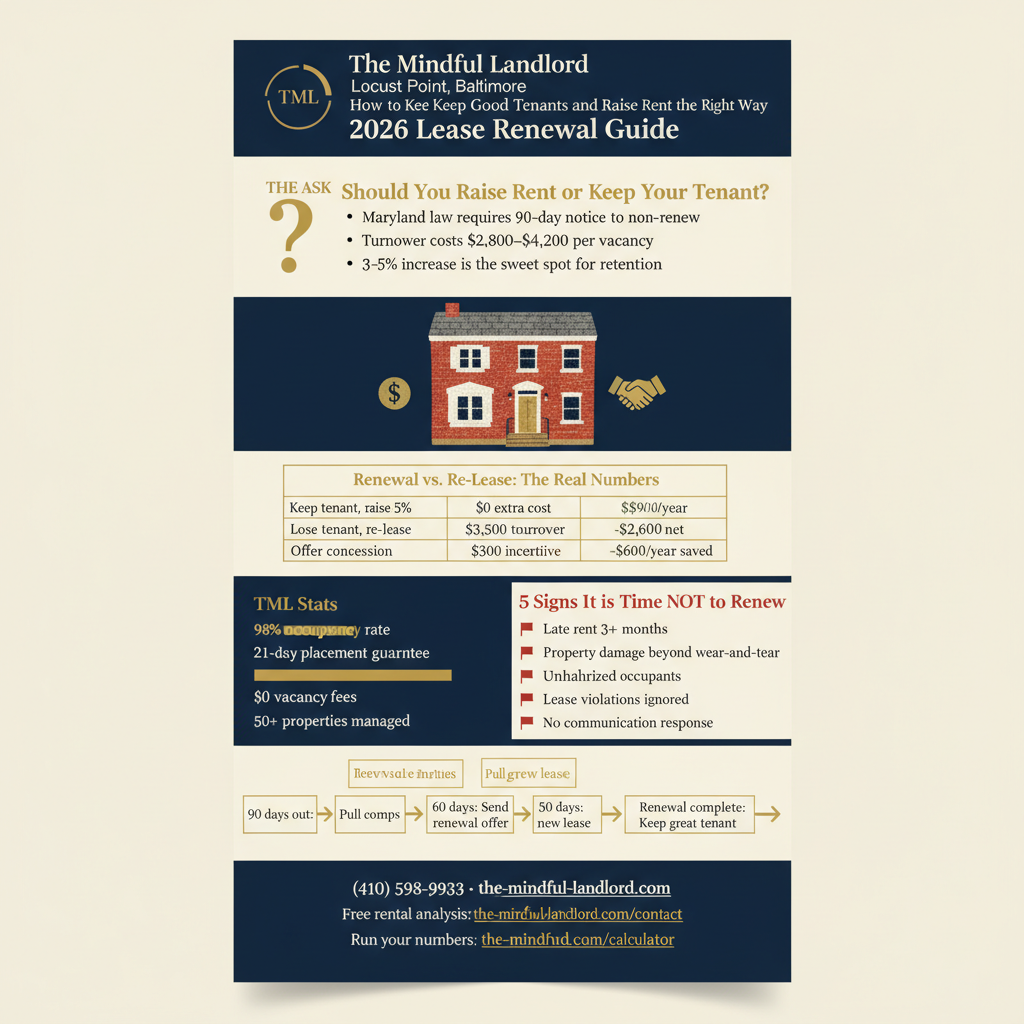
Run the numbers before you run to Zillow. On a $1,400/month Locust Point rowhouse, a $75 rent increase nets $900 in year one. Sounds like a win. But if that tenant walks, you’re looking at 2–4 weeks of vacancy ($700–$1,400 in lost rent), a professional cleaning ($250–$400), fresh paint and minor repairs ($300–$600), and placement costs if you use a property manager ($800–$1,800). Total: $2,800–$4,200 out of pocket — before you collect a single dollar from the replacement tenant.
The retention calculus is clear: unless you’re severely underpriced, the right question at renewal isn’t “how much can I raise rent?” It’s “how much is this tenant worth keeping?”
What TML’s 21-Day Placement Guarantee Actually Tells You About Vacancy Risk
The Mindful Landlord backs its placements with a 21-day tenant placement guarantee — meaning we find qualified tenants in three weeks or fewer. That’s one of the fastest turnaround times in the Baltimore market. But here’s the thing: even 21 days of vacancy on a $1,500/month unit is $1,050 in lost rent. Add placement fees and turnover prep, and you’re staring at $2,500–$3,500 minimum per turnover event. Our 98% occupancy rate across all managed properties isn’t an accident — it’s the result of treating renewals as the retention tool they are.
Maryland Law: What You Must Do Before Renewing (or Not Renewing)
Required Notice Periods Under Maryland Code
Before anything else, know your legal obligations. Under Maryland Real Property section 8-402, the notice requirements are non-negotiable:
- Month-to-month tenancies: Either party must give at least 1 month’s written notice before terminating.
- Annual leases: If a landlord does not intend to renew, they must provide 90 days’ written notice before lease end. Failure to do so can result in an automatic renewal or legal complications.
- Rent increases: Cannot take effect mid-lease without a written addendum signed by both parties. The increase applies at renewal, with notice per the lease terms.
Locust Point and Baltimore City Lease Addendum Requirements
Baltimore City adds a layer of requirements on top of state law. Landlords operating in Locust Point and other city neighborhoods must comply with Baltimore City’s lead paint addendum rules (for pre-1978 housing), habitability certifications, and any applicable rental registry updates. If your property is subject to a Housing Authority overlay or historic district restrictions, verify that your renewal documentation reflects current city requirements. Questions? Call TML at (443) 378-9456 — our team fields city compliance questions daily.
When Your Lease Auto-Renews — and When It Doesn’t
Many Baltimore leases contain auto-renewal clauses. Read your lease: if yours auto-renews on the same terms, you may need to act before a trigger date (often 60–90 days out) to modify rent or terms. If the lease is silent on auto-renewal, Maryland law defaults the holdover tenancy to month-to-month under section 8-402. Don’t assume — a missed trigger date can lock in flat rent for another full year.
How to Calculate the Right Rent Increase for Your Baltimore Rental
Pulling Real Comps: Zillow, Rentometer, and Baltimore MLS Data
Start with data, not gut feel. Here’s a repeatable comp process TML uses across its managed portfolio:
- Zillow Rent Estimate: Pull the estimate for your exact address. Note the range, not just the midpoint.
- Rentometer: Run a 0.5-mile radius search for similar bedroom counts. Look at median rent and the 25th–75th percentile range.
- Baltimore MLS / Bright MLS: Filter recently leased comparables in the same zip code, similar square footage. This is the most accurate signal.
- Walk the neighborhood: In Locust Point, a block can shift $150–$200/month depending on water views, parking availability, and proximity to the Under Armour campus.
The 3–5% Rule and When to Break It
For reliable, long-term tenants, TML recommends a 3–5% annual increase as the default. On a $1,500/month unit, that’s $45–$75/month — meaningful revenue without triggering a move-out decision. Break the rule upward only if your property is 10%+ below market and you’re willing to risk turnover. Break it downward (or skip the increase entirely) if the tenant has exceptional payment history, keeps the unit in great condition, or is filling a unit that historically sits vacant for 45+ days.
How TML’s 20+ Years of Baltimore Data Informs Renewal Pricing
With over 20 years of experience managing Baltimore rentals and $0 vacancy fees charged to owners during placement, TML has longitudinal data on what rent levels drive turnover in specific neighborhoods. Locust Point and Federal Hill regularly support 4–6% annual increases without elevated churn. Neighborhoods with newer construction comps (Harbor East, Fells Point) compress landlord pricing power. If you’re unsure where your property falls, use the free calculator below — or call (443) 378-9456 for a free renewal consultation.
Use Our Free Lease Renewal Calculator to Run the Math
Should you raise rent — or risk turnover? Run the numbers in under 60 seconds at the-mindful-landlord.com/calculator. Enter your current rent, proposed increase, and estimated turnover cost to see your net ROI for keeping vs. re-leasing.
Open the CalculatorCalculator Inputs: Current Rent, Proposed Increase, Estimated Turnover Cost
The TML lease renewal calculator takes three primary inputs: your current monthly rent, the proposed increase amount, and your estimated turnover cost (vacancy + cleaning + repairs + placement). It outputs year-one and year-three net ROI for both the renewal path and the re-lease path — so you can see the real cost of the decision, not just the rent line.
How to Interpret Your Results: Keep or Re-Lease?
If your year-one renewal ROI is positive and your estimated turnover cost exceeds the cumulative rent delta over 18 months, renew. If the tenant is chronically late, has caused property damage, or if your unit is more than 12% below market, the re-lease path may pencil. The calculator doesn’t make the decision — it makes the math honest.
Real Example: A Locust Point Rowhouse, 2026 Renewal Season
Take a real scenario: a $1,500/month Locust Point unit, tenant in place for 2 years with perfect payment history, proposed $75/month increase. If the tenant accepts: $900 in year-one revenue gain. If the tenant declines and vacates: $3,500 in estimated turnover costs (3 weeks vacancy at $1,500/month equals $1,125 + $600 cleaning/repairs + $1,775 placement). Net difference: the rent increase saves $4,400 versus the turnover scenario in year one alone. The calculator confirms: renew.
Writing the Renewal Offer: How to Make Tenants Say Yes
Timing the Offer: 90, 60, or 30 Days Out?
Send the renewal offer 60–90 days before lease expiration. Sixty days gives the tenant time to consider without feeling pressured, and gives you a 30-day window to pivot if they decline. Annual leases in Maryland require 90 days’ notice for non-renewal, so sending your renewal offer at 90 days also starts that clock cleanly. Waiting until 30 days out is legally marginal and practically unwise — it signals disorganization and often triggers a decline.
What to Include in the Renewal Letter (Template Outline)
A strong Baltimore renewal letter covers:
- Current lease expiration date and proposed new term
- Current rent and proposed new rent (with effective date)
- Any changes to lease terms (updated addenda, utility responsibility changes, etc.)
- Response deadline (typically 15–21 days)
- A brief, human acknowledgment of the tenant relationship: “We appreciate your care of the property and your consistent on-time payments.”
- Contact information for questions — for TML-managed properties, that’s (443) 378-9456
TML handles renewal communications as part of full property management — including drafting, delivery, and follow-up negotiations.
Incentives That Work: Small Upgrades vs. Rent Concessions
Sometimes a small incentive tips a fence-sitting tenant into a yes. The most effective options in the Baltimore market:
- Minor upgrades: New bathroom fixtures, fresh kitchen hardware, a smart thermostat ($150–$350 cost, high perceived value)
- Rent hold for 6 months: “We’re holding rent flat through October, then moving to market rate.” Splits the difference and keeps a good tenant.
- One-time renewal bonus: A $200–$300 gift card or appliance upgrade for signing a 2-year term
A $250 upgrade costs a fraction of $3,500 in turnover. Use incentives strategically for tenants worth keeping, not as a standard offer to all.
When NOT to Renew: Red Flags That Signal It’s Time to Re-Lease
Late Payment History and What It Predicts
Three or more late payments in a 12-month period — even if eventually paid — is a statistically significant predictor of future delinquency. In Maryland, the eviction process is time-consuming and costly. If a tenant’s payment pattern is deteriorating, non-renewal is cleaner and less expensive than a future eviction. Document the late payments with timestamps before making the non-renewal decision.
Property Damage vs. Normal Wear and Tear Under Maryland Law
Maryland distinguishes between normal wear and tear (landlord’s responsibility) and tenant-caused damage (tenant’s liability). Scuffed paint and carpet wear after 3+ years: normal. Holes in walls, broken fixtures, and pet stains on hardwood: damage. If a mid-lease inspection reveals significant tenant-caused damage, factor the repair cost into your renewal calculus. A tenant who costs $1,500 in damage per year is not a good tenant to retain, regardless of on-time payments.
The Quiet Decline: Signs a Tenant Has Stopped Caring for the Unit
Sometimes the signal is softer: a tenant who stops reporting maintenance issues (which means they’re living with them or causing them), who ignores HOA notices, or whose unit shows visible neglect at the annual inspection. TML’s systematic inspection process — part of full property management — catches quiet decline before it becomes an expensive repair bill. If the inspection tells a story of deterioration, non-renewal with proper 90-day Maryland notice is the professional response.
Frequently Asked Questions About Lease Renewal in Maryland
- How much notice does a Baltimore landlord have to give before raising rent?
- For a fixed-term lease, the rent increase takes effect at renewal — the landlord must give notice per the lease terms or Maryland’s statutory notice periods (1 month for month-to-month, 90 days to non-renew an annual lease). Rent cannot be raised mid-lease without a written addendum and tenant agreement.
- How much can a Baltimore landlord raise rent at renewal?
- Maryland has no statewide rent control. Baltimore City’s proposed rent stabilization bill has not passed as of 2026. TML recommends 3–5% for good tenants to balance market rate with retention value. The free calculator at the-mindful-landlord.com/calculator can model the net ROI of any proposed increase.
- What happens if a tenant stays after the lease expires in Maryland?
- In Maryland, if a tenant stays beyond lease end without a signed renewal, the tenancy typically converts to month-to-month under the same terms. The landlord can issue a 1-month notice to quit or negotiate a new term under MD Real Property section 8-402.
- Is it worth offering an incentive to renew a lease in Baltimore?
- Yes, for reliable tenants. A small upgrade or one-month rent hold can cost $200–$500 but prevent $2,800–$4,200 in vacancy and re-leasing costs. TML’s 21-day placement guarantee illustrates what fast turnaround looks like — but prevention is always cheaper.
- Does a Baltimore landlord need a reason to not renew a lease?
- For most residential leases in Maryland, a landlord is not required to give a reason for non-renewal — just proper notice (typically 90 days for annual leases). However, non-renewal cannot be retaliatory or discriminatory under the Fair Housing Act and Maryland state law.
Ready to stop stressing over lease renewals? Call (443) 378-9456 or visit the-mindful-landlord.com/contact for a same-day response.