How a nonpayment case moves through the city court

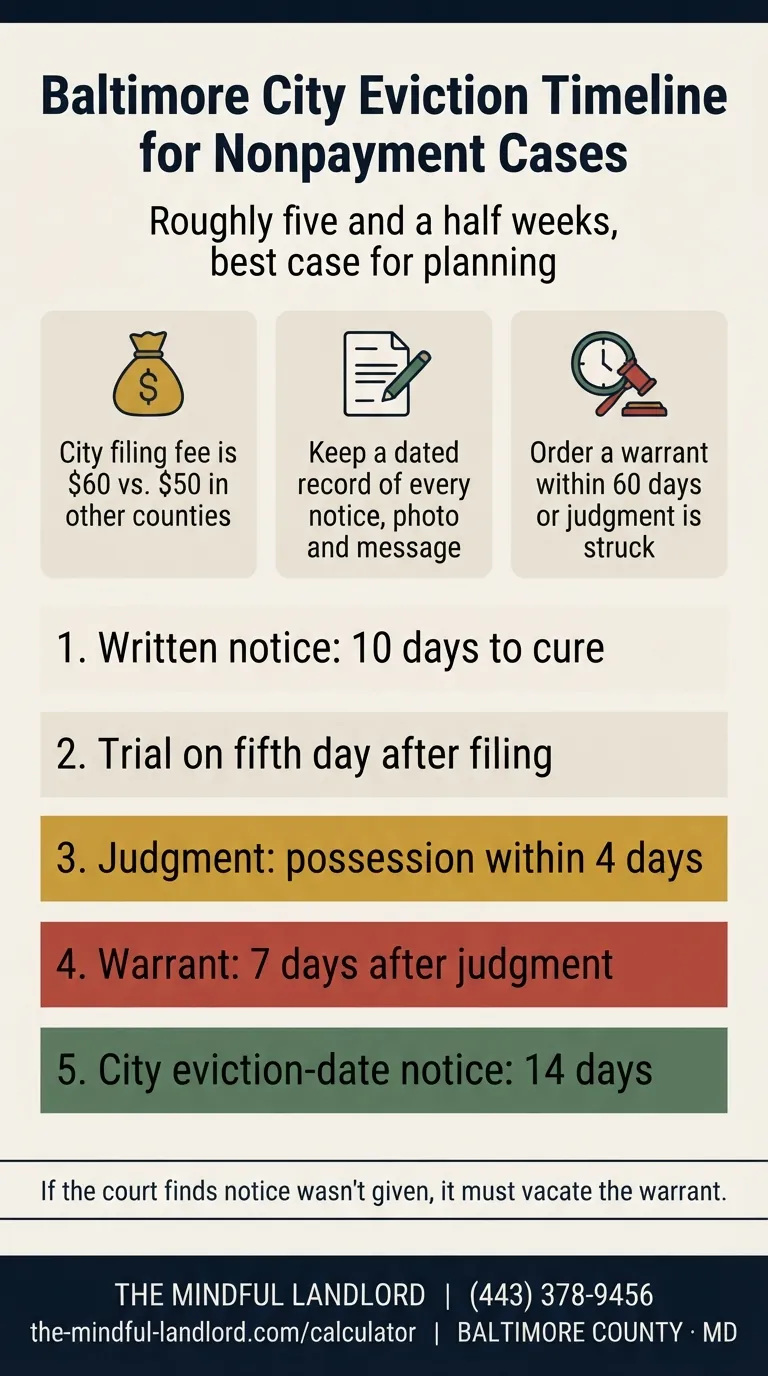
You give the tenant a written notice of intent to file, and the tenant gets 10 days to cure. That notice has to be on the Maryland Judiciary form and go out by first-class mail with a certificate of mailing, by posting on the door, or electronically if the tenant chose that. Your complaint has to state the date the notice was given, and if the tenant successfully challenges that date, the court may dismiss the case. Keep the certificate of mailing, a dated photo of any posting, and a copy of the form in the tenant file before you do anything else. Write the notice date on your copy so the date in your complaint matches what you can show. If you aren’t sure you have the current form, ask the court clerk before you send it.
After you file, the summons tells the tenant to appear at a trial held on the fifth day after filing. If the court finds rent is owed, the judgment orders possession returned to you within 4 days after trial. The court can issue the warrant of restitution only after the tenant has failed to comply for 7 days after judgment.
The Baltimore City filing fee for a failure-to-pay-rent complaint is $60, compared with $50 in other counties. Budget it as your cost. You can pass filing fees to the tenant only if the court grants you possession and the lease allows you to deduct them from the security deposit, and a lease can’t set up any other way to collect them. Read your lease’s security deposit clause before you count on getting the fee back. If the lease says nothing about it, treat the fee as money you may not recover.
The city’s eviction-date notice adds the longest wait
Once the warrant issues, Baltimore City adds its own step. You mail notice of the first scheduled eviction date by first-class mail with a certificate of mailing at least 14 days before that date. The day you mail or post counts as Day 1.
State law runs alongside it. Under Real Property § 8-407, once a warrant issues you have to notify the tenant of the scheduled eviction date at least 6 days ahead, by first-class mail with a certificate of mailing, by posting on the front door with a date-stamped photo, and by email or text if you have that contact information. The statute lets local governments raise that period to as many as 14 days.
If the sheriff believes the § 8-407 notice wasn’t given, or that the tenant may have redeemed, the sheriff may not carry out the eviction without a further court order. If the court finds the notice wasn’t given, it must vacate the warrant. A tenant who wins on a violation can recover actual damages and reasonable attorney’s fees. Keep a dated record of every notice, photo and message after judgment, and keep it longer than you think you need to. A simple notice log helps here. For each notice, record what you sent, how you sent it, the date, and where the proof is stored. Hypothetically, say a tenant later claims the door posting never happened. If your log points to a date-stamped photo and a certificate of mailing in the same folder, you can answer that in minutes.
If you count every step at its earliest possible day, you get 10 days of notice, a trial on the fifth day after filing, 7 days after judgment before the warrant, and 14 days of city notice. That’s roughly five and a half weeks. Use that as a best case for planning, and build your cash reserve around a longer stretch.
What pushes a case toward three months
In a failure-to-pay-rent case, the tenant can pay the past-due amounts at trial. Bring an updated ledger to trial showing every charge and payment through that morning. Hypothetically, if a tenant offers payment and you aren’t sure the amount covers what’s owed, ask the judge how to proceed rather than guessing.
If you don’t order a warrant within 60 days of the judgment, or of the end of any stay, the judgment for possession is struck, and the same thing happens if you order a warrant but take no action on it within 60 days. Calendar the judgment date the day you get it.
Not sure what your rental should earn or what this will cost you? Run the numbers in our free rental calculator at https://the-mindful-landlord.com/calculator, or call us at (443) 378-9456.
Holdovers and lease violations follow a slower calendar
Not every case is about rent. If a tenant stays past the lease or breaks a lease term, start documenting the day you notice the problem. A vague note like “always loud” is hard to prove. A log of specific incidents, photos and neighbor statements is a much stronger file. Write each entry the same day, with the time, what happened and who saw it. Confirm the notice period that applies to your situation before you send anything. For a side-by-side of every notice period, see our breakdown of Maryland eviction notice periods for Baltimore landlords.
When it makes sense to hand the case off
Many owners can run a clean nonpayment case themselves if they own one or two city units, live nearby and keep good records. The process is mostly forms and dates. If you’re weighing help, ask in this order: Who signs and files the complaint? Who attends trial? Who tracks the post-judgment deadlines and the city notice? How will you get copies of every notice and photo? Consider handing off the case if you live far from the unit, can’t attend court, or have already missed a notice step.
The Mindful Landlord manages 50+ properties across Baltimore City and Baltimore County for a flat 10% of rent collected. If you want the full sequence from lease signing to possession, our Maryland eviction process guide lays it out.
Whoever handles it, collect these before you serve the first notice:
- the lease
- the rent ledger
- the tenant’s phone and email
- a camera that date-stamps photos
Then set up one folder, paper or digital, and file each notice, photo and receipt in it the same day.
Questions people ask
Does the tenant get a chance to pay before I can file? Yes. After the written notice of intent to file, the tenant has 10 days to cure before you can file the complaint.
What happens if I wait too long after winning? If you don’t order a warrant within 60 days of the judgment or the end of any stay, the judgment for possession is struck.
What should I bring to trial?
Own a rental in Baltimore City or Baltimore County? Tell us about it at https://the-mindful-landlord.com/contact or call (443) 378-9456. To see the numbers first, use the free calculator at https://the-mindful-landlord.com/calculator.