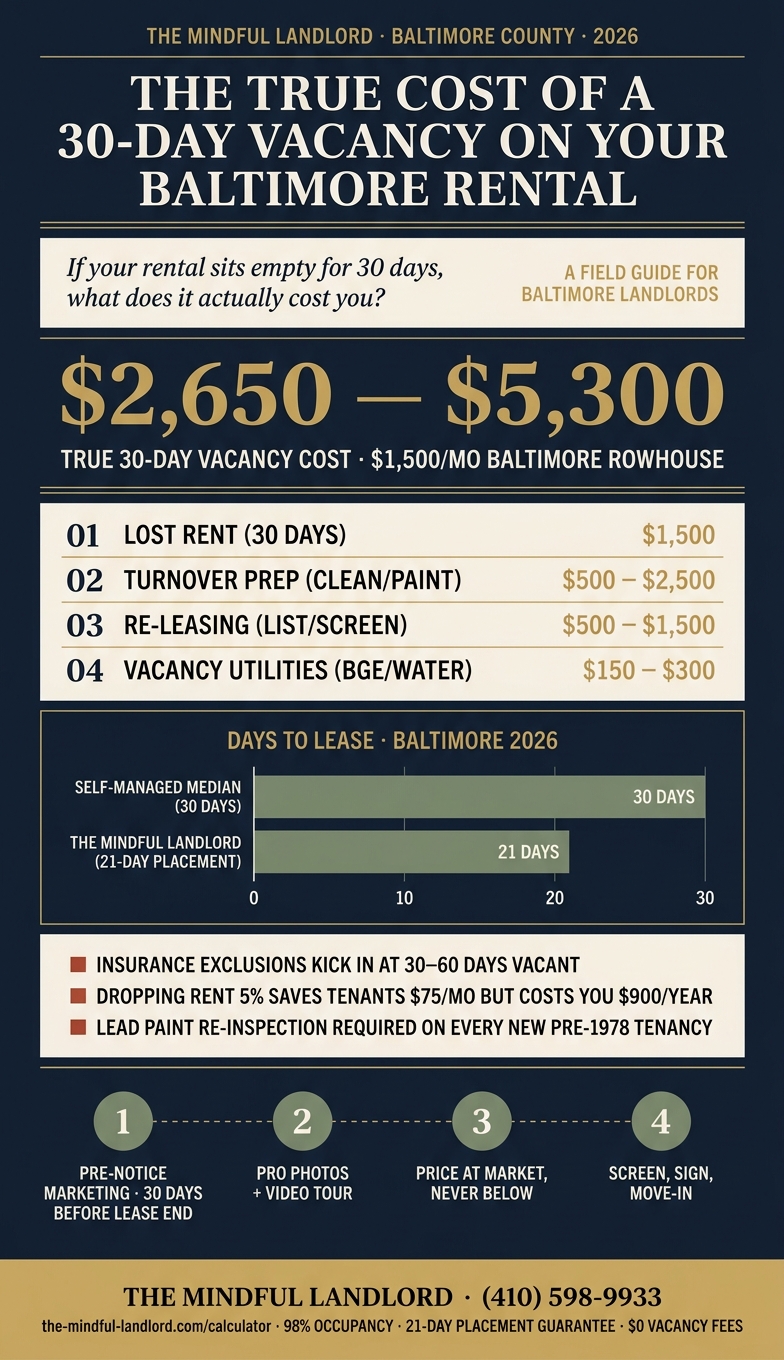
A 30-day vacancy on a typical $1,500/month Baltimore rental rowhouse does not cost you $1,500. It costs you between $2,650 and $5,300 once you add utilities you keep paying, turnover prep, lead paint compliance, and re-leasing costs. Most landlords budget for one number and quietly absorb the other four. This guide builds the full vacancy model, anchors it in Baltimore-specific numbers, and hands you a free vacancy and ROI calculator so you can run your own property in under a minute.
Lost Rent Is Just the Start: The Full Vacancy Cost Model
Most landlords underestimate vacancy because they only count the rent check that did not arrive. The full picture has four components, and three of them keep draining your account whether or not a tenant is in the unit.
Lost gross rent
For a $1,500/month Baltimore rowhouse, every day vacant equals roughly $50 in lost rent. A standard 30-day gap is $1,500 gone before any other line item. Forty-five days climbs to $2,250. Rent is the one cost that compounds across both ROI and tax liability.
Utilities you still pay during vacancy
BGE does not turn off when the tenant moves out. To keep pipes from freezing, drywall stable, and the unit show-ready, most Baltimore landlords run heat at 55°F, AC at 78°F, and keep water on. Expect $80 to $120 per month in BGE plus $40 to $80 in city water/sewer — roughly $150 to $300 for a 30-day gap.
Turnover prep
Even a clean tenant leaves a unit needing professional cleaning ($200–$400), interior touch-up paint ($300–$900), and minor repairs to door hardware, blinds, and grout ($100–$500). If carpets need replacement or appliances are end-of-life, add $1,000–$1,500 more. Realistic turnover prep on a Baltimore rowhouse: $500 to $2,500.
Re-leasing costs
If you self-manage, your re-leasing cost is your time. If you hire a leasing-only service, expect to pay one half to one full month of rent. Add tenant screening ($30–$50 per applicant) and professional photography ($150–$250). Real number: $500 to $1,500 per turn.
What Baltimore-Specific Costs Look Like in 2026
Vacancy economics in Remington, Hampden, or Govans are not the same as a generic national average. Three Baltimore line items quietly inflate the bill.
| Cost Component | Low | High | Source / Notes |
|---|---|---|---|
| Lost rent (30 days @ $1,500/mo) | $1,500 | $1,500 | U.S. Census ACS rowhouse rent |
| Vacancy utilities (BGE + water) | $150 | $300 | BGE residential vacant-unit averages |
| Turnover prep (clean, paint, repairs) | $500 | $2,500 | The Mindful Landlord, 50+ properties |
| Re-leasing (listing, screening, showings) | $500 | $1,500 | NARPM Baltimore market data |
| Lead paint re-inspection (pre-1978) | $25 | $150 | Maryland Department of the Environment |
| Total 30-day vacancy | $2,675 | $5,950 | Real cost on a typical Baltimore unit |
Baltimore City requires rental license renewal every two years, not at every turnover, but lead paint inspection compliance must be current for every new tenancy in any pre-1978 unit — and Baltimore’s housing stock skews older than 80% pre-1978 in neighborhoods like Remington and Hampden. The Maryland Department of the Environment sets the inspection rules. The U.S. Census confirms median rent and housing-age data.
Neighborhood pricing matters. Remington median rent ran around $1,550 in early 2026; Govans about $1,300; Canton north of $2,000. The dollar cost of a 30-day vacancy scales with rent, but utilities, turnover, and lead paint do not — which means lower-rent neighborhoods feel vacancy proportionally harder.
The 21-Day vs. 30-Day Gap: Why Placement Speed Is a Financial Decision
The single biggest variable in vacancy cost is days vacant. The Mindful Landlord runs a 21-day tenant placement guarantee backed by data from 50+ managed Baltimore properties. The Baltimore market median for properly priced units sits at 25–35 days. Nine days does not sound like much. On a $1,500/month rental, those nine days are worth $450 — about three months of an 8% management fee.
What happens at day 22, day 30, day 45
At day 22 you start to lose insurance protection on some carriers, who exclude or surcharge vacant properties past 30–60 days. At day 30 you are paying a full month of utilities and have started a second cleaning to keep the unit showable. At day 45, most landlords start cutting price, which compounds the loss into next year’s rent ceiling.
Compounding cost on annual ROI
One avoided 9-day delay per turn is $450. If your average tenancy is 18 months, that is $300/year in pure ROI improvement on a single unit, every year, forever. Across 5 units, that is $1,500/year — roughly the cost of professional management for one of those units.
What Vacancy and Bad Tenants Really Cost You
Vacancy alone hurts. A bad-tenant cycle hurts more. Baltimore’s failure-to-pay-rent timeline through Rent Court typically runs 60–90 days from filing to warrant of restitution per the Maryland Courts guidance, with court costs of $150–$300 per filing and damages on a contested move-out commonly running $2,000–$5,000. Add 30+ days of additional vacancy after the eviction, and a single bad-tenant cycle can total $8,000 to $15,000+ all-in.
Before You Commit, Run the Numbers
Generic averages do not match your property. Plug your real rent, your turnover prep cost, and your last vacancy length into our free Baltimore Vacancy & ROI Calculator to see your annual vacancy drag. Most landlords find their actual number is 30–60% higher than the rough estimate they had in their head. Then call (443) 378-9456 and we will walk you through how a 21-day placement on your specific unit would change the math.
How to Minimize Vacancy Without Racing to the Bottom on Price
The reflex when a unit sits is to drop the rent. That is almost always the wrong move. A 5% rent cut on a $1,500/month unit saves a future tenant $75/month and costs you $900 over the next year — and it resets your comp ceiling for the entire neighborhood.
Pre-notice marketing: 30 days before lease end
The single most effective vacancy lever is starting to market 30 days before your current tenant moves out. NARPM market data and our internal numbers across Baltimore County and City service areas show this reduces average days vacant by roughly 40%. It costs nothing.
Professional photos and pricing at market
Listings with professional photography and a 30-second walkthrough video lease 15–20% faster on average. On a $1,500 unit, that is another 4–6 days of avoided vacancy. Pricing slightly below market does not just lose you future rent — it attracts a different applicant pool. Properly priced units screen better and stay leased longer. Our full-service management handles all of this on a 21-day placement guarantee.
The Property Management Math: Is 8–10% Worth It?
On a $1,500/month Baltimore rental, an 8–10% full management fee runs $120 to $150 per month, or $1,440 to $1,800 per year. One prevented vacancy event saves $2,650 to $5,300. The break-even is straightforward: if a property manager prevents one extra vacancy event over the lifetime of your ownership, the math favors professional management. Across our 50+ managed Baltimore properties, the average is closer to one prevented vacancy event every 18 months — roughly 2x the break-even.
How The Mindful Landlord Helps
The Mindful Landlord runs Baltimore rental properties at a 98% occupancy rate with a 21-day tenant placement guarantee and $0 vacancy fees. Pricing is transparent: 8–10% of monthly rent for full management, one month’s rent for leasing-only. You can cancel anytime with 30 days’ notice. We staff a licensed general contractor in-house, which compresses turnover prep timelines (typically 5–9 days vs. the Baltimore self-manage average of 14–21). Browse our latest landlord guides or get a free rental analysis at (443) 378-9456.
A Real Remington Scenario
A landlord who owns a $1,550/month rowhouse near Hampden Avenue called us in late February 2026. Her tenant gave 30 days’ notice, but she did not start marketing for two weeks because she wanted to repaint first. The unit sat vacant for 41 days. Her actual costs: $2,107 in lost rent, $245 in BGE and water, $1,200 in paint and cleaning, $150 in lead paint re-inspection, and $775 to a leasing-only agent — $4,477 total.
If she had started marketing the day notice was given, used the calculator to set rent precisely at the Remington 2026 median, and bundled paint with the previous tenant’s exit walk-through, her vacancy would have closed around day 18. Estimated savings: $1,650. We are now her property manager. Her last two turnovers averaged 17 days.
Frequently Asked Questions
What does it actually cost to have a vacant rental unit in Baltimore for 30 days?
For a typical $1,500/month Baltimore rowhouse, a 30-day vacancy costs roughly $2,650 to $5,300 all-in: $1,500 in lost rent, $150–$300 in vacancy utilities, $500–$2,500 in turnover prep, and $500–$1,500 in re-leasing costs. Add $25–$150 for lead paint re-inspection in any pre-1978 unit. Use our free vacancy calculator to compute your specific number.
How long does it take to find a tenant in Baltimore in 2026?
The Baltimore market median for properly priced units sits at 25–35 days from listing to lease signing. Professionally managed properties consistently place tenants in 14–21 days. The Mindful Landlord backs every full-management contract with a 21-day tenant placement guarantee, which on average saves landlords $400–$500 per turn versus the market median.
Does Baltimore City require a new rental license when a tenant turns over?
No. Baltimore City requires rental license renewal every two years, not at every turnover. However, lead paint inspection compliance must be current for every new tenancy in any pre-1978 unit, which covers the vast majority of Baltimore’s rowhouse stock. The Maryland Department of the Environment publishes inspection rules and certified inspector lists.
Is it cheaper to lower rent or pay a property manager to fill a vacancy faster?
Almost always cheaper to use a property manager. Lowering rent 5% on a $1,500/month unit saves a tenant $75/month but costs the landlord $900 per year and resets the neighborhood comp. A property manager at 8–10% who reduces average vacancy by 9 days per turn typically recovers the full annual fee in the first avoided vacancy event.
What happens if my Baltimore rental is vacant for more than 60 days?
Some insurance carriers exclude or surcharge vacant properties past 30 to 60 days. Deferred maintenance gets worse without a tenant to flag issues. Baltimore City code enforcement may issue notices on visible exterior conditions. And every additional day of vacancy makes the unit feel stale on the market, which leads to further price cuts.
Ready to stop managing and start owning? Get your free rental analysis today.
Call (443) 378-9456 or visit the-mindful-landlord.com/contact for a same-day response.